
Exam Name: Certified Kubernetes Security Specialist (CKS)
Certification Provider: Linux Foundation
Corresponding Certification: Kubernetes Security Specialist

Over 66114+ Satisfied Customers
Instant Download Linux Foundation : CKS

Check Updated on: Sep 08, 2026
No. of Questions: 66 Questions & Answers with Exam Engine
Download Limit: Unlimited
Instant Download: Upon successful payment, Our systems will automatically send the product you have purchased to your mailbox by email. (If not received within 12 hours, please contact us. Note: don't forget to check your spam.)
100% Money Back Guarantee
2Pass4sure has an unprecedented 99.6% first time pass rate among our customers.  We're so confident of our products that we provide no hassle product exchange.
- Best exam practice material
- Three formats are optional
- 10+ years of excellence
- 365 Days Free Updates
- Learn anywhere, anytime
- 100% Safe shopping experience
CKS Desktop Test Engine
- Installable Software Application
- Simulates Real CKS Exam Environment
- Builds CKS Exam Confidence
- Supports MS Operating System
- Two Modes For CKS Practice
- Practice Offline Anytime
- Software Screenshots
- Total Questions: 66
- Updated on: Sep 08, 2026
- Price: $69.00
CKS PDF Practice Q&A's
- Printable CKS PDF Format
- Prepared by Linux Foundation Experts
- Instant Access to Download CKS PDF
- Study Anywhere, Anytime
- 365 Days Free Updates
- Free CKS PDF Demo Available
- Download Q&A's Demo
- Total Questions: 66
- Updated on: Sep 08, 2026
- Price: $69.00
CKS Online Test Engine
- Online Tool, Convenient, easy to study.
- Instant Online Access CKS Dumps
- Supports All Web Browsers
- CKS Practice Online Anytime
- Test History and Performance Review
- Supports Windows / Mac / Android / iOS, etc.
- Try Online Engine Demo
- Total Questions: 66
- Updated on: Sep 08, 2026
- Price: $69.00
Failing the CKS means paying the registration fee all over again, plus weeks of lost momentum. The Linux Foundation Certified Kubernetes Security Specialist (CKS) practice material from 2Pass4sure is built to help you succeed on the first attempt, with 66 questions that mirror the scope of the official syllabus.
Linux Foundation CKS Exam Overview:
| Certification Vendor: | Linux Foundation |
|---|---|
| Exam Name: | Certified Kubernetes Security Specialist (CKS) Exam |
| Exam Number: | CKS |
| Exam Format: | Terminal-based tasks, Hands-on lab (Kubernetes environment), Performance-based exam |
| Certificate Validity Period: | 2 years |
| Exam Duration: | 120 minutes |
| Passing Score: | Not publicly disclosed |
| Related Certifications: | Certified Kubernetes Administrator (CKA) Certified Kubernetes Application Developer (CKAD) |
| Available Languages: | English |
| Exam Price: | USD 395 |
| Real Exam Qty: | Performance-based tasks (no fixed number) |
| Recommended Training: | CKS Exam Preparation Course Kubernetes Security Essentials (Linux Foundation Training) |
| Exam Registration: | Linux Foundation Candidate Handbook Linux Foundation Certification Page |
| Sample Questions: | DOWNLOAD DEMO |
| Exam Way: | Online, proctored, remote performance-based exam |
| Pre Condition: | Valid Certified Kubernetes Administrator (CKA) certification is required |
| Official Syllabus URL: | https://training.linuxfoundation.org/certification/certified-kubernetes-security-specialist/ |
Linux Foundation CKS Exam Syllabus Topics:
| Section | Weight | Objectives |
|---|---|---|
| System Hardening | 15% | - Kernel and node security configuration - Host security controls |
| Minimizing Microservice Vulnerabilities | 20% | - Container isolation and security contexts - Pod security standards |
| Monitoring, Logging and Runtime Security | 15% | - Audit logging and monitoring - Runtime threat detection |
| Cluster Hardening | 15% | - Authentication and authorization - API server security |
| Supply Chain Security | 20% | - Image scanning and verification - Secure CI/CD practices |
| Cluster Setup | 15% | - Secure installation configuration - Hardening cluster components |
Common Questions About the Linux Foundation Certified Kubernetes Security Specialist (CKS) Exam
The Linux Foundation Certified Kubernetes Security Specialist (CKS) (exam code CKS) is the exam you pass to earn the Certified Kubernetes Security Specialist (CKS) certification, a credential at the Professional level. It is also connected with related credentials such as Certified Kubernetes Administrator (CKA), Certified Kubernetes Application Developer (CKAD). If you are mapping out a certification path with Linux Foundation, this exam is a milestone worth planning around.
The CKS exam includes Performance-based tasks (no fixed number) questions, and you have 120 minutes to complete them. With that many questions on the clock, pacing is part of the challenge: divide your time into rough blocks as you go, and flag the items that stall you so you can circle back at the end instead of burning minutes on a single question. A week or two before your exam date, sit at least one full timed session in the 2Pass4sure test engine under the same time limit, so the pace feels familiar rather than frantic on the day.
You need Not publicly disclosed to pass the CKS exam, and the official registration fee is USD 395. That fee is due again in full for every retake, which makes thorough preparation the cheaper investment by far. Before you book your seat, test yourself with the 2Pass4sure practice questions until you are scoring comfortably above the passing mark on a consistent basis — it is the simplest way to avoid paying for the same exam twice.
Valid Certified Kubernetes Administrator (CKA) certification is required
Eligibility rules can be adjusted by Linux Foundation over time, so before you register, confirm the current requirements on the official exam page: view the official CKS exam information.
You can book the CKS exam through the official registration channels below:
How the exam is taken: Online, proctored, remote performance-based exam.
Linux Foundation lists the following official training options for candidates preparing for this exam:
Once you have worked through the training, measure your readiness with the 66 practice questions from 2Pass4sure — they show you exactly which topics still need attention before you book the exam.
Yes. 2Pass4sure offers a free PDF demo of the CKS practice questions, so you can judge the quality of the material firsthand before paying anything. Every purchase also includes 365 days of free updates — if Linux Foundation changes the exam during that year, your material changes with it. And when the free update period expires, you can extend it at a 50% discount from within your member zone.
Every CKS purchase at 2Pass4sure is backed by a 100% Money Back Guarantee: if you take the corresponding exam within 60 days of your purchase and do not pass, you can apply for a full refund. The guarantee has clear conditions — it does not apply if you sit the exam within 3 days of purchase, if you downloaded the material but never actually took the exam, or to free materials and expired orders, and the candidate name must match the payer name. To file a claim, send a scan of your exam enrollment slip together with your official Score Report PDF within 2 days of the exam; claims are processed within 7 days. If you would rather not take a refund, you can exchange the product instead and receive two additional exam preparation products of equal value for free, while your original product keeps its update service. Delivery itself is instant: your material is available for download right after payment and is also sent to your email within one minute — if it has not arrived within 2 hours, contact our customer service. There is no limit on how many computers you can install it on.
The official Linux Foundation Certified Kubernetes Security Specialist (CKS) outline divides the exam content into 6 main domains. The first three are:
- Minimizing Microservice Vulnerabilities — 20%
- Cluster Setup — 15%
- Cluster Hardening — 15%
That is only the headline view — scroll back up to the Exam Topics section on this page for the complete domain-by-domain breakdown before you plan your study schedule.
Linux Foundation Certified Kubernetes Security Specialist (CKS) Sample Questions:
SIMULATION
Documentation Namespace, NetworkPolicy, Pod
You must connect to the correct host . Failure to do so may result in a zero score.
[candidate@base] $ ssh cks000031
Context
You must implement NetworkPolicies controlling the traffic flow of existing Deployments across namespaces.
Task
First, create a NetworkPolicy named deny-policy in the prod namespace to block all ingress traffic.
The prod namespace is labeled env:prod
Next, create a NetworkPolicy named allow-from-prod in the data namespace to allow ingress traffic only from Pods in the prod namespace.
Use the label of the prod names & Click to copy traffic.
The data namespace is labeled env:data
Do not modify or delete any namespaces or Pods . Only create the required NetworkPolicies.
See the Explanation below for complete solution
Explanation:
1) Connect to the correct host
ssh cks000031
sudo -i
2) Use admin kubeconfig (safe default)
export KUBECONFIG=/etc/kubernetes/admin.conf
PART A - Deny ALL ingress traffic in prod namespace
Requirement:
NetworkPolicy name: deny-policy
Namespace: prod (namespace is labeled env=prod)
Effect: block all ingress
3) Create deny-policy in prod
Create the policy directly with kubectl (fastest & safest):
cat <<EOF | kubectl apply -f -
apiVersion: networking.k8s.io/v1
kind: NetworkPolicy
metadata:
name: deny-policy
namespace: prod
spec:
podSelector: {}
policyTypes:
- Ingress
EOF
✅ What this does:
podSelector: {} → selects all Pods in prod
No ingress: rules → deny all ingress traffic
4) Verify
kubectl -n prod get networkpolicy deny-policy
PART B - Allow ingress to data ONLY from Pods in prod
Requirement:
NetworkPolicy name: allow-from-prod
Namespace: data (namespace is labeled env=data)
Allow ingress only from Pods in prod namespace
Use namespace label (env=prod)
5) Create allow-from-prod policy in data
cat <<EOF | kubectl apply -f -
apiVersion: networking.k8s.io/v1
kind: NetworkPolicy
metadata:
name: allow-from-prod
namespace: data
spec:
podSelector: {}
policyTypes:
- Ingress
ingress:
- from:
- namespaceSelector:
matchLabels:
env: prod
EOF
✅ What this does:
Applies to all Pods in data
Allows ingress only from namespaces labeled env=prod
All other ingress traffic is denied by default
6) Verify
kubectl -n data get networkpolicy allow-from-prod
FINAL CHECK (What the examiner expects)
kubectl get networkpolicy -n prod
kubectl get networkpolicy -n data
You should see:
deny-policy in prod
allow-from-prod in data
SIMULATION
Create a new NetworkPolicy named deny-all in the namespace testing which denies all traffic of type ingress and egress traffic
You can create a "default" isolation policy for a namespace by creating a NetworkPolicy that selects all pods but does not allow any ingress traffic to those pods.
---
apiVersion: networking.k8s.io/v1
kind: NetworkPolicy
metadata:
name: default-deny-ingress
spec:
podSelector: {}
policyTypes:
- Ingress
You can create a "default" egress isolation policy for a namespace by creating a NetworkPolicy that selects all pods but does not allow any egress traffic from those pods.
---
apiVersion: networking.k8s.io/v1
kind: NetworkPolicy
metadata:
name: allow-all-egress
spec:
podSelector: {}
egress:
- {}
policyTypes:
- Egress
Default deny all ingress and all egress traffic
You can create a "default" policy for a namespace which prevents all ingress AND egress traffic by creating the following NetworkPolicy in that namespace.
---
apiVersion: networking.k8s.io/v1
kind: NetworkPolicy
metadata:
name: default-deny-all
spec:
podSelector: {}
policyTypes:
- Ingress
- Egress
This ensures that even pods that aren't selected by any other NetworkPolicy will not be allowed ingress or egress traffic.
SIMULATION
Context
The kubeadm-created cluster's Kubernetes API server was, for testing purposes, temporarily configured to allow unauthenticated and unauthorized access granting the anonymous user duster-admin access.
Task
Reconfigure the cluster's Kubernetes API server to ensure that only authenticated and authorized REST requests are allowed.
Use authorization mode Node,RBAC and admission controller NodeRestriction.
Cleaning up, remove the ClusterRoleBinding for user system:anonymous.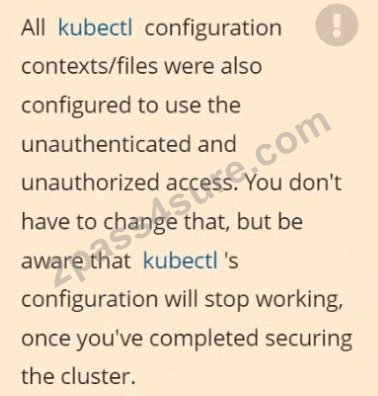
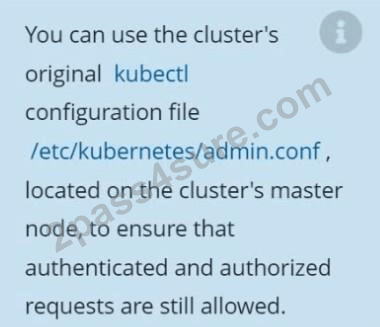
See the Explanation below
Explanation:


SIMULATION
Cluster: dev
Master node: master1
Worker node: worker1
You can switch the cluster/configuration context using the following command:
[desk@cli] $ kubectl config use-context dev
Task:
Retrieve the content of the existing secret named adam in the safe namespace.
Store the username field in a file names /home/cert-masters/username.txt, and the password field in a file named /home/cert-masters/password.txt.
1. You must create both files; they don't exist yet.
2. Do not use/modify the created files in the following steps, create new temporary files if needed.
Create a new secret names newsecret in the safe namespace, with the following content:
Username: dbadmin
Password: moresecurepas
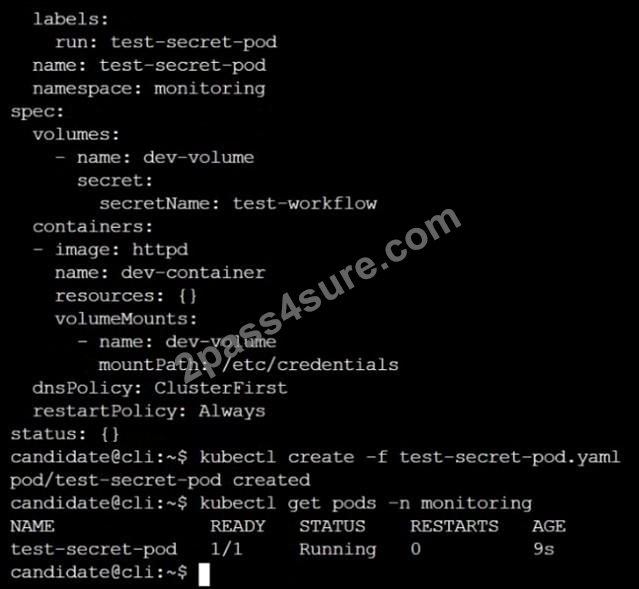
Finally, create a new Pod that has access to the secret newsecret via a volume:
Namespace: safe
Pod name: mysecret-pod
Container name: db-container
Image: redis
Volume name: secret-vol
Mount path: /etc/mysecret
See the Explanation below
Explanation:


SIMULATION
You must complete this task on the following cluster/nodes:
Cluster: trace
Master node: master
Worker node: worker1
You can switch the cluster/configuration context using the following command:
[desk@cli] $ kubectl config use-context trace
Given: You may use Sysdig or Falco documentation.
Task:
Use detection tools to detect anomalies like processes spawning and executing something weird frequently in the single container belonging to Pod tomcat.
Two tools are available to use:
1. falco
2. sysdig
Tools are pre-installed on the worker1 node only.
Analyse the container's behaviour for at least 40 seconds, using filters that detect newly spawning and executing processes.
Store an incident file at /home/cert_masters/report, in the following format:
[timestamp],[uid],[processName]
Note: Make sure to store incident file on the cluster's worker node, don't move it to master node.
See the Explanation below
Explanation:
$vim /etc/falco/falco_rules.local.yaml
- rule: Container Drift Detected (open+create)
desc: New executable created in a container due to open+create
condition: >
evt.type in (open,openat,creat) and
evt.is_open_exec=true and
container and
not runc_writing_exec_fifo and
not runc_writing_var_lib_docker and
not user_known_container_drift_activities and
evt.rawres>=0
output: >
%evt.time,%user.uid,%proc.name # Add this/Refer falco documentation
priority: ERROR
$kill -1 <PID of falco>
Explanation:
[desk@cli] $ ssh node01
[node01@cli] $ vim /etc/falco/falco_rules.yaml
search for Container Drift Detected & paste in falco_rules.local.yaml
[node01@cli] $ vim /etc/falco/falco_rules.local.yaml
- rule: Container Drift Detected (open+create)
desc: New executable created in a container due to open+create
condition: >
evt.type in (open,openat,creat) and
evt.is_open_exec=true and
container and
not runc_writing_exec_fifo and
not runc_writing_var_lib_docker and
not user_known_container_drift_activities and
evt.rawres>=0
output: >
%evt.time,%user.uid,%proc.name # Add this/Refer falco documentation
priority: ERROR
[node01@cli] $ vim /etc/falco/falco.yaml
 1116 Customer ReviewsCustomers Feedback (* Some similar or old comments have been hidden.)
The 2-3 simulation questions in the beginning of the CKS exam don't count towards your overall score. Just skip them. I passed with a perfect 900 using CKS dumps from here.

Dylan

I think that I could have never been able to make it without your services.

Meroy
The questions from your CKS practice dumps were very helpful and 90% were covered. Thanks for so accurate!

Frederica
I really feel grateful to 2Pass4sure exam pdf for my CKS exam. I passed the CKS exam with good score.

Sebastiane

I read all CKS questions and answers, then remembered all of them.

Alma
I choose 2Pass4sure because I my firend introduced ith to me at first, now I know the CKS exam dumps are good too. Passed!

Lionel
The service is really good, I believe in the Linux Foundation dumps, and I have passed the CKS exam, now I am preparing for another two, hope I can pass as well.

Zona
I passed my CKS exam yesterday with a score of 97%. I used the exam guide by 2Pass4sure and it cleared all my problems regarding the exam. Thank you so much team 2Pass4sure.

Heather
The price for CKS learning materials is reasonable, I strong recommend you to buy

Hayden
I read all your CKS questions and answers.

Henry
For any average student like me, passing this CKS certification was not so easy. But with the CKS practice dump, i passed it at the first try. Thanks!

Renata
Pass the CKS exam today and get a nice score. Most questions are valid and only 3 questions are new. I didn't expect the CKS practice dumps could be so accurate until i finished the exam. Really surprised and feel grateful!

Benson
2Pass4sure, i find it is the best platform for providing me with such helpful CKS practice file. Much appreciated. I passed my exam highly.

Pandora
Excellent dump, would recommend to anyone looking to take the CKS test. I have passed Linux Foundation CKS exams today. Thanks a lot.

Spencer
The dumps from 2Pass4sure is very helpful for me.Thanks for the precise info. I passed the CKS exam as the other gays. Thanks a lot!

Maurice
Real questions!
You guys finally update this CKS exam.

Donna
I took the test last week and passed CKS exam with a high score.

Regan
Related Exams
Instant Download CKS
After Payment, our system will send you the products you purchase in mailbox in a minute after payment. If not received within 2 hours, please contact us.
365 Days Free Updates
Free update is available within 365 days after your purchase. After 365 days, you will get 50% discounts for updating.
Money Back Guarantee
Full refund if you fail the corresponding exam in 60 days after purchasing. And Free get any another product.
Security & Privacy
We respect customer privacy. We use McAfee's security service to provide you with utmost security for your personal information & peace of mind.
