

2026 Updated Oracle 1z1-076 Dumps PDF - Want To Pass 1z1-076 Fast
1z1-076 Practice Exam Dumps - 99% Marks In Oracle Exam
Oracle 1z1-076 Exam Syllabus Topics:
| Topic | Details |
|---|---|
| Topic 1 |
|
| Topic 2 |
|
| Topic 3 |
|
| Topic 4 |
|
| Topic 6 |
|
| Topic 7 |
|
| Topic 8 |
|
| Topic 9 |
|
| Topic 10 |
|
NEW QUESTION # 52
In Oracle Database 19c, you can set the value of database initialization parameters in a database using the EDIT DATABASE... SET PARAMETER Command:
DGMGRL> EDIT DATABASE 'boston' SET PARAMETER log_archive_trace - 1;
Which THREE statements are TRUE about the command?
- A. The value set using this command is directly stored in the broker configuration file.
- B. The EDIT DATABASE PARAMETER command can be used to set the value of a static parameter in a database.
- C. The edit database parameter command can only be used to modify the value of a dynamic parameter in a database.
- D. The database must be available when the above command is run.
- E. The value set using this command is directly applied to the boston database.
Answer: C,D,E
Explanation:
The EDIT DATABASE...SET PARAMETER command in Data Guard Management (DGMGRL) is used to modify the value of initialization parameters for a database within a Data Guard configuration. This command can be used to modify both static and dynamic parameters, but if a static parameter is changed, the new value will take effect only after the database is restarted. The database must be up and running for the command to execute, and the values set using the command are directly applied to the specified database (in this case, 'boston') .
NEW QUESTION # 53
Examine this query and its output: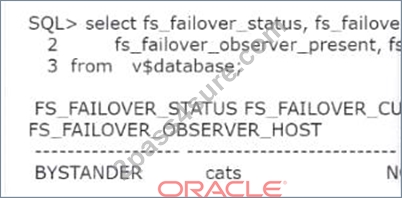
Which two statements are true?
- A. The master observer is connected to the database on which the query was executed.
- B. The master observer is not connected to the database on which the query was executed.
- C. The master observer is currently running on ol7.example.com.
- D. Cats is a bystander database.
- E. The master observer is not running, but should run on ol7.example.com.
Answer: B,D
Explanation:
D: The database role indicated by FS_FAILOVER_STATUS as BYSTANDER implies that the database is a standby database in the Data Guard configuration. This means the database is neither a primary database nor an active failover target.
E: Since the FS_FAILOVER_OBSERVER_HOST column shows cats, it suggests that this is the host on which the observer would run. However, because the FS_FAILOVER_OBSERVER_PRESENT column is not shown, we cannot definitively state if the observer is currently connected or not. If FS_FAILOVER_OBSERVER_PRESENT is 'YES', the observer is connected, if 'NO', then it's not. In the absence of this column's output, the best assumption based on the available data is that the observer is not connected.
The output shows that the FS_FAILOVER_STATUS is BYSTANDER, which indicates that the database in question is not actively involved in a fast-start failover configuration as a primary or standby. It is in a bystander role, meaning that while it is part of a Data Guard configuration, it is neither a target for failover nor actively participating in failover operations. Additionally, FS_FAILOVER_OBSERVER_HOST shows
'cats', which indicates the host where the observer process is expected to run. However, since there is no information about the observer being present, we can infer that although 'cats' is designated for the observer to run, the observer is not currently connected to this database.
ReferencesOracle documentation on Data Guard configurations and the V$DATABASE view which provides information about the fast-start failover status and observer host.
NEW QUESTION # 54
Which THREE steps are prerequisites for the creation of a physical standby database on a separate server using the RMAN active database duplication method?
- A. Establish user equivalence for the database software owner between the primary host and standby host.
- B. startup nomount the standby database instance.
- C. Configure Oracle Net connectivity on the primary host to the standby database instance.
- D. Set the DB_UNIQUE_NAME parameter on the primary database to a different value than that of the DB_NAME name parameter.
- E. Put the primary database into archivelog mode.
Answer: A,B,C
Explanation:
Creating a physical standby database using RMAN active database duplication requires certain prerequisites to ensure a successful and seamless operation:
Configure Oracle Net connectivity on the primary host to the standby database instance (A): Proper Oracle Net connectivity between the primary and standby servers is essential for communication and data transfer during the duplication process. Oracle Net services provide the network foundation for Oracle Database, Oracle Net Listener, and Oracle applications.
Establish user equivalence for the database software owner between the primary host and standby host (B): User equivalence ensures that the user who owns the Oracle Database software on the primary server has the same privileges on the standby server. This is crucial for RMAN to perform operations on both servers without encountering permission issues.
Startup nomount the standby database instance (C): The standby database instance needs to be started in the NOMOUNT stage before the duplication can begin. This prepares the environment for creating the control file and restoring the database without mounting it, which is a necessary step in the RMAN duplication process.
Reference:
Oracle Database Backup and Recovery User's Guide
Oracle Data Guard Concepts and Administration
NEW QUESTION # 55
Which THREE steps are prerequisites for the creation of a physical standby database on a separate server using the RMAN active database duplication method?
- A. Establish user equivalence for the database software owner between the primary host and standby host.
- B. startup nomount the standby database instance.
- C. Configure Oracle Net connectivity on the primary host to the standby database instance.
- D. Set the DB_UNIQUE_NAME parameter on the primary database to a different value than that of the DB_NAME name parameter.
- E. Put the primary database into archivelog mode.
Answer: A,B,C
Explanation:
Creating a physical standby database using RMAN active database duplication requires certain prerequisites to ensure a successful and seamless operation:
* Configure Oracle Net connectivity on the primary host to the standby database instance (A):
* Proper Oracle Net connectivity between the primary and standby servers is essential for communication and data transfer during the duplication process. Oracle Net services provide the network foundation for Oracle Database, Oracle Net Listener, and Oracle applications.
* Establish user equivalence for the database software owner between the primary host and standby host (B): User equivalence ensures that the user who owns the Oracle Database software on the primary server has the same privileges on the standby server. This is crucial for RMAN to perform operations on both servers without encountering permission issues.
* Startup nomount the standby database instance (C): The standby database instance needs to be started in the NOMOUNT stage before the duplication can begin. This prepares the environment for creating the control file and restoring the database without mounting it, which is a necessary step in the RMAN duplication process.References:
* Oracle Database Backup and Recovery User's Guide
* Oracle Data Guard Concepts and Administration
NEW QUESTION # 56
Which THREE statements are TRUE about Global Sequences when connected to a physical standby database with Real-Time Query enabled?
- A. Their usage may have a performance impact on the physical standby database if the CACHE size is too small.
- B. Their creation requires that a LOG archive_dest_n parameter be defined in the standby that points back to the primary.
- C. They must have the NOORDEK and CACHE options set.
- D. Their usage will always have a performance impact on the primary database.
- E. If the CACHE option is set then the size of the cache must be at least 100.
Answer: A,C,D
Explanation:
Global Sequences are Oracle sequences that generate unique values across multiple instances in an Oracle RAC or a Data Guard configuration. Regarding their behavior and performance when connected to a physical standby database with Real-Time Query enabled:
A: The usage of Global Sequences can indeed have a performance impact on the primary database due to the need to generate unique values that are consistent across both primary and standby databases.
D: The performance impact on the physical standby database may occur if the CACHE size is too small. This is because the standby database will frequently have to access the primary database to replenish the cache, which can increase the load and potentially lead to performance degradation.
E: Global Sequences should have the NOORDER and CACHE options set. The NOORDER option ensures that sequence numbers are provided without guaranteeing sequence order, thus improving scalability and performance. The CACHE option is used to specify how many sequence values will be held in memory for faster access.
Option B is incorrect as the LOG_ARCHIVE_DEST_n parameter's definition for standbys pointing back to the primary does not directly pertain to the creation of sequences.
Option C is incorrect because there is no requirement that the size of the cache for a sequence must be at least 100. The CACHE size can be set to a different number based on specific use cases or performance considerations.
NEW QUESTION # 57
Which TWO statements are true about Far Sync instances?
- A. They work in Maximum Availability mode.
- B. They work in Maximum Protection mode.
- C. They do not work with Snapshot Standby databases.
- D. They work in Maximum Performance mode.
- E. They do not work with Logical Standby databases.
Answer: D,E
NEW QUESTION # 58
You have a Data Guard broker configuration consisting of:
A primary database
One local physical standby database
One far sync instance
A remote physical standby database
The broker configuration was created with the DGMGRL utility after creating all the databases and the far sync instance with command-line tools.
What is the correct way to add this configuration to Enterprise Manager Cloud Control assuming all the nodes have been discovered already as Enterprise Manager targets?
- A. Discover the primary database as a target in Enterprise Manager Cloud Control. Then discover the existing Data Guard Broker configuration for the primary and all the other databases in the configuration will be discovered as targets and be ready to be monitored.
- B. Use the DGMGRL utility to register the configuration with the Enterprise Manager Cloud Control agent on the primary database node. This will enable the discovery of all the other databases in the configuration as targets which will be ready to be monitored.
- C. Delete the Data Guard Broker configuration using DGMGRL and then re-create it using Enterprise Manager Cloud Control to enable all the databases in the configuration to be discovered as targets and to be ready to be monitored.
- D. Discover the primary as a target by refreshing the node on which it runs, and the other databases and instances in the Data Guard broker configuration will be discovered as targets automatically and be ready to be monitored.
- E. Discover either of the physical standby databases as a target by refreshing the node on which they run, and the other databases and instances in the Data Guard Broker configuration will be discovered as targets automatically and be ready to be monitored.
Answer: A
NEW QUESTION # 59
There are currently 6 applief. and 6 pfepafef processes running and no idle applier processes on y logical standby database.
The max_SERVERS SQL apply parameter and number of archiver processes are both set to 12.
Identify two changes, each of which would allow you to increase the number of applier processes.
- A. Increase the parallel_max_server initialization parameter.
- B. Increase the RECOVERY_PARALLEL initialization parameter.
- C. Decrease the number of archiver processes on the standby database.
- D. Increase the value for the MAX_SERVERS SQL apply parameter.
- E. Increase the processes initialization parameter. D Decrease the number of FREPARER processes.
Answer: A,D
Explanation:
To increase the number of applier processes on a logical standby database, the following changes can be made:
C: Increasing the value for the MAX_SERVERS SQL apply parameter would allow for more applier processes to be initiated, assuming that system resources permit.
D: Increasing the PARALLEL_MAX_SERVERS initialization parameter would allow for more parallel execution processes, which can be used by SQL apply to increase the number of applier processes.
Option A is incorrect as decreasing the number of archiver processes will not necessarily increase the number of applier processes; these are unrelated components.
Option B is incorrect because the 'FREPARER' processes do not exist, it seems to be a typographical error, and the 'REPARER' is not a valid Oracle process or parameter.
Option E is incorrect because the RECOVERY_PARALLELISM parameter controls the number of processes used for instance recovery and media recovery, not for SQL apply.
NEW QUESTION # 60
Examine this list of possible steps:
1. Raise the compatibility level on both databases.
2. Restart SQL Apply on the upgraded logical standby database.
3. Start SQL Apply on the old primary database.
4. Perform a Switchover to the logical standby database.
5. Upgrade the logical standby database.
6. Upgrade the old primary database.
Which is the minimum number of steps in the correct order, to perform a rolling release upgrade of a data guard environment using an existing logical standby database and to enable the new functionality?
- A. 5,2,4,3,6,1
- B. 4,6,5,2,3,1
- C. 5,2,4,6,3,1
- D. 5,2,4,1
- E. 1,5,2,4,6,3
Answer: E
Explanation:
The process of performing a rolling release upgrade in a Data Guard environment using a logical standby database generally involves these steps:
Raise the compatibility level on both databases (1): Ensuring both the primary and logical standby databases are operating with the same and correct compatibility level is essential before starting the upgrade process.
Upgrade the logical standby database (5): Apply the database upgrade to the logical standby first, which allows the primary database to continue serving the workload without interruption.
Restart SQL Apply on the upgraded logical standby database (2): Once the logical standby has been upgraded, SQL Apply must be restarted to apply the redo data from the primary database, which is still running the earlier version.
Perform a switchover to the logical standby database (4): After confirming that the logical standby database is successfully applying redo data, perform a switchover to make it the new primary database.
Upgrade the old primary database (6): With the new primary database now in place, upgrade the old primary database (which is now the new standby) to the new Oracle Database release.
Start SQL Apply on the old primary database (3): Finally, start SQL Apply on what is now the standby database to synchronize it with the new primary database.
Reference:
Oracle Data Guard Concepts and Administration Guide
Oracle Database Upgrade Guide
NEW QUESTION # 61
You are planning to perform block comparison using the dbms comp package:
Which TWO statements are true?
- A. It can be used to detect lost writes and inconsistencies between the primary database and the cascaded standbys.
- B. You can monitor the progress of an ongoing block comparison operation by querying VS SES SION_LONGOPS.
- C. It requires that the DB_LOST_WKITE_protect initialization parameter be enabled.
- D. The databases should be at least mounted before block comparison.
- E. Logical standby databases can be the target database for the dbms_dbcomp.dbcomp procedure.
Answer: B,D
Explanation:
The DBMS_COMPARISON package, used for comparing and converging data objects within a single database or between databases, requires that the databases involved in the block comparison be at least mounted (A). This allows the procedure to access the data blocks for comparison. Additionally, the progress of long-running operations such as block comparison can be monitored using the dynamic performance view V$SESSION_LONGOPS (D), which provides information on the operation's progress and estimated completion time.
References:Oracle Database PL/SQL Packages and Types Reference provides comprehensive details on the DBMS_COMPARISON package, including its procedures and how to monitor their progress. Additionally, Oracle Database Reference explains the V$SESSION_LONGOPS view, which is commonly used for monitoring long operations in the database.
NEW QUESTION # 62
Your Data Guard environment consists of these components and settings:
A primary database supporting an OLTP workload
A remote physical standby database
Real-time query is enabled
The redo transport mode is set to SYNC
The protection mode is set to Maximum Availability
Which two statements are true regarding the DelayMins database property for the standby database?
- A. It allows user errors on the primary to be recovered by using the physical standby database.
- B. It specifies a delay before the primary ships redo to the standby destination having DelayMins set.
- C. It enables you to bypass the default network timeout interval specified for the standby redo transport destination.
- D. It can only be enabled for a configuration in Maximum Performance mode.
- E. It allows logical corruptions on the primary to be recovered by using the physical standby database.
- F. It can only be enabled for a configuration in Maximum Availability mode.
Answer: A,E
NEW QUESTION # 63
Which two factors can cause an increase in redo transport lag?
- A. Increase in network latency between the primary database and a redo transport destination.
- B. The size of the online redo log files on the standby database.
- C. The size of the standby redo log files on the primary database.
- D. The size of the online redo log files on the primary database.
- E. Increase in redo generation rate on the primary database.
Answer: A,E
NEW QUESTION # 64
Which three statements are true about redo transport?
- A. Multiple RFS processes may receive redo on one far sync instance.
- B. Multiple RFS processes may receive redo on one standby database instance.
- C. With synchronous redo transport, LGWR ships redo directly to RFS processes on the standby database instances and waits for an acknowledgment.
- D. An RFS process on a standby database instance may receive redo from an archiver process on the primary database instance to perform archive gap resolution.
- E. With asynchronous redo transport, TTnn processes may read redo from the log buffer or from standby redo logs on the primary database.
Answer: B,C,D
NEW QUESTION # 65
Active Data Guard (ADG) databases are widely used to offload reporting or ad hoc query-only jobs from the primary database. Reporting workload profile is different from the primary database and often requires tuning.
Which tool is used to tune SQL workloads running on an ADG database?
- A. SQL Tuning Advisor
- B. Automatic Workload Repository (AWR)
- C. Standby Statspack
- D. In-Memory Active Session History (ASH)
- E. Automatic Diagnostic Database Monitor (ADDM)
Answer: B
Explanation:
AWR collects, processes, and maintains performance statistics for problem detection and self-tuning purposes.
In an Active Data Guard environment, where the physical standby database can be used for read-only workloads, AWR can be instrumental in identifying performance bottlenecks and areas for optimization. It provides detailed reports that include wait events, time model statistics, and active session history, making it an invaluable tool for tuning SQL queries and overall database performance in an ADG setup.
NEW QUESTION # 66
Examine the Data Guard configuration after an accidental switchover to Sheep:
DGMGRL> show configuration;
Configuration - Animals
Protection Mode: MaxAvailability
Databases:
sheep - Primary database
dogs - Logical standby database
cats - Physical standby database (disabled)
ORA-16795: the standby database needs to be re-created
Fast-Start Failover: DISABLED
Configuration Status:
SUCCESS
Which three statements will be true after a switchover to Dogs?
- A. Dogs will be the primary database.
- B. Cats will be an enabled physical standby database.
- C. Cats will be a disabled physical standby database that can be manually enabled.
- D. Sheep will be a disabled logical standby database.
- E. Sheep will be an enabled logical standby database.
Answer: A,C,E
NEW QUESTION # 67
You must design an Oracle Data Guard configuration for a DSS database that meets these permanent requirements:
1. Creating and maintaining bitmap indexes should not impact the performance of the primary database.
2. Creating and maintaining materialized views should not impact the performance of the primary database.
Additionally, there are these requirements, only one of which is ever done at any one time:
1. It should be possible to apply designated patches with a minimum amount of downtime.
2. Upgrading to a new database release should be performed with the least possible amount of downtime.
3. New application software releases should be tested against an exact and up-to-date replica of the primary database.
Which configuration meets these requirements with the fewest of databases?
- A. a primary database with two logical standby databases
- B. a primary database with one logical standby database
- C. a primary database with two physical standby databases
- D. a primary database with one physical standby database
- E. A primary database with one logical and one physical standby database
Answer: B
Explanation:
* Logical standby databases allow the execution of DDL and DML operations, which makes them suitable for maintaining bitmap indexes and materialized views without affecting the performance of the primary database .
* Logical standby databases can be used for performing rolling upgrades and patching with minimum downtime, meeting another requirement .
* They also enable the testing of new application software releases against an up-to-date replica of the primary database, fulfilling the last requirement.
Other configurations involving physical standby databases or combinations of logical and physical standby databases might not meet all the specified requirements as efficiently or with the same level of performance isolation for the primary database.
NEW QUESTION # 68
Your Data Guard environment contains a four-instance RAC primary database whose SID is PROD and a RAC physical standby database whose std is PROD_SBY.
Examine the command executed on a node of the primary database cluster to create a service OLTPWORKLOAD that the applications will use to connect to the database when it is in the FRlMARYTclatabase role:
srvctl add service -db PROD -service oltpworkload -role PRIMARY -failovertype SESSION -failovermethod BASIC -failoverdelay 10 -failoverretry 150 The service is then started Consider this list of tasks:
1. On a node of the standby database cluster execute:
srvctl add service -db PROD_SBY -service oltpworkload -role PRIMARY -failovertype SESSION -failovermethod BASIC -failoverdelay 10 -failoverretry 150
2. On the primary database, create the oltpworkload database service using the dbms_service.create_service procedure.
3. Configure tap for clients in the tnsnames.ora files.
4. Make sure clients use the OLTPWORKLOAD service to connect to the database instances.
5. On the standby database, create the oltpworkload database service using the dbms_service.create_servi;l procedure.
Identify the required steps to configure and use Transparent Application Failover (taf).
- A. 1.4
- B. 3,4
- C. 2,3,4
- D. 1,3,4
- E. 0
- F. 1
Answer: A
Explanation:
To set up Transparent Application Failover (TAF) in a Data Guard environment with RAC, you would need to:
On a node of the standby database cluster, execute the srvctl command to add the oltpworkload service for the PRIMARY role (1): This prepares the standby cluster to provide the oltpworkload service in case a failover occurs, and the standby becomes the primary database.
Make sure clients use the OLTPWORKLOAD service to connect to the database instances (4): This ensures that client connections are directed to the correct service, which is managed by TAF and can fail over in case of a primary database outage.
Reference:
Oracle Real Application Clusters Administration and Deployment Guide
Oracle Data Guard Concepts and Administration Guide
NEW QUESTION # 69
Which three Data Guard monitoring activities may be performed using Enterprise Manager Cloud Control?
- A. You can check if redo apply needs to be tuned.
- B. You can set a critical threshold on the redo generation rate metric for a primary database.
- C. You can monitor the redo apply rate on a snapshot standby database.
- D. You can check the potential data loss in the event of a disaster.
- E. You can set a warning threshold on the redo generation rate metric for a physical standby database.
- F. You can monitor the redo apply rate on a logical standby database.
Answer: B,D,F
Explanation:
Enterprise Manager Cloud Control offers comprehensive monitoring capabilities for Oracle Data Guard environments. It enables monitoring the rate at which redo is being applied on a logical standby database (A), which is crucial for ensuring that the standby database is keeping up with the changes from the primary. It also allows setting thresholds on performance metrics, such as the redo generation rate on the primary database (B), to alert administrators when values exceed critical or warning thresholds. Additionally, it provides the capability to estimate the potential data loss in the event of a disaster (E), helping in disaster recovery planning and ensuring business continuity.
References:Oracle Enterprise Manager Cloud Control documentation provides extensive information on its monitoring features for Oracle Data Guard, including setting thresholds, estimating potential data loss, and tracking redo apply rates.
NEW QUESTION # 70
Which two are true about database roles in an Oracle Data Guard configuration?
- A. A Physical Standby Database can be converted into a Logical Standby Database.
- B. A configuration consisting only of a primary and one or more physical standby databases can support a rolling release upgrade.
- C. A Logical Standby Database can cascade redo to a terminal destination.
- D. A Logical Standby Database can be converted to a Snapshot Standby Database.
- E. A Snapshot Standby Database can be a fast-start failover target.
Answer: A,B
Explanation:
A Physical Standby Database can indeed be converted into a Logical Standby Database, providing flexibility in a Data Guard configuration. This allows for the database to switch roles and supports SQL apply operations, enabling more granular control over the data and transactions being replicated and applied. Additionally, having a configuration with a primary database and one or more physical standby databases allows for rolling upgrades to be performed. This means that each database in the Data Guard configuration can be upgraded in a phased manner, minimizing downtime and ensuring high availability during the upgrade process.
NEW QUESTION # 71
Which TWO are benefits of using Transaction Guard in a Data Guard environment?
- A. It provides application continuity by rolling back uncommitted transactions interrupted by a failover or switchover.
- B. It protects against user errors being replicated to standby databases.
- C. It provides application continuity by replaying transactions interrupted by a failover or a switchover
- D. It protects against recoverable errors during a planned or an unplanned outage of a primary database.
- E. It protects against logical corruptions being replicated to standby databases.
Answer: A,D
Explanation:
Transaction Guard provides benefits in terms of transaction consistency and recovery in a Data Guard environment:
It provides application continuity by rolling back uncommitted transactions interrupted by a failover or switchover (B): Transaction Guard ensures that any uncommitted transactions at the time of an outage are rolled back consistently, thus preserving the integrity of the application's data and state.
It protects against recoverable errors during a planned or an unplanned outage of a primary database (D): Transaction Guard offers protection against errors that can occur during outages, allowing applications to resume operations more quickly and reliably after recovery.
Reference:
Oracle Database High Availability Overview
Oracle Real Application Clusters Administration and Deployment Guide
NEW QUESTION # 72
......
Updated Verified 1z1-076 Q&As - Pass Guarantee: https://www.2pass4sure.com/Oracle-Database-19c/1z1-076-actual-exam-braindumps.html
1z1-076 Certification with Actual Questions: https://drive.google.com/open?id=1pQKJ0GF1tbMrka3xmLggk2k5zJDYQBT_