

[Dec 12, 2025] DP-420 Exam Dumps, DP-420 Practice Test Questions
Free DP-420 Study Guides Exam Questions and Answer
Microsoft DP-420 (Designing and Implementing Cloud-Native Applications Using Microsoft Azure Cosmos DB) Certification Exam is an advanced-level certification designed for professionals who want to demonstrate their expertise in designing and implementing cloud-native applications using Microsoft Azure Cosmos DB. Designing and Implementing Cloud-Native Applications Using Microsoft Azure Cosmos DB certification exam is designed to test the candidates' skills and knowledge related to designing and implementing cloud-native applications using Cosmos DB, including concepts like partitioning, scalability, and consistency.
Microsoft DP-420 certification exam is aimed at software engineers, application developers, database administrators, and architects who are responsible for designing and implementing cloud-native applications. DP-420 exam measures the candidate's ability to design, implement, and manage cloud-native applications using Azure Cosmos DB. DP-420 exam covers a wide range of topics, including data modeling, partitioning, indexing, querying, and scaling. Candidates will also be required to demonstrate their knowledge of Azure Cosmos DB's multi-model capabilities, including support for SQL, MongoDB, Cassandra, and Azure Table storage APIs.
Microsoft DP-420 certification exam is designed for professionals who want to demonstrate their ability to design and implement cloud-native applications using Microsoft Azure Cosmos DB. DP-420 exam is intended for individuals who have a strong understanding of Azure Cosmos DB and have experience working with cloud-native applications.
NEW QUESTION # 39
You plan to create an Azure Cosmos DB container named account that will contain items in the following format.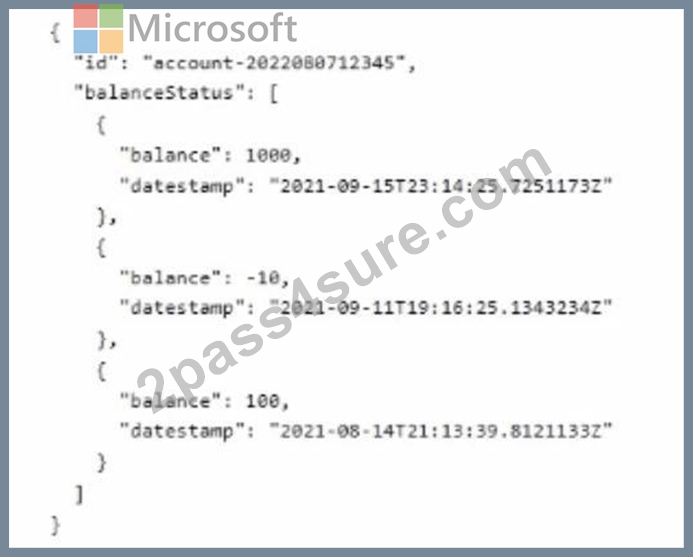
You need to define a query that will return the ids of all accounts that have ever recorded a negative value for balance.
How should you complete the query? To answer, select the appropriate options in the answer area.
NOTE: Each correct selection is worth one point.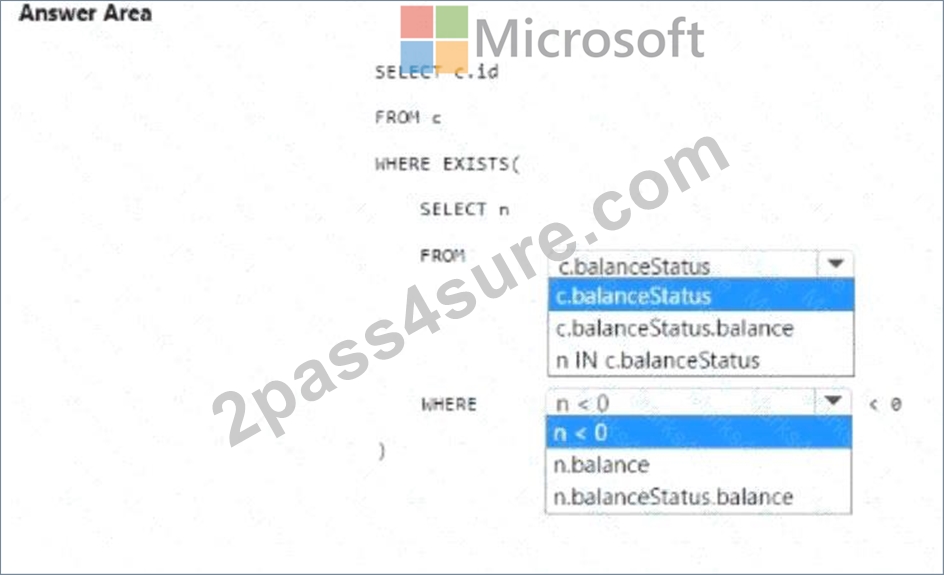
Answer:
Explanation: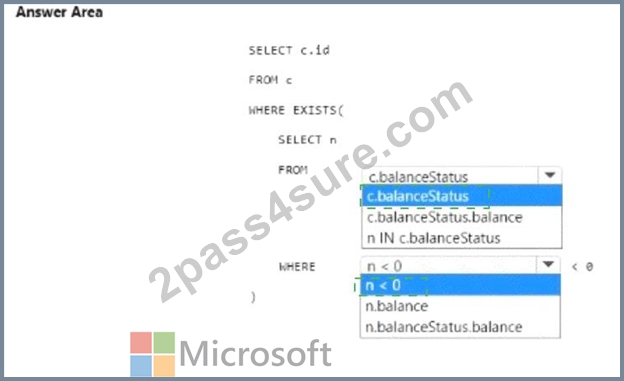
Explanation: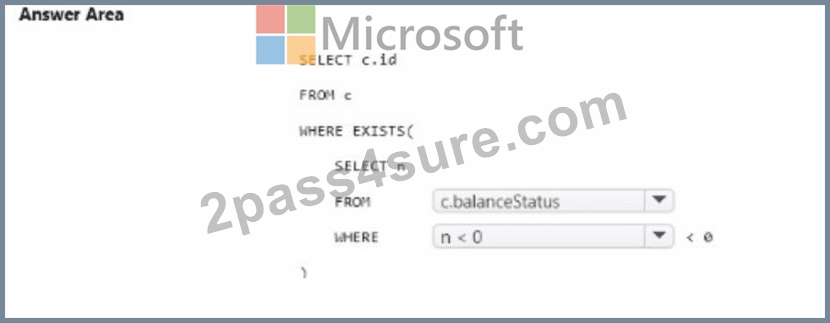
NEW QUESTION # 40
You have an Apache Spark pool in Azure Synapse Analytics that runs the following Python code in a notebook.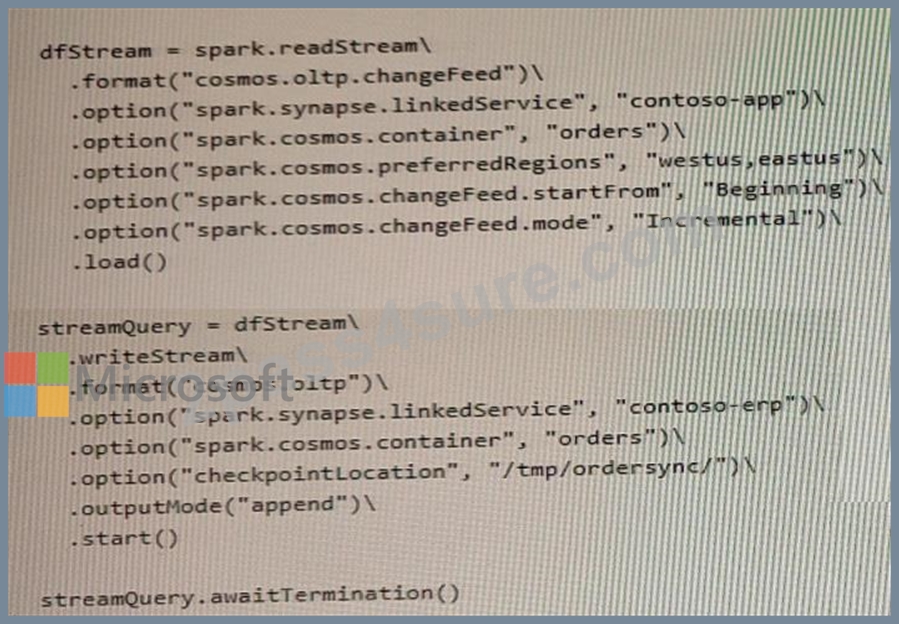
For each of the following statements, select Yes if the statement is true. Otherwise, select No.
NOTE: Each correct selection is worth one point.
Answer:
Explanation:
Explanation:
New and updated orders will be added to contoso-erp.orders: Yes
The code performs bulk data ingestion from contoso-app: No
Both contoso-app and contoso-erp have Analytics store enabled: Yes
The code uses the spark.readStream method to read data from a container named orders in a database named contoso-app. The data is then filtered by a condition and written to another container named orders in a database named contoso-erp using the spark.writeStream method. The write mode is set to"append", which means that new and updated orders will be added to the destination container1.
The code does not perform bulk data ingestion from contoso-app, but rather stream processing. Bulk data ingestion is a process of loading large amounts of data into a data store in batches. Stream processing is a process of continuously processing data as it arrives in real-time2.
Both contoso-app and contoso-erp have Analytics store enabled, because they are both accessed by Spark pools using the spark.cosmos.oltp method. This method requires that the containers have Analytics store enabled, which is a feature that allows Spark pools to query data stored in Azure Cosmos DB containers using SQL APIs3.
NEW QUESTION # 41
You have a container named container1 in an Azure Cosmos DB Core (SQL) API account.
The following is a sample of a document in container1.
{
"studentId": "631282",
"firstName": "James",
"lastName": "Smith",
"enrollmentYear": 1990,
"isActivelyEnrolled": true,
"address": {
"street": "",
"city": "",
"stateProvince": "",
"postal": "",
}
}
The container1 container has the following indexing policy.
{
"indexingMode": "consistent",
"includePaths": [
{
"path": "/*"
},
{
"path": "/address/city/?"
}
],
"excludePaths": [
{
"path": "/address/*"
},
{
"path": "/firstName/?"
}
]
}
For each of the following statements, select Yes if the statement is true. Otherwise, select No.
NOTE: Each correct selection is worth one point.
Answer:
Explanation:
Explanation:
Box 1: Yes
"path": "/*" is in includePaths.
Include the root path to selectively exclude paths that don't need to be indexed. This is the recommended approach as it lets Azure Cosmos DB proactively index any new property that may be added to your model.
Box 2: No
"path": "/firstName/?" is in excludePaths.
Box 3: Yes
"path": "/address/city/?" is in includePaths
Reference: https://docs.microsoft.com/en-us/azure/cosmos-db/index-policy
NEW QUESTION # 42
You have an Azure Cosmos DB Core (SQL) API account named account1.
You have the Azure virtual networks and subnets shown in the following table.
The vnet1 and vnet2 networks are connected by using a virtual network peer.
The Firewall and virtual network settings for account1 are configured as shown in the exhibit.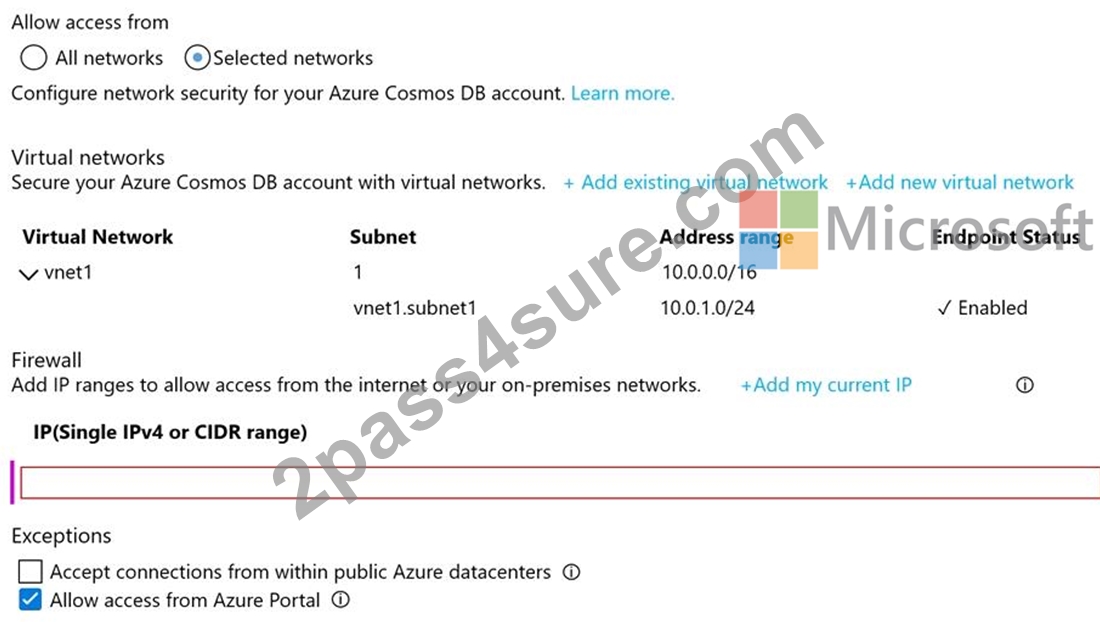
For each of the following statements, select Yes if the statement is true. Otherwise, select No.
NOTE: Each correct selection is worth one point.
Answer:
Explanation: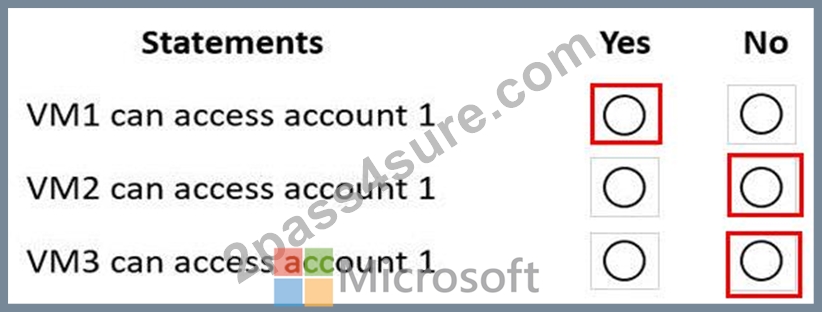
NEW QUESTION # 43
You have an Azure Cosmos DB for NoSQL account that frequently receives the same three queries.
You need to configure indexing to minimize RUs consumed by the queries.
Which type of index should you use for each query? To answer, select the appropriate options in the answer area.
NOTE: Each correct selection is worth one point.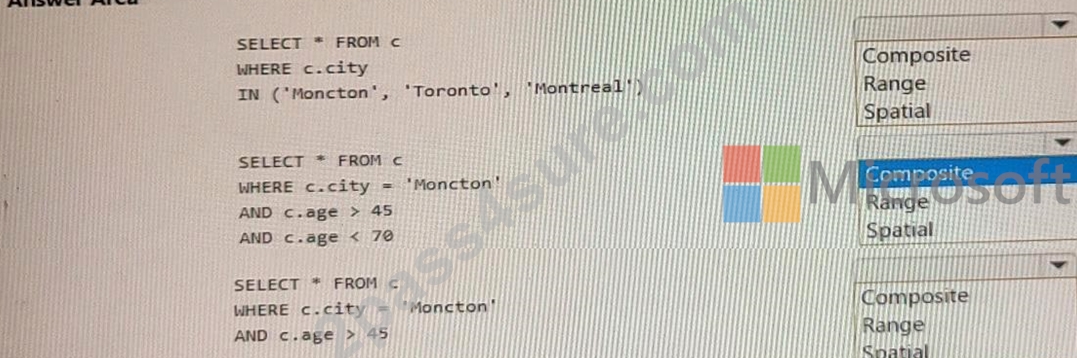
Answer:
Explanation: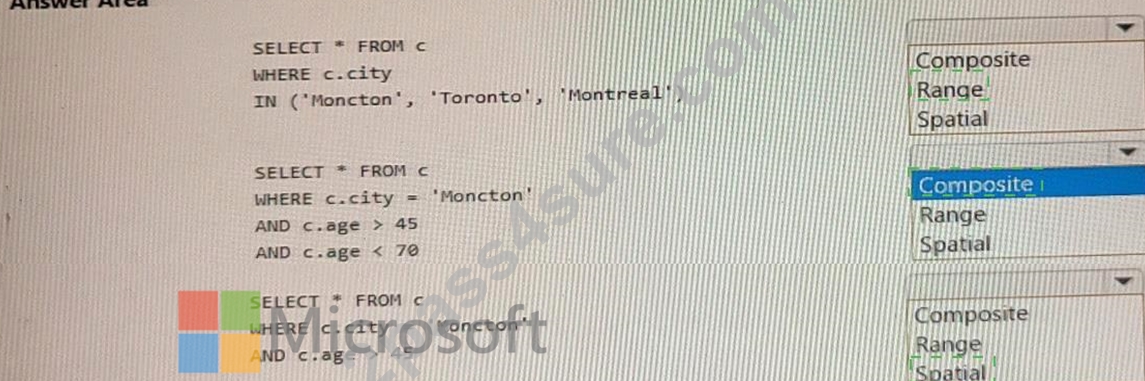
Explanation
Box 1 = Range Azure Cosmos DB supports three types of indexes: range, spatial and composite. For the query you provided, which is an equality query on a single property, the best type of index to use is range. Range index is based on an ordered tree-like structure and it is used for equality queries, range queries and checking for the presence of a property1. Range index also supports any string or number .
Box 2 = Composite
Azure Cosmos DB supports three types of indexes: range, spatial and composite. For the query you provided, which is an order by query on two properties, the best type of index to use is composite. Composite index is used for optimizing order by queries on multiple properties1. Composite index allows you to specify a list of property paths and sort orders that are used for ordering items2.
Box 3 = spatial
Azure Cosmos DB supports three types of indexes: range, spatial and composite. For the query you provided, which is a spatial query on a point property, the best type of index to use is spatial. Spatial index is used for querying items based on their location or proximity to a given point1. Spatial index supports point, polygon and linestring data types2.
NEW QUESTION # 44
You have an Azure Cosmos DB for NoSQL account.
You plan 10 create a container named container1. The container1 container will store items that include two properties named nm and age The most commonly executed queries will query container1 for a specific name. The following is a sample of the query.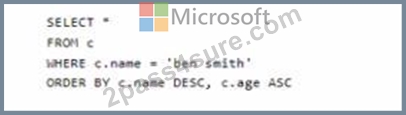
You need to define an opt-in Indexing policy for container1. The solution must meet the following requirements:
* Minimize the number of request units consumed by the queries.
* Ensure that the _etag property is excluded from indexing.
How should you define the indexing poky? To answer, select the appropriate options in the answer area.
NOTE: Each correct selection Is worth one point.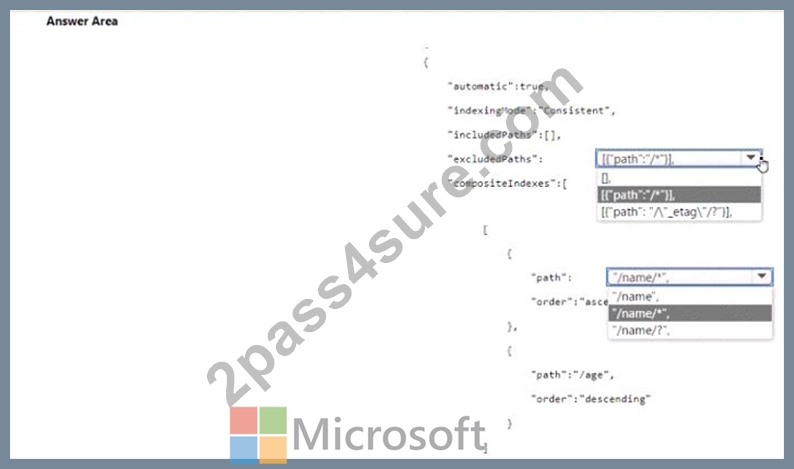
Answer:
Explanation: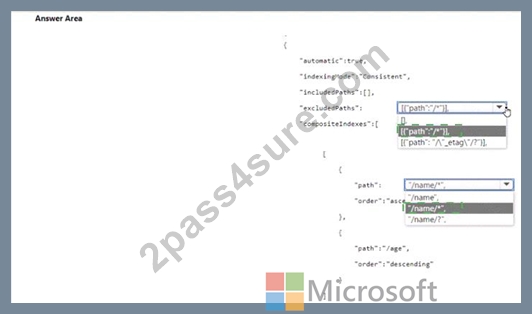
Explanation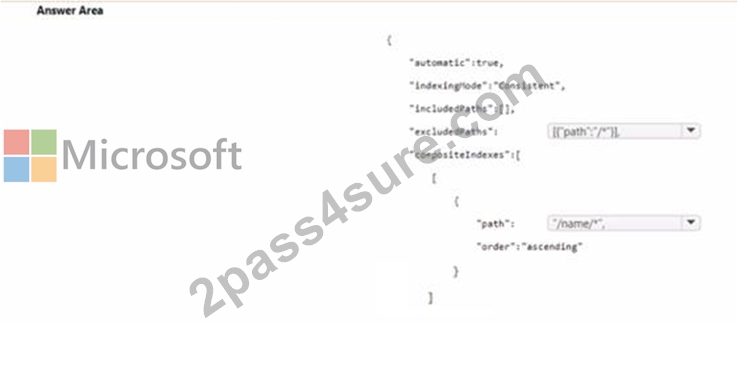
NEW QUESTION # 45
You need to implement a solution to meet the product catalog requirements.
What should you do to implement the conflict resolution policy.
- A. Set the default consistency level for account1 to eventual.
- B. Create a new container and migrate the product catalog data to the new container.
- C. Disable indexing on all fields in the index policy of the con-product container.
- D. Remove frequently changed field from the index policy of the con-product container.
Answer: B
NEW QUESTION # 46
You have an Azure Cosmos DB for NoSQL account1 that is configured for automatic failover. The account1 account has a single read-write region in West US and a and a read region in East US.
You run the following PowerShell command.
What is the effect of running the command?
- A. The account will be configured for multi-region writes.
- B. The account will be unavailable to writes during the change.
- C. The provisioned throughput for account1 will increase.
- D. A manual failover will occur.
Answer: B
Explanation:
You can use the Set-AzCosmosDBAccountRegion cmdlet to update the regions that an Azure Cosmos DB account uses. You can use this cmdlet to add a region or change the region failover order. The cmdlet requires a resource group name, an Azure Cosmos DB account name, and a list of regions in desired failover order1.
For your scenario, based on the PowerShell command, you are using the Set-AzCosmosDBAccountRegion cmdlet to update the regions for an Azure Cosmos DB account named account1 that is configured for automatic failover. The command specifies two regions: West US and East US. The effect of running the command is that the account will be configured for multi-region writes.
Multi-region writes is a feature of Azure Cosmos DB that allows you to write data to any region in your account and have it automatically replicated to all other regions. This feature provides high availability and low latency for write operations across multiple regions. To enable multi-region writes, you need to specify at least two regions in your account and set them as write regions2. In your command, you are setting both West US and East US as write regions by using the -IsZoneRedundant parameter with a value of $true for both regions.
NEW QUESTION # 47
You have an Azure Cosmos DB Core (SQL) API account that is configured for multi-region writes. The account contains a database that has two containers named container1 and container2.
The following is a sample of a document in container1:
{
"customerId": 1234,
"firstName": "John",
"lastName": "Smith",
"policyYear": 2021
}
The following is a sample of a document in container2:
{
"gpsId": 1234,
"latitude": 38.8951,
"longitude": -77.0364
}
You need to configure conflict resolution to meet the following requirements:
For container1 you must resolve conflicts by using the highest value for policyYear.
For container2 you must resolve conflicts by accepting the distance closest to latitude: 40.730610 and longitude: -73.935242.
Administrative effort must be minimized to implement the solution.
What should you configure for each container? To answer, drag the appropriate configurations to the correct containers. Each configuration may be used once, more than once, or not at all. You may need to drag the split bar between panes or scroll to view content.
NOTE: Each correct selection is worth one point.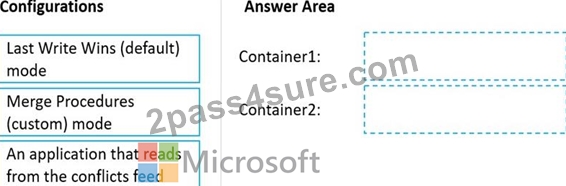
Answer:
Explanation: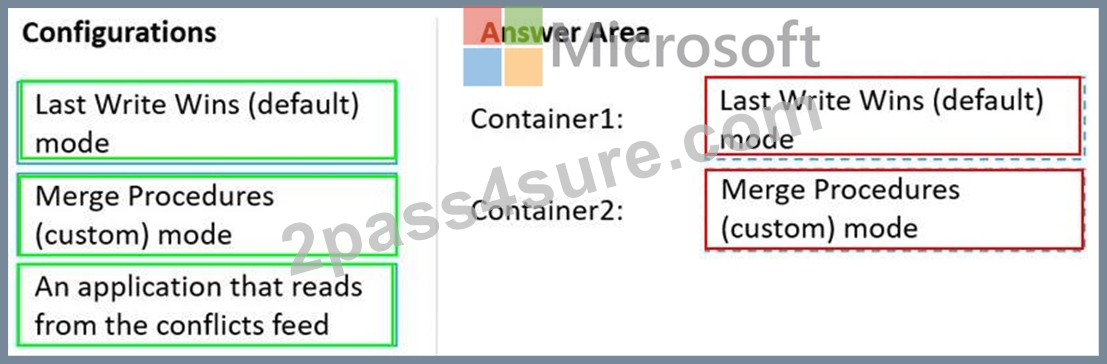
Reference:
https://docs.microsoft.com/en-us/azure/cosmos-db/conflict-resolution-policies
https://docs.microsoft.com/en-us/azure/cosmos-db/sql/how-to-manage-conflicts
NEW QUESTION # 48
You have a container named container1 in an Azure Cosmos DB Core (SQL) API account.
The following is a sample of a document in container1.
{
"studentId": "631282",
"firstName": "James",
"lastName": "Smith",
"enrollmentYear": 1990,
"isActivelyEnrolled": true,
"address": {
"street": "",
"city": "",
"stateProvince": "",
"postal": "",
}
}
The container1 container has the following indexing policy.
{
"indexingMode": "consistent",
"includePaths": [
{
"path": "/*"
},
{
"path": "/address/city/?"
}
],
"excludePaths": [
{
"path": "/address/*"
},
{
"path": "/firstName/?"
}
]
}
For each of the following statements, select Yes if the statement is true. Otherwise, select No.
NOTE: Each correct selection is worth one point.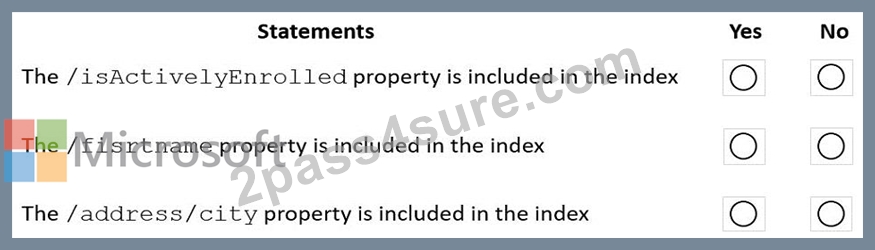
Answer:
Explanation: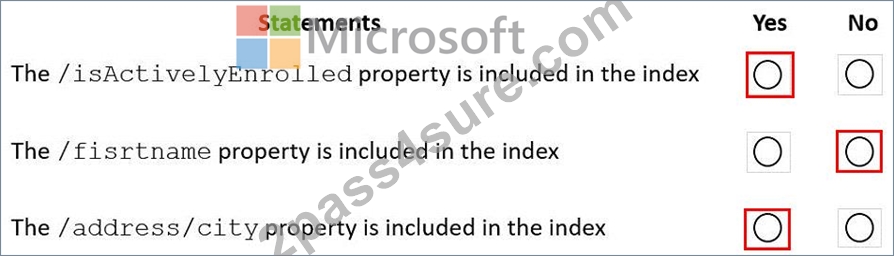
NEW QUESTION # 49
You have an Azure subscription that contains a resource group named RG1. RG1 contains an Azure Cosmos DB for NoSQL account named account1.
You plan to audit changes to the control plane of account1.
You need to ensure that audit events include the details of the security principal that performs each control plane change.
How should you complete the az command? To answer select the appropriate options in the answer area.
NOTE: Each correct selection is worth one point.
Answer:
Explanation:
Explanation
NEW QUESTION # 50
You have an Azure Cosmos DB Core (SQL) API account named account1.
In account1, you run the following query in a container that contains 100GB of data.
SELECT *
FROM c
WHERE LOWER(c.categoryid) = "hockey"
You view the following metrics while performing the query.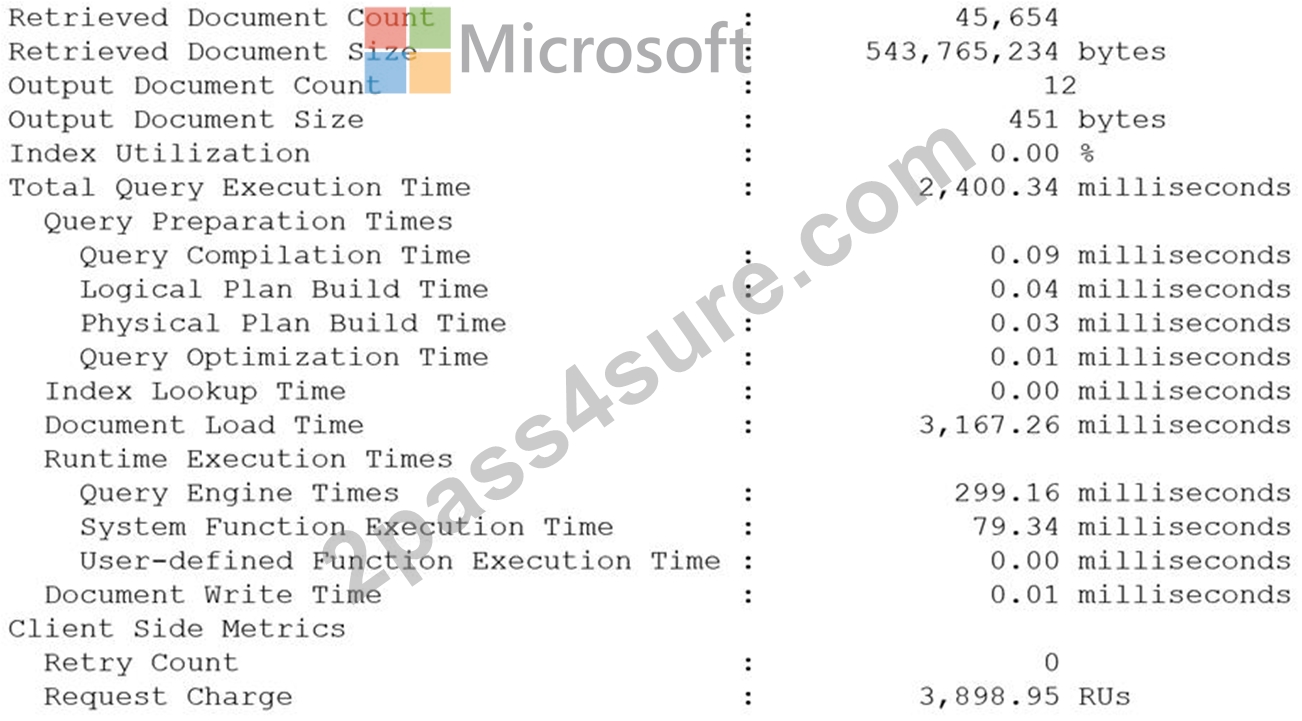
For each of the following statements, select Yes if the statement is true. Otherwise, select No.
NOTE: Each correct selection is worth one point.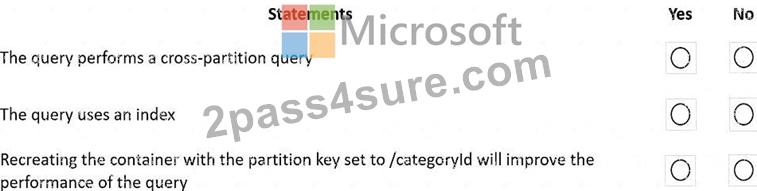
Answer:
Explanation: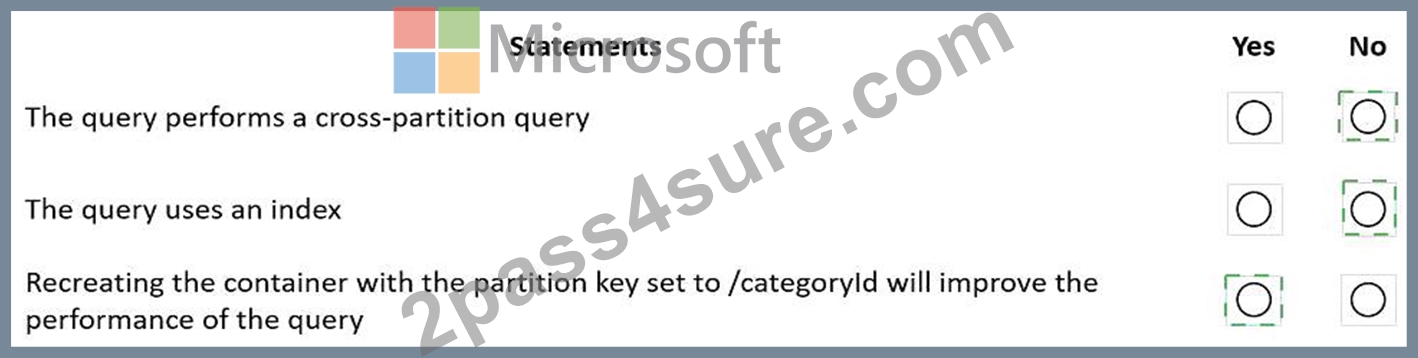
Explanation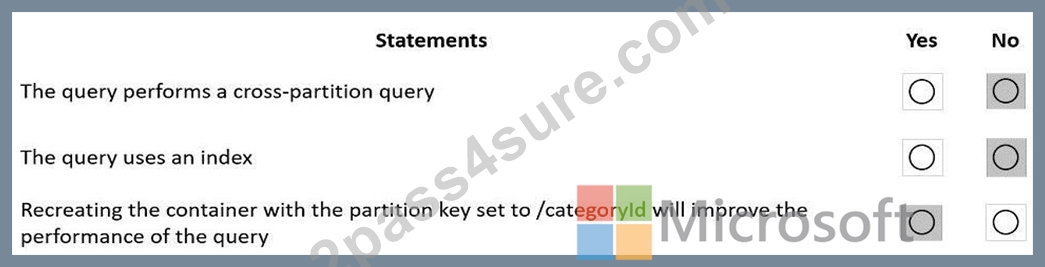
Box 1: No
Each physical partition should have its own index, but since no index is used, the query is not cross-partition.
Box 2: No
Index utilization is 0% and Index Look up time is also zero.
Box 3: Yes
A partition key index will be created, and the query will perform across the partitions.
Reference: https://docs.microsoft.com/en-us/azure/cosmos-db/sql/how-to-query-container
NEW QUESTION # 51
You have an Azure Cosmos DB container named container1.
You need to insert an item into contained. The solution must ensure that the item is deleted automatically after two hours.
How should you complete the item definition? To answer, select the appropriate options in the answer area.
NOTE: Each correct selection is worth one point.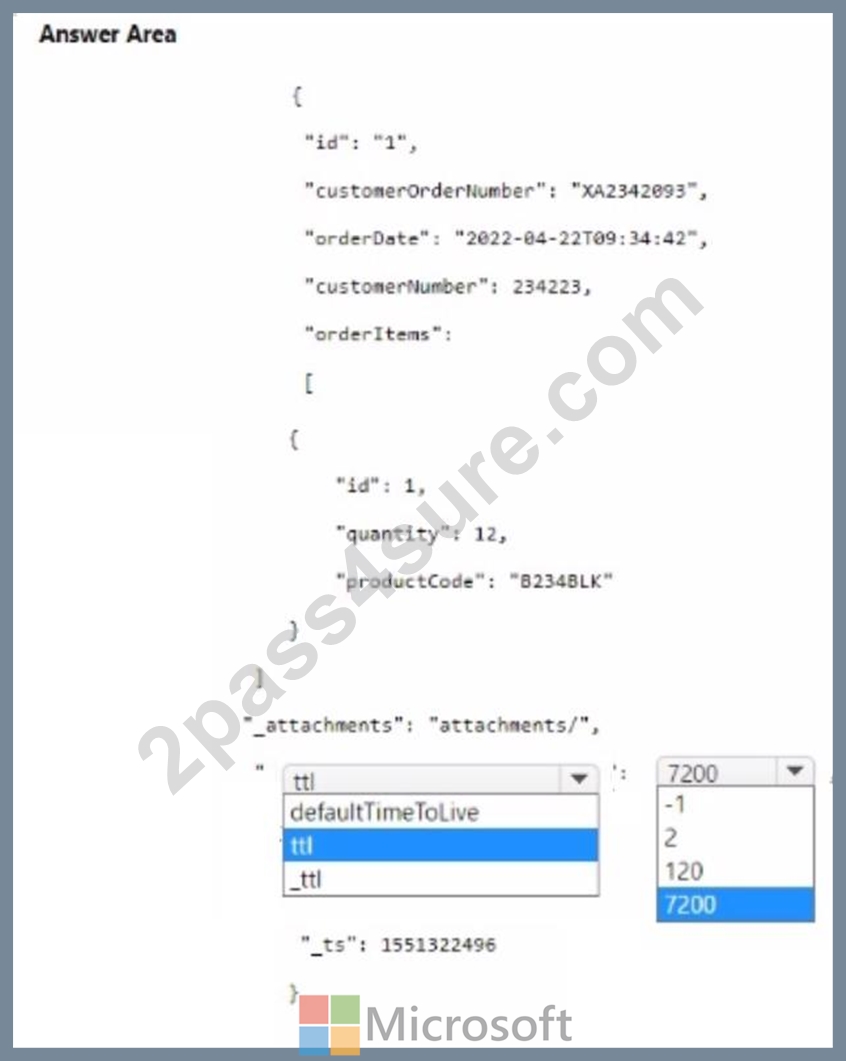
Answer:
Explanation: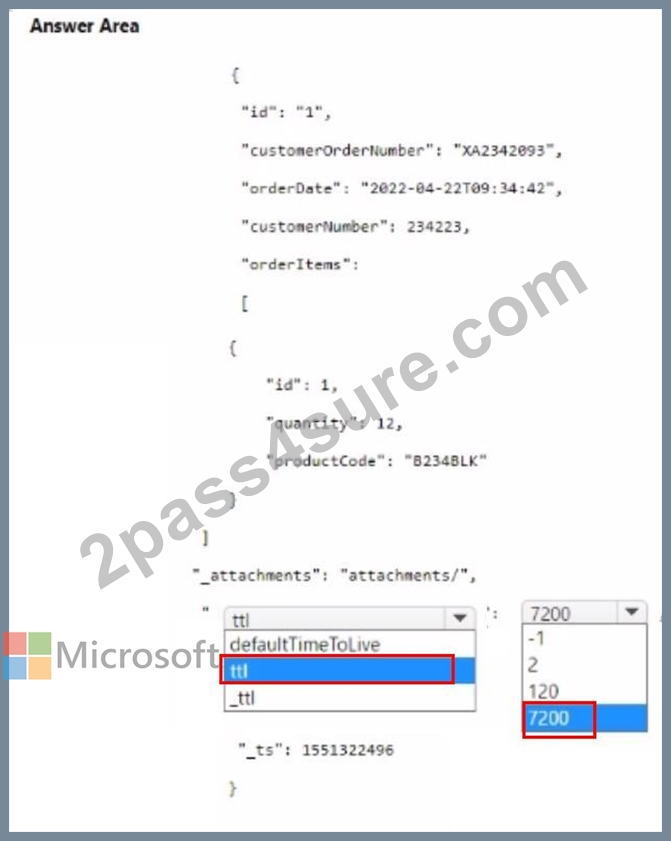
NEW QUESTION # 52
You have an Azure Cosmos DB for NoSQL account that contains a container named container1.
You plan to use container1 as a key-value store that will perform point reads on the item ID and partition key.
You need to define an indexing policy for container! The solution must meet the following requirements:
* Provide the ability to set DefauitTimeToLive for container1.
* Minimize implementation time.
* Minimize costs.
How should you complete the JSON definition of the indexing policy? To answer, select the appropriate options in the answer area.
NOTE: Each correct selection is worth one point.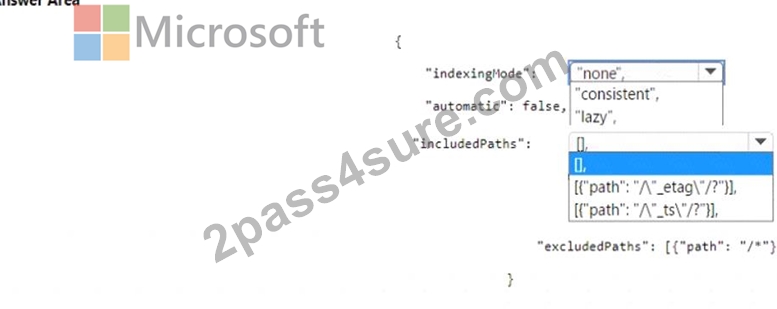
Answer:
Explanation: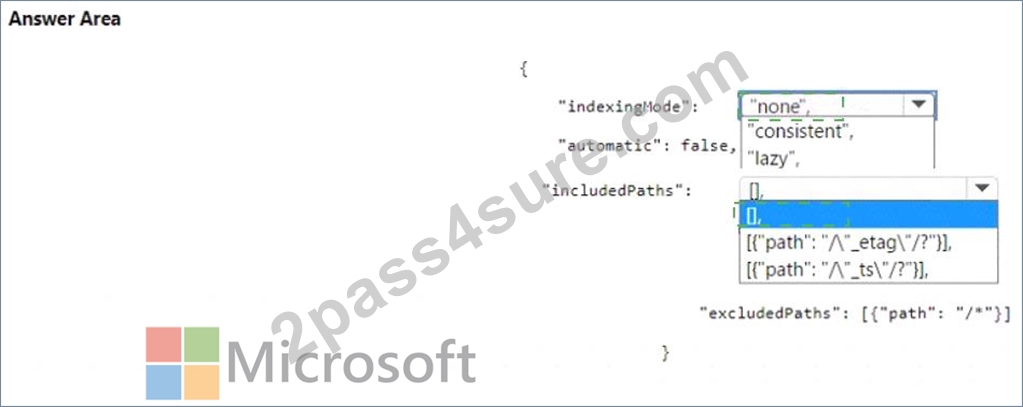
Explanation: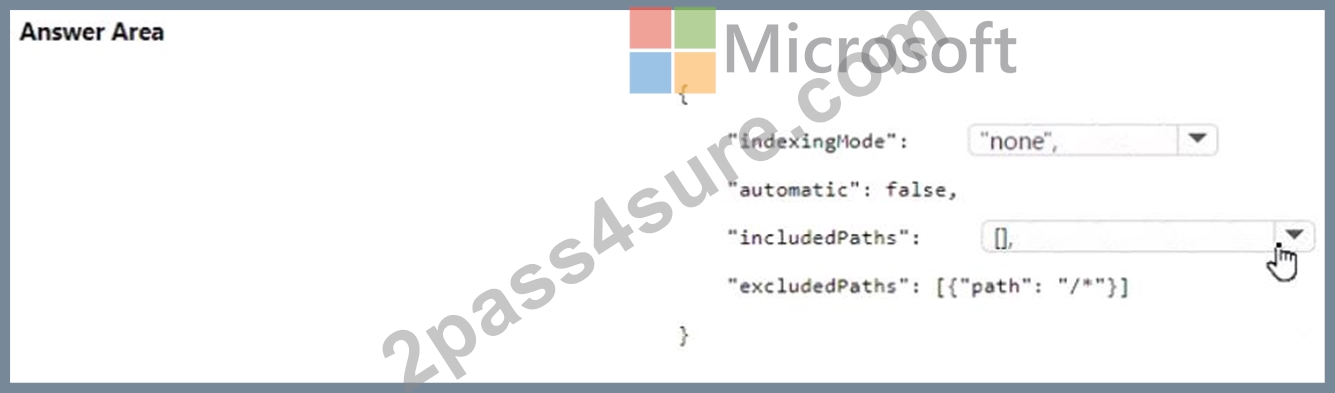
NEW QUESTION # 53
You plan to use a multi-region Azure Cosmos DB for NoSQL account to store data for a new application suite.
The suite contains the applications shown in the following table.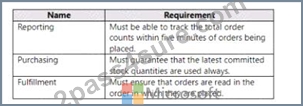
Each application should use the weakest consistency level possible.
Which consistency level should you configure for each application? To answer, select the appropriate options in the answer area. NOTE: Each correct selection is worth one point.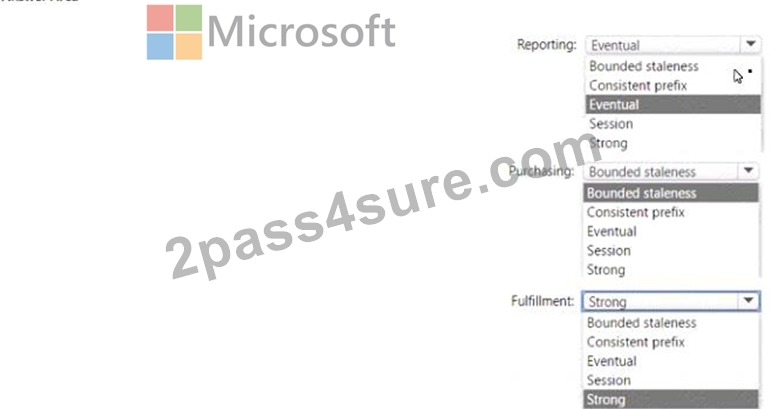
Answer:
Explanation: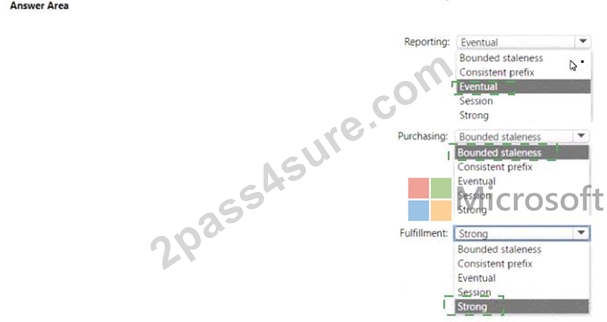
Explanation: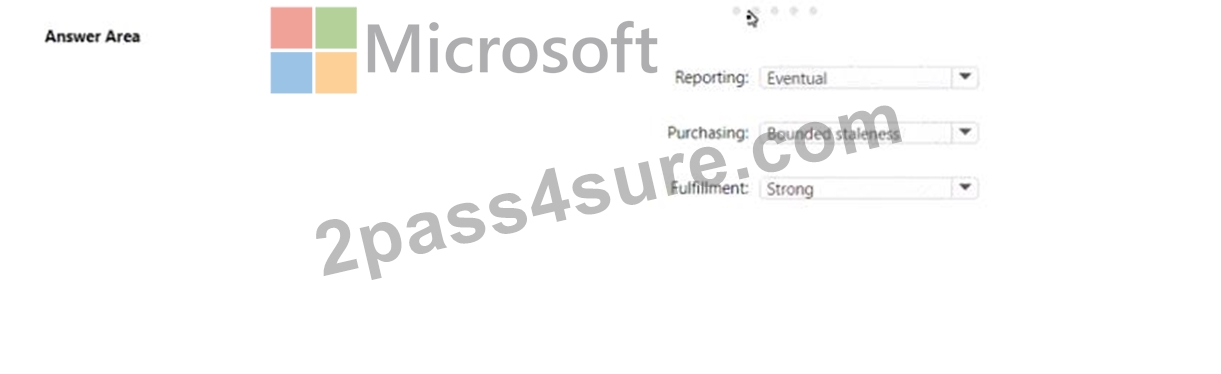
NEW QUESTION # 54
You have a database named db1 in an Azure Cosmos DB f You have a third-party application that is exposed thro You need to migrate data from the application to a What should you use?
- A. Azure Migrate
- B. Azure Data Factory
- C. Database Migration Assistant
Answer: B
Explanation:
Explanation
you can migrate data from various data sources to Azure Cosmos DB using different tools and methods. The choice of the migration tool depends on factors such as the data source, the Azure Cosmos DB API, the size of data, and the expected migration duration . Some of the common migration tools are:
* Azure Cosmos DB Data Migration tool: This is an open source tool that can import data to Azure Cosmos DB from sources such as JSON files, MongoDB, SQL Server, CSV files, and Azure Cosmos DB collections. This tool supports the SQL API and the Table API of Azure Cosmos DB2.
* Azure Data Factory: This is a cloud-based data integration service that can copy data from various sources to Azure Cosmos DB using connectors. This tool supports the SQL API, MongoDB API, Cassandra API, Gremlin API, and Table API of Azure Cosmos DB
* Azure Cosmos DB live data migrator: This is a command-line tool that can migrate data from one Azure Cosmos DB container to another container within the same or different account. This tool supports live migration with minimal downtime and works with any Azure Cosmos DB API4.
For your scenario, if you want to migrate data from a third-party application that is exposed through an OData endpoint to a container in Azure Cosmos DB for NoSQL, you should use Azure Data Factory. Azure Data Factory has an OData connector that can read data from an OData source and write it to an Azure Cosmos DB sink using the SQL API5. You can create a copy activity in Azure Data Factory that specifies the OData source and the Azure Cosmos DB sink, and run it on demand or on a schedule.
NEW QUESTION # 55
You have a database named db1 in an Azure Cosmos DB for NoSQL
You are designing an application that will use dbl.
In db1, you are creating a new container named coll1 that will store in coll1.
The following is a sample of a document that will be stored in coll1.
The application will have the following characteristics:
* New orders will be created frequently by different customers.
* Customers will often view their past order history.
You need to select the partition key value for coll1 to support the application. The solution must minimize costs.
To what should you set the partition key?
- A. id
- B. orderId
- C. orderDate
- D. customerId
Answer: D
Explanation:
Explanation
Based on the characteristics of the application and the provided document structure, the most suitable partition key value for coll1 in the given scenario would be the customerId, Option B.
The application frequently creates new orders by different customers and customers often view their past order history. Using customerId as the partition key would ensure that all orders associated with a particular customer are stored in the same partition. This enables efficient querying of past order history for a specific customer and reduces cross-partition queries, resulting in lower costs and improved performance.
a partition key is a JSON property (or path) within your documents that is used by Azure Cosmos DB to distribute data among multiple partitions . A partition key should have a high cardinality, which means it should have many distinct values, such as hundreds or thousands . A partition key should also align with the most common query patterns of your application, so that you can efficiently retrieve data by using the partition key value1.
Based on these criteria, one possible partition key that you could use for coll1 is B. customerId.
This partition key has the following advantages:
It has a high cardinality, as each customer will have a unique ID
It aligns with the query patterns of the application, as customers will often view their past order history3.
It minimizes costs, as it reduces the number of cross-partition queries and optimizes the storage and throughput utilization1.
This partition key also has some limitations, such as:
It may not be optimal for scenarios where orders need to be queried independently from customers or aggregated by date or other criteria It may result in hot partitions or throttling if some customers create orders more frequently than others or have more data than others It may not support transactions across multiple customers, as transactions are scoped to a single logical partition2.
Depending on your specific use case and requirements, you may need to adjust this partition key or choose a different one. For example, you could use a synthetic partition key that concatenates multiple properties of an item2, or you could use a partition key with a random or pre-calculated suffix to distribute the workload more evenly2.
NEW QUESTION # 56
You have the following query.
SELECT * FROM #
WHERE c.sensor = "TEMP1"
AND c.value < 22
AND c.timestamp >= 1619146031231
You need to recommend a composite index strategy that will minimize the request units (RUs) consumed by the query.
What should you recommend?
- A. a composite index for (sensor ASC, value ASC) and a composite index for (sensor ASC, timestamp ASC)
- B. a composite index for (sensor ASC, value ASC, timestamp ASC)
- C. a composite index for (sensor ASC, value ASC, timestamp ASC) and a composite index for (sensor DESC, value DESC, timestamp DESC)
- D. a composite index for (value ASC, sensor ASC) and a composite index for (timestamp ASC, sensor ASC)
Answer: A
Explanation:
If a query has a filter with two or more properties, adding a composite index will improve performance.
Consider the following query:
SELECT * FROM c WHERE c.name = "Tim" and c.age > 18
In the absence of a composite index on (name ASC, and age ASC), we will utilize a range index for this query. We can improve the efficiency of this query by creating a composite index for name and age.
Queries with multiple equality filters and a maximum of one range filter (such as >,<, <=, >=, !=) will utilize the composite index.
Reference: https://azure.microsoft.com/en-us/blog/three-ways-to-leverage-composite-indexes-in-azure- cosmos-db/
NEW QUESTION # 57
......
DP-420 Exam Dumps, DP-420 Practice Test Questions: https://www.2pass4sure.com/Azure-Cosmos-DB-Developer-Specialty/DP-420-actual-exam-braindumps.html
Attested DP-420 Dumps PDF Resource [2025]: https://drive.google.com/open?id=1emF5QHAl7G5VUmgmyXcywd0A3fycE6We