

ISTQB-CTFL Dumps are Available for Instant Access [2026]
Practice with these ISTQB-CTFL dumps Certification Sample Questions
NEW QUESTION # 167
Which of the following is an example of black-box dynamic testing?
- A. Checking memory leaks for a program by executing it
- B. Functional Testing
- C. Code inspection
- D. Coverage analysis
Answer: B
NEW QUESTION # 168
Which of the following statements are true?
1. Early and frequent feedback helps to avoid requirements misunderstanding.
2. Early feedback allows teams to do more with less.
3. Early feedback allows the team to focus on the most Important features.
4. Early and frequent feedback clarifies customer feedback by applying static testing techniques Select the correct answer:
- A. 0
- B. 1
- C. 2
- D. 3
Answer: B
Explanation:
The statement "Early and frequent feedback helps to avoid requirements misunderstanding" is true. Early feedback from stakeholders, through reviews and other static testing techniques, helps clarify requirements and ensures that any misunderstandings are addressed promptly. This practice aligns with Agile principles and contributes to developing software that meets user needs more accurately.
References: ISTQB CTFL Syllabus, Section 2.1.1, "The Influence of Development Models on Testing" and Section 3.2.1, "The Advantages of Early Feedback."
NEW QUESTION # 169
A software module to be used in a mission critical application incorporates an algorithm for secure transmission of dat a.
Which review type is most appropriate to ensure high quality and technical correctness of the algorithm?
- A. Walkthrough
- B. Technical Review
- C. Informal Review
- D. Management Review
Answer: B
Explanation:
A technical review is a type of formal review that involves a team of technical experts who evaluate a software product against a set of predefined quality criteria. A technical review is suitable for ensuring high quality and technical correctness of complex or critical software components, such as algorithms, architectures or designs. A technical review is not a walkthrough, which is an informal review led by the author of the work product. A technical review is not an informal review, which is a review that does not follow a defined process and has no formal entry or exit criteria. A technical review is not a management review, which is a type of formal review that focuses on business aspects and project progress. Verified Reference: A Study Guide to the ISTQB Foundation Level 2018 Syllabus - Springer, Chapter 3, page 29-30.
NEW QUESTION # 170
Consider the following table, which contains information about test cases from the test management system: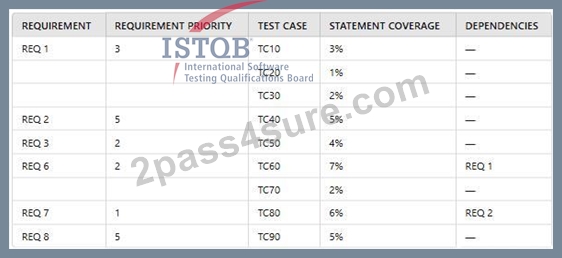
Which ONE of the following options organizes the test cases based on the statement coverage strategy, while considering practical constraints?
- A. {TC 60; TC 80; TC 40; TC 90; TC 50; TC 10; TC 70; TC 30; TC 20}
- B. {TC 10; TC 30; TC 20; TC 60; TC 40; TC 80; TC 90; TC 50; TC 70}
- C. {TC 20; TC 30; TC 10; TC 40; TC 50; TC 70; TC 60; TC 80; TC 90}
- D. {TC 80; TC 70; TC 50; TC 60; TC 20; TC 30; TC 10; TC 40; TC 90}
Answer: A
Explanation:
Comprehensive and Detailed In-Depth Explanation:
Statement coverage strategy prioritizes test cases with higher statement coverage first, while resolving dependencies before execution.
* TC60 (7%) has the highest coverage but depends on REQ 1, so it should be executed after its dependency is covered.
* TC80 (6%) depends on REQ 2, so it should be prioritized after TC40 (REQ 2).
* TC40 (5%) and TC90 (5%) should be executed early.
* Lower coverage test cases (TC10, TC70, TC30, TC20) should come last.
Thus, the correct order is {TC 60; TC 80; TC 40; TC 90; TC 50; TC 10; TC 70; TC 30; TC 20} (D).
Reference: ISTQB CTFL v4.0 Syllabus, Section 4.3 - White-Box Testing Techniques
NEW QUESTION # 171
Which ONE of the following activities TYPICALLY belongs to the planning phase of the review process?
- A. A separate defect report is created for each identified defect so that corrective actions can be tracked.
- B. Each reviewer conducts an individual review to identify anomalies, recommendations, and questions.
- C. The purpose and scope of the review are defined, as well as the work product to be reviewed and the exit criteria.
- D. The reviewers analyze and discuss the anomalies found during the review in a joint meeting.
Answer: C
Explanation:
Comprehensive and Detailed In-Depth Explanation:
The planning phase of the review process (C) includes defining the review's purpose, scope, and exit criteria to ensure alignment. Option A is part of the defect management phase, B happens during individual preparation, and D takes place in the review meeting.
NEW QUESTION # 172
The following chart represents metrics related to testing of a project that was competed. Indicate what is represented by tie lines A, B and the axes X.Y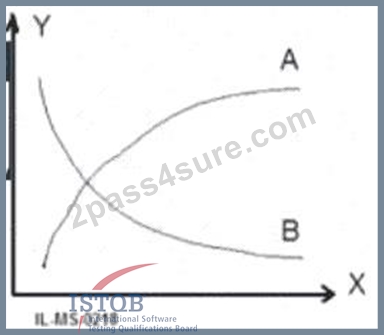
A)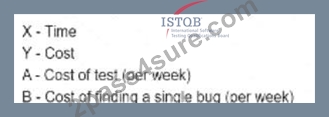
B)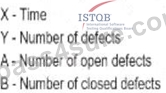
C)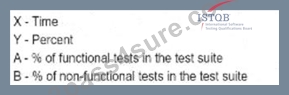
D)
- A. Option A
- B. Option D
- C. Option B
- D. Option C
Answer: B
Explanation:
Option D correctly explains what is represented by the lines A, B and the axes X, Y in a testing metrics chart.
According to option D:
* X-axis represents Time
* Y-axis represents Count
* Line A represents Number of open bugs
* Line B represents Total number of executed tests
This information is essential in understanding and analyzing the testing metrics of a completed project.
ISTQB Certified Tester Foundation Level (CTFL) v4.0 Syllabus, Section 2.5.1, Page 35.
NEW QUESTION # 173
Which ONE of the following elements is TYPICALLYNOTpart of atest progress report?
- A. Obstacles and their workarounds
- B. New or changed risks
- C. A detailed assessment of product quality
- D. Test metrics to show the current status of the test process
Answer: C
Explanation:
Comprehensive and Detailed In-Depth Explanation:Atest progress reportprovides an overview of testing activities, metrics, and identified risks. It focuses on tracking testing progress rather thanevaluating overall product quality (B), which is typically included in atest summary reportafter testing is completed.
* (A) is correctbecause obstacles (challenges) are reported to ensure test execution stays on track.
* (C) is correctas test metrics help stakeholders track execution progress.
* (D) is correctbecause new or changed risks impact test focus and priorities.
A test progress reporttracks execution and informs stakeholders about ongoing testing activities.
NEW QUESTION # 174
An alphanumeric password must be between 4 and 7 characters long and must contain at least one numeric character, one capital (uppercase) letter and one lowercase letter of the alphabet.
Which one of the following sets of test cases represents the correct outcome of a two-value boundary value analysis applied to the password length? (Note: test cases are separated by a semicolon)
- A. aB11;99rSp:5NnN10;7iDD0a1x
- B. 1xB: aB11: 99rSp: 5NnN10; 4NnN10T; 44ghWn19
- C. 1RhT;rSp53;3N3e10;8sBdby
- D. 1xA;aB11;Pq1ZZab;7iDD0a1x
Answer: C
Explanation:
The correct outcome of a two-value boundary value analysis applied to the password length is the set of test cases represented by option D. Boundary value analysis is a test design technique that focuses on the values at the boundaries of an equivalence partition, such as the minimum and maximum values, or the values just above and below the boundaries. A two-value boundary value analysis uses two values for each boundary, one representing the valid value and one representing the invalid value. For example, if the valid range of values is from 4 to 7, then the two values for the lower boundary are 3 and 4, and the two values for the upper boundary are 7 and 8. The test cases in option D use these values for the password length, while also satisfying the other requirements of the password, such as containing at least one numeric character, one capital letter, and one lowercase letter. The test cases in option D are:
* 1RhT: a 4-character password that is valid
* rSp53: a 5-character password that is valid
* 3N3e10: a 6-character password that is valid
* 8sBdby: an 8-character password that is invalid The test cases in the other options are incorrect, because they either use values that are not at the boundaries of the password length, or they do not meet the other requirements of the password. For example, the test cases in option A are:
* 1xA: a 3-character password that is invalid, but it does not contain a capital letter
* aB11: a 4-character password that is valid
* Pq1ZZab: a 7-character password that is valid
* 7iDD0a1x: an 8-character password that is invalid References: ISTQB Certified Tester Foundation Level (CTFL) v4.0 sources and documents:
* ISTQB Certified Tester Foundation Level Syllabus v4.0, Chapter 2.2.1, Black-box Test Design Techniques1
* ISTQB Glossary of Testing Terms v4.0, Boundary Value Analysis, Equivalence Partition2
NEW QUESTION # 175
Which of the following statements about estimation of the test effort is WRONG?
- A. Effort estimate depends on the budget of the project.
- B. Experience based estimation is one of the estimation techniques.
- C. Effort estimate can be inaccurate because the quality of the product under tests is not known.
- D. Once the test effort is estimated, resources can be identified and a schedule can be drawn up.
Answer: A
Explanation:
Effort estimate does not depend on the budget of the project, but rather on the scope, complexity, and quality of the software product and the testing activities1. Budget is a constraint that may affect the feasibility and accuracy of the effort estimate, but it is not a factor that determines the effort estimate. Effort estimate is the amount of work required to complete the testing activities, measured in terms of person-hours, person-days, or person-months2.
The other options are correct because:
A) Once the test effort is estimated, resources can be identified and a schedule can be drawn up, as they are interrelated aspects of the test planning process3. Resources are the people, tools, equipment, and facilities needed to perform the testing activities4. Schedule is the time frame and sequence of the testing activities, aligned with the project milestones and deadlines5.
B) Effort estimate can be inaccurate because the quality of the product under tests is not known, as it affects the number and severity of the defects that may be found and the rework that may be needed to fix them6. Quality is the degree to which the software product satisfies the specified requirements and meets the needs and expectations of the users and clients7.
D) Experience based estimation is one of the estimation techniques, which relies on the judgment and expertise of the testers and other project stakeholders to estimate the test effort based on similar projects or tasks done in the past. Experience based estimation can be useful when there is a lack of historical data, formal methods, or detailed information about the software product and the testing activities.
Reference =
1 ISTQB Certified Tester Foundation Level Syllabus v4.0, 2023, p. 154
2 ISTQB Certified Tester Foundation Level Syllabus v4.0, 2023, p. 155
3 ISTQB Certified Tester Foundation Level Syllabus v4.0, 2023, p. 156
4 ISTQB Certified Tester Foundation Level Syllabus v4.0, 2023, p. 157
5 ISTQB Certified Tester Foundation Level Syllabus v4.0, 2023, p. 158
6 ISTQB Certified Tester Foundation Level Syllabus v4.0, 2023, p. 159
7 ISTQB Certified Tester Foundation Level Syllabus v4.0, 2023, p. 16
[8] ISTQB Certified Tester Foundation Level Syllabus v4.0, 2023, p. 160
[9] ISTQB Certified Tester Foundation Level Syllabus v4.0, 2023, p. 161
NEW QUESTION # 176
Which ONE of the following options BEST describes a key characteristic of non-functional testing?
- A. Ensuring non-functional testing focuses only on user experience and usability.
- B. Limiting non-functional testing to security testing and performance testing only.
- C. Performing non-functional testing starting at the system test level.
- D. Conducting non-functional testing exclusively at the acceptance test level.
Answer: C
Explanation:
Comprehensive and Detailed In-Depth Explanation:
Non-functional testing evaluates attributes like performance, security, and usability, which are typically assessed at the system test level or higher (A). It is not restricted to acceptance testing (B), goes beyond security and performance testing (C), and covers more than just user experience (D).
Reference: ISTQB CTFL v4.0 Syllabus, Section 2.2.2 - Non-functional Testing
NEW QUESTION # 177
A company wants to reward each of its salespeople with an annual bonus that represents the sum of all the bonuses accumulated for every single sale made by that salesperson. The bonus for a single sale can take on the following four values: 3%, 5%, 7% and 10% (the percentage refers to the amount of the single sale). These values are determined on the basis of the type of customer (classified as "Basic" or "Premium") to which such sale was made, and on the amount of such sale classified into the following three groups G1, G2 and G3:
* [G1]: less than 300 euros
* [G2]: between 300 and 2000 euros
* [G3]: greater than 2000 euros
Which of the following is the minimum number of test cases needed to cover the full decision table associated with this scenario?
- A. 0
- B. 1
- C. 2
- D. 3
Answer: C
Explanation:
The minimum number of test cases needed to cover the full decision table associated with this scenario is 6.
This is because the decision table has 4 conditions (type of customer and amount of sale) and 4 actions (bonus percentage). The conditions have 2 possible values each (Basic or Premium, and G1, G2 or G3), so the total number of combinations is 2 x 2 x 2 x 2 = 16. However, not all combinations are valid, as some of them are contradictory or impossible. For example, a sale cannot be both less than 300 euros and greater than 2000 euros at the same time. Therefore, we need to eliminate the invalid combinations and keep only the valid ones.
The valid combinations are:
Type of customer
Amount of sale
Bonus percentage
Basic
G1
3%
Basic
G2
5%
Basic
G3
7%
Premium
G1
5%
Premium
G2
7%
Premium
G3
10%
These 6 combinations cover all the possible values of the conditions and actions, and they are the minimum number of test cases needed to cover the full decision table.
References: ISTQB Certified Tester Foundation Level (CTFL) v4.0 sources and documents,
NEW QUESTION # 178
Which of the following statements about reviews are TRUE?
I In walkthroughs the review meeting is typically led by the author.
II Inspection is characterized by an open-ended review meeting
III Preparation before the review meeting is part of informal reviews
IV Management rarely participates in technical review meetings
- A. I, II
- B. I, IV
- C. II, Ill
- D. III, IV
Answer: B
Explanation:
The following statements about reviews are true:
I) In walkthroughs the review meeting is typically led by the author. A walkthrough is a type of review that has a predefined objective and agenda but no formal process or roles. A walkthrough is typically led by the author of the work product under review, who guides the participants through a scenario and solicits feedback.
IV) Management rarely participates in technical review meetings. A technical review is a type of review that has a predefined objective and agenda but no formal process or roles. A technical review is typically performed by peers with technical expertise in order to evaluate technical aspects of a work product. Management rarely participates in technical review meetings, as they may not have sufficient technical knowledge or skills to contribute effectively. The following statements about reviews are false:
II) Inspection is characterized by an open-ended review meeting. An inspection is a type of review that follows a defined process with formal entry and exit criteria and roles and responsibilities for participants. An inspection is characterized by a structured review meeting with a fixed duration and agenda.
III) Preparation before the review meeting is part of informal reviews. Preparation before the review meeting is part of formal reviews, such as inspections or technical reviews. Preparation involves checking
NEW QUESTION # 179
Which ONE of the following options BEST describes Behavior-Driven Development (BDD)?
- A. Requires testing to be performed after development is completed to validate software functionality.
- B. Is primarily focused on non-functional testing techniques to ensure system reliability and performance.
- C. Defines test cases at a low level, close to the implementation, using unit test frameworks.
- D. Expresses the desired behavior of an application with test cases written in a simple form of natural language that is easy to understand by stakeholders-usually using the Given/When/Then format. Test cases are then automatically translated into executable tests.
Answer: D
Explanation:
Comprehensive and Detailed In-Depth Explanation:BDD emphasizes collaboration between developers, testers, and business stakeholders to define systembehavior in a readable format (A). It typically uses the Given-When-Thensyntax. Unlike unit testing (B), BDD is at a higher level of abstraction. It does not focus solely on non-functional testing (C) and encourages early testing rather than post-development validation (D).
NEW QUESTION # 180
You are working on creating test cases for a user story -
As a customer, I want to be able to book an ISTQB exam for a particular date, so that I can find choose my time slot and pay the correct amount, including discounts, if any.
The acceptance criteria for this :
1. The dates shown should be from the current date to 2 years in future
2. Initially there should be 10 timeslots available for each day, 1 hour each, starting at 8 AM GMT
3. Maximum 5 persons should be able to select a time slot after which that time slot should become unavailable
4. First timeslot should have a 10% discount
Which of the following is the BEST example of a test case for this user story?
- A. Logon to the site. Book 5 exams for the current date. Expected result: Exams should be booked. Book
6th timeslot for the same date. Expected result: The exam should be booked but no discount should be given. - B. Logon to the site. Book an exam for the current date. Expected result: timeslots should be shown.
Change the time to any other date prior to the selected date. Expected result: New slot should become visible. - C. Logon to the site and book an exam for the 8 AM (GMT) timeslot Expected result: You should get 10% discounted price. Change the time to any other timeslot. Expected result: Discount should be removed
- D. Logon to the site. Expected result: Default 8 AM (GMT) timeslot should be selected Change the time to any other timeslot. Expected result: New slot should be booked
Answer: C
NEW QUESTION # 181
Which of the following statements about the shift-left approach is true?
- A. Performance testing performed during component testing, is a form of shift-left in testing that avoids planning and executing costly end-to-end testing at the system test level in a production-like environment
- B. Continuous integration supports shift-left in testing as it can reduce the time between the introduction of a defect and its detection, thereby reducing the cost to fix it
- C. Shift-left in testing can be implemented in several ways to find functional defects early in the lifecycle, but it cannot be relied upon to find defects associated with non-functional characteristics
- D. Shift-left in testing can be implemented only in Agile/DevOps frameworks, as it relies completely on automated testing activities performed within a continuous integration process
Answer: B
Explanation:
This answer is correct because shift-left in testing is an approach that aims to perform testing activities as early as possible in the software development lifecycle, in order to find and fix defects faster and cheaper, and to improve the quality of the software product. Continuous integration is a practice that supports shift-left in testing, as it involves integrating and testing the software components frequently, usually several times a day, using automated tools and processes. Continuous integration can reduce the time between the introduction of a defect and its detection, thereby reducing the cost to fix it and the risk of accumulating defects that could affect the functionality or performance of the software product. Reference: ISTQB Foundation Level Syllabus v4.0, Section 3.1.1.3, Section 3.2.1.3
NEW QUESTION # 182
Consider the following iteration planning tasks where a tester can provide value:
* Break down user stories into tasks (particularly testing tasks)
* Estimate test effort for all testing tasks
* Identify and refine functional and non-functional aspects of the test object Which ONE of the following tasks should be ADDED to the above list?
- A. Participating in the detailed risk analysis of user stories and determining their testability
- B. Determining the test strategy
- C. Planning the testing for the release
- D. Writing testable user stories and acceptance criteria
Answer: A
Explanation:
Comprehensive and Detailed In-Depth Explanation:
During iteration planning, testers provide input on risk analysis, testability, and the feasibility of test automation. Participating in risk analysis (B) helps identify areas needing more extensive testing.
* (A) is incorrect because the test strategy is usually set at a higher level (project or release level).
* (C) is incorrect as release planning is broader than iteration planning.
* (D) is incorrect since writing user stories is mainly the responsibility of the product owner, though testers contribute to defining acceptance criteria.
Risk-based test prioritization ensures testing efforts are aligned with business needs and software risks.
Reference: ISTQB CTFL v4.0 Syllabus, Section 5.2.3 - Risk-Based Testing
NEW QUESTION # 183
Which ONE of the following options corresponds to an activity in the testing process in which testable features are identified?
- A. Test design
- B. Test execution
- C. Test analysis
- D. Test implementation
Answer: C
Explanation:
Comprehensive and Detailed In-Depth Explanation:
Test analysis involves identifying the features to be tested and deriving test conditions. It is the phase where testers analyze the test basis (e.g., requirements, specifications) to identify testable aspects of the system. Test design (A) focuses on creating test cases, test implementation (C) involves preparing the test environment, and test execution (D) runs the tests.
NEW QUESTION # 184
Which ONE of the following statements about maintenance testing is CORRECT?
- A. Maintenance testing is performed exclusively for adaptive maintenance.
- B. Maintenance testing does not require test cases since it focuses solely on defect verification.
- C. Maintenance testing is only required when defects are reported in production.
- D. Maintenance testing should be performed when enhancements, fixes, or updates are applied to an existing system.
Answer: D
Explanation:
Comprehensive and Detailed In-Depth Explanation:Maintenance testing is carried outwhenever changes are made to an existing system, including enhancements, defect fixes, and system migrations (C). It is not limited to adaptive maintenance (A) and is needed even when no defects are reported (B). Test cases are essential to validate fixes and prevent regressions (D).
NEW QUESTION # 185
You are working in an agile team on the creation of software for use in robotic assistance systems that support industrial manufacturing processes. You are currently in the effort estimation phase using planning poker. In the current sprint, three user stories are to be implemented:
A . The assistance system is to have a customizable layout. For this purpose, the user should be able to choose between 3 combinations of font size and background color at startup.
B . In the initialization phase, the assistance system should validate the inputs of the 10 customer specific and process specific parameters against a list of 5 consistency rules and display the result to the user.
C . The assistance system currently supports the manufacturing process with 2 robot gripper arms, this shall be extended to 5 gripper arms. In addition, the system shall perform a pre-calculation of the movements of all gripper arms in real time and automatically stop the system in case of a calculated collision of the gripper arms.
You are now asked to estimate the test effort for each of these user stories by using planning poker. The following value rules apply for the test effort estimation:
3 - low (<= 10 test cases)
8 - medium (> 10 and <= 20 test cases)
13 - high (> 20 and <= 50 test cases)
21 - very high (> 50 and <= 100 test cases)
34 - too complex (number of test cases cannot be estimated from information) For each of the three user stories, which planning poker value makes the most sense when estimating the test effort?
- A. A:21; B:13; C:13;
- B. A:3; B:21; C:8;
- C. A:3; B:13; C:34;
- D. A:13; B:13; C:13;
Answer: B
NEW QUESTION # 186
Which of the following should be included in a test status report?
I. Estimation details
II. Total number of open and closed defects
III Actual effort spent
IV. Defect reports
V. Number of executed, failed, blocked tests
- A. III.V
- B. I. II. IV
- C. II, III
- D. II, III.V
Answer: D
Explanation:
The following should be included in a test status report: total number of open and closed defects, actual effort spent, and number of executed, failed, and blocked tests. A test status report is a document that provides information on the results and status of testing activities for a given period or phase. A test status report should include information that is relevant, accurate, and timely for the intended audience and purpose. Some of the information that should be included in a test status report are: total number of open and closed defects, which can indicate the defect trend and defect density of the software product; actual effort spent, which can indicate the productivity and efficiency of the testing process; number of executed, failed, and blocked tests, which can indicate the test progress and test coverage of the software product. The following should not be included in a test status report: estimation details, defect reports, and impact analysis. Estimation details are not part of a test status report, but rather part of a test plan or a test estimation document. Estimation details provide information on the expected time, resources, and costs for testing activities, not on the actual results or status of testing activities. Defect reports are not part of a test status report, but rather separate documents that provide detailed information on individual defects found during testing. Defect reports include information such as defect description, defect severity, defect priority, defectstatus, defect resolution, etc.
Defect reports can be referenced or summarized in a test status report, but not included in full. Impact analysis is not part of a test status report, but rather part of a risk assessment or prioritization process. Impact analysis provides information on the potential effects or consequences of a change or a defect on the software product or project. Impact analysis can be used to evaluate the amount or scope of testing to be performed, but not to report the results or status of testing activities. Verified References: A Study Guide to the ISTQB® Foundation Level 2018 Syllabus - Springer, page 141.
NEW QUESTION # 187
The whole-team approach:
- A. promotes the idea that all team members should be responsible for the quality of the product
- B. promotes the idea that all team members should have a thorough understanding of test techniques
- C. is mostly adopted in projects aimed at developing safety-critical systems, as it ensures the highest level of testing independence
- D. is a consensus-based approach that engages the whole team in estimating the user stories
Answer: A
Explanation:
This answer is correct because the whole-team approach is a way of working in agile projects where all team members share the responsibility for the quality of the product, and collaborate on delivering value to the customer. The whole-team approach involves testers, developers, business analysts, product owners, and other stakeholders in planning, designing, developing, testing, and delivering the product. The whole-team approach fosters communication, feedback, learning, and continuous improvement within the team. References: ISTQB Glossary of Testing Terms v4.0, ISTQB Foundation Level Syllabus v4.0, Section 3.1.1.1
NEW QUESTION # 188
Which ONE of the following options BEST describes black-box test techniques?
- A. Black-box testing techniques are based on experience with the test object without knowing the internal structure.
- B. Black-box testing techniques are based on analyzing the test object's specified and implied behavior without knowledge of its internal data structure.
- C. In black-box testing techniques, test cases are created based on the software's implementation.
- D. Black-box testing techniques involve analyzing the specified behavior of the test object without knowledge of its internal structure.
Answer: D
Explanation:
Comprehensive and Detailed In-Depth Explanation:Black-box testing techniques focus ontesting the functionality of the software without knowledge of its internal workings(D). They derive test cases from specifications, requirements, or expected behavior.Option Adescribes exploratory testing,Bcontradicts the definition by focusing on implementation, andCincorrectly includes "implied behavior," which is not a core characteristic of black-box testing.
NEW QUESTION # 189
Which of the following is not an example of a typical generic skill required for testing?
- A. Possess the necessary social skills that support effective teamwork
- B. Be able to communicate defects and failures to developers as objectively as possible
- C. Be able to apply test-driven development
- D. Be able to use test management tools and defect tracking tools
Answer: C
Explanation:
Test-driven development is not an example of a typical generic skill required for testing, but rather an example of a specific technical skill or a development practice that may or may not be relevant for testing, depending on the context and the objectives of the testing activities. Test-driven development is an approach to software development and testing, in which the developers write automated unit tests before writing the source code, and then refactor the code until the tests pass. Test-driven development can help to improve the quality, the design, and the maintainability of the code, as well as to provide fast feedback and guidance for the developers. However, test-driven development is not a skill that is generally expected or needed for testers, especially for testers who are not involved in unit testing or who do not have access to the source code. The other options are examples of typical generic skills required for testing, which are skills that are applicable and beneficial for testing in any context or situation, regardless of the specific testing techniques, tools, or methods used. The typical generic skills required for testing include:
* Be able to use test management tools and defect tracking tools: These are tools that help testers to plan, organize, monitor, and control the testing activities and resources, as well as to record, track, analyze, and resolve the defects detected during testing. These tools can improve the efficiency, the effectiveness, and the communication of the testing process, as well as to provide traceability, metrics, and reports for the testing outcomes.
* Be able to communicate defects and failures to developers as objectively as possible: This is a skill that involves the ability to report and describe the defects and failures found during testing in a clear, concise, accurate, and unbiased manner, using relevant information, evidence, and terminology, without making assumptions, judgments, or accusations. This skill can facilitate the collaboration, the understanding, and the resolution of the defects and failures between the testers and the developers, as well as to prevent conflicts, misunderstandings, or blame games.
* Possess the necessary social skills that support effective teamwork: These are skills that involve the ability to interact, cooperate, and coordinate with other people involved in or affected by the testing activities, such as the test manager, the test team, the project manager, the developers, the customers, the users, etc. These skills can include communication, negotiation, leadership, motivation, feedback, conflict resolution, etc. These skills can enhance the quality, the productivity, and the satisfaction of the testing process, as well as to foster a positive and constructive testing culture. References: ISTQB Certified Tester Foundation Level (CTFL) v4.0 sources and documents:
* ISTQB Certified Tester Foundation Level Syllabus v4.0, Chapter 1.1.1, Testing and the Software Development Lifecycle
* ISTQB Certified Tester Foundation Level Syllabus v4.0, Chapter 1.1.2, Testing and Quality
* ISTQB Certified Tester Foundation Level Syllabus v4.0, Chapter 1.2.1, Testing Principles
* ISTQB Certified Tester Foundation Level Syllabus v4.0, Chapter 1.2.2, Testing Policies, Strategies, and Test Approaches
* ISTQB Glossary of Testing Terms v4.0, Test-driven Development, Test Management Tool, Defect Tracking Tool, Defect Report, Failure, Social Skill2
NEW QUESTION # 190
A test engineer finds a defect while testing. After the developer has fixed the defect, the test engineer decides to re-run a complete section of the tests. Which of the following is correct?
- A. The test engineer should not re-run the tests, they should be part of the developer tests.
- B. The test engineer should re-run the tests, in order to ensure that new defects have not been introduced by the fix.
- C. The lest engineer should not re-run the tests, as they have already been run, and results recorded.
- D. The test engineer should re-run the tests, because the defect shows that the test cases need to be updated.
Answer: B
Explanation:
The test engineer should re-run the tests, in order to ensure that new defects have not been introduced by the fix. This is also known as regression testing, which is a type of testing that verifies that previously tested software still performs correctly after a change. Regression testing helps to detect any side effects or unintended consequences of a fix or a modification. The other options are incorrect reasons for re-running the tests. The test engineer should not re-run the tests, as they have already been run, and results recorded, because this ignores the possibility of new defects caused by the fix. The test engineer should not re-run the tests, they should be part of the developer tests, because this assumes that developer tests are sufficient and reliable, which may not be true. The test engineer should not re-run the tests, because the defect shows that the test cases need to be updated, because this does not address the impact of the fix on other test cases or functionalities. Verified References: A Study Guide to the ISTQB® Foundation Level 2018 Syllabus - Springer, page 41.
NEW QUESTION # 191
......
Get Instant Access REAL ISTQB-CTFL DUMP Pass Your Exam Easily: https://www.2pass4sure.com/Foundation-Level/ISTQB-CTFL-actual-exam-braindumps.html
ISTQB-CTFL Free Exam Questions with Quality Guaranteed: https://drive.google.com/open?id=1oyPTIsezVpyspOX7Ry-5Br8wZJlB0BZW