

100% Pass Top-selling VMCE_v12 Exams - New 2025 Veeam Pratice Exam
VMCE Dumps VMCE_v12 Exam for Full Questions - Exam Study Guide
Veeam VMCE_v12 Exam Syllabus Topics:
| Topic | Details |
|---|---|
| Topic 1 |
|
| Topic 2 |
|
| Topic 3 |
|
| Topic 4 |
|
| Topic 5 |
|
| Topic 6 |
|
| Topic 7 |
|
| Topic 8 |
|
| Topic 9 |
|
| Topic 10 |
|
| Topic 11 |
|
| Topic 12 |
|
| Topic 13 |
|
NEW QUESTION # 29
Which of the following statements are true when comparing a synthetic full backup to an active full backup on an NTFS-based backup repository? Choose two options.
- A. The synthetic full backup file has a .vsb extension, whereas the active full backup has a .vbk extension.
- B. Synthetic full backups are always best when launched on a dedupe appliance.
- C. If the backup repository performance is weak, creating synthetic full backups is the best choice.
- D. Synthetic full backups consume more network bandwidth.
- E. In terms of content and retention, the synthetic full backup file is identical to an active full backup file.
- F. Synthetic full backups impose less load on the production environment.
Answer: E,F
NEW QUESTION # 30
A backup job is configured as follows.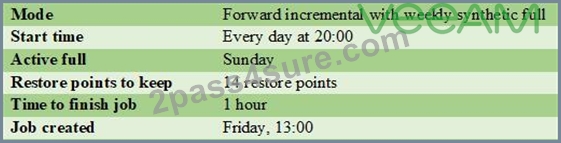
How many full and incremental restore points will be in a repository on day 16 at 23:00?
- A. 2 full and 12 incremental
- B. 1 full and 13 incremental
- C. 3 full and 14 incremental
- D. 3 full and 15 incremental
Answer: A
NEW QUESTION # 31
Figure A shows the backup files on a Scale-out Backup Repository (SOBR) created by a single Veeam backup job. The SOBR is configured to offload to capacity tier in move mode. If the offload was completed successfully, what will remain on the performance extents for the files uploaded to the capacity tier?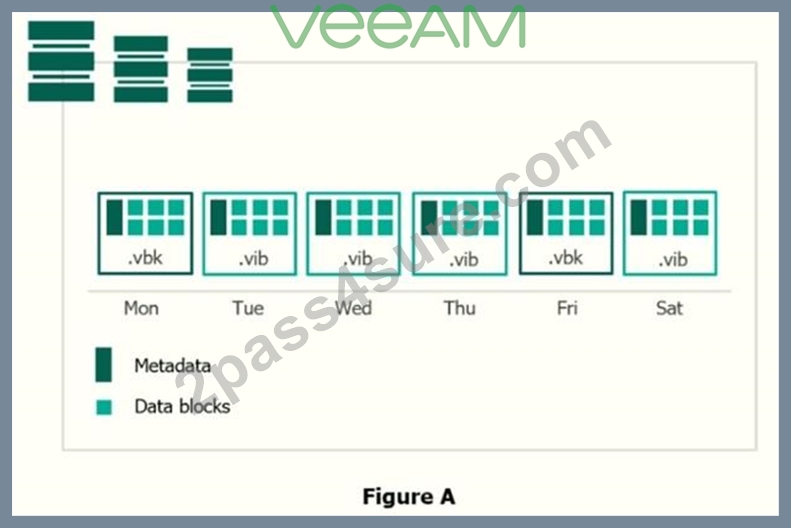
- A. VBM files (metadata only)
- B. VIB files (metadata and data)
- C. VIB and VBK files (data blocks only)
- D. VBK files (metadata and data)
- E. VIB and VBK files (metadata only)
Answer: E
NEW QUESTION # 32
An engineer has 3 Veeam Backup servers in 3 different data centers. The engineer needs a way to have centralized licensing and role-based access control.
How should the engineer accomplish this with the least effort?
- A. Install the Remote console on a different client
- B. Use the Veeam Web Portal
- C. Create a web portal using REST API
- D. Deploy the Enterprise Manager
Answer: D
Explanation:
Veeam Enterprise Manager provides centralized management for Veeam Backup & Replication environments.
It enables the administrator to manage licensing and role-based access control across multiple Veeam Backup servers in different locations, offering a unified control panel with minimal effort compared to other options that would require more complex setups or custom development work.References:
* Veeam Backup & Replication User Guide: Veeam Enterprise Manager
* Veeam Help Center: Centralized Management with Enterprise Manager
NEW QUESTION # 33
A company has the following requirements:
Mission-critical VMs: hourly replication to disaster recovery site, daily backups of these VMs should be available at the disaster recovery site when required, the mission critical applications need to be available within 20 minutes.
Business-important VMs: daily backups should be stored at the disaster recovery site. When required, the business-important applications need to be available within four hours.
Define the RPO and RTO for the company's disaster recovery site.
- A. Mission-critical VMs: RPO = 60 minutes, RTO = 20 minutes; business-important VMs: RPO = 24 hours, RTO = four hours
- B. Mission-critical VMs: RPO = 24 hours, RTO = four hours; business-important VMs: RPO = 24 hours, RTO = four hours
- C. Mission-critical VMs: RPO = 60 minutes, RTO = one hour; business-important VMs: RPO = 60 minutes, RTO = four hours
- D. Mission-critical VMs: RPO = 24 hours, RTO = 20 minutes; business-important VMs: RPO = 24 hours, RTO = four hours
Answer: C
NEW QUESTION # 34
Which of the following statements regarding the Backup from Storage Snapshots feature when backing up virtual machines from a VMware vSphere environment are true? (Choose two.)
- A. Higher transfer speed from production NFS datastores
- B. Lower impact on WAN link during off-site backups
- C. A virtual machine with one virtual drive on shared storage and another drive on local storage will be processes with Backup from Storage Snapshots transport mode
- D. Reduce the impact of consolidating VM snapshots
- E. A virtual machine with one virtual drive on shared storage and another drive on local storage will failover to a different transport mode
Answer: A,D
NEW QUESTION # 35
Veeam ONE ______________________ can detect when a potential ransomware attack is happening and be configured to take mitigating actions.
- A. Alarm Management
- B. Alert Management
- C. Reporting
- D. Data Protection View
Answer: A
Explanation:
Explanation
Veeam ONE can help notify you of suspicious activity in your datacenter through the Possible Ransomware Activity alarm. This alarm can be configured to takemitigating actions such as sending an email notification, running a script or creating a support case.
NEW QUESTION # 36
What type of backup can Veeam Plug-ins for Enterprise Applications provide?
- A. A complete backup of the database and the host server
- B. A transactionally consistent backup of active director
- C. A transactionally consistent backup of the database and its database logs
- D. A backup of changes to the database after the agent backs up the whole server
Answer: C
Explanation:
Veeam Plug-ins for Enterprise Applications provide a transactionally consistent backup of databases and their database logs. This ensures that the backup is not only complete but also consistent at a transactional level, capturing all transactions up to the point of the backup. This is crucial for databases to ensure data integrity and consistency when restored.
NEW QUESTION # 37
What are the three Veeam Backup & Replication technologies required to verify recoverability of the backup?
(Choose three.)
- A. Gateway Server
- B. Backup proxy
- C. SureBackup job
- D. Replication job
- E. Application group
- F. Virtual lab
Answer: C,E,F
Explanation:
Reference: https://helpcenter.veeam.com/docs/backup/vsphere/recovery_verification_overview.html?ver=100
NEW QUESTION # 38
The configuration database is corrupted, and the backup administrator wants to recover the data. Which configuration restore mode should be used?
- A. Migrate
- B. Restore
- C. Failover
- D. Instant Recovery
Answer: B
Explanation:
In the event that the Veeam Backup & Replication configuration database is corrupted, the appropriate action to take is to perform a configuration restore. Veeam Backup & Replication allows you to back up and restore its configuration database. The Restore option should be used to recover the data from a configuration backup.
This process will restore the configuration database from the backup file, which includes information about backup jobs, repository settings, and more. Instant Recovery, Failover, and Migrate are not appropriate options for recovering a corrupted configuration database. Instant Recovery is used to quickly restore a VM to a running state, Failover is used for High Availability in case a VM fails, and Migrate is used to move VMs from one host or storage to another.
NEW QUESTION # 39
A daily backup job for seven Hyper-V VMs has been configured at the main site, keeping 14 days' worth of backup files. They want to get a copy of the VM backups to a repository at the disaster recovery site. They want to keep six months' worth of backup files at the disaster recovery site.
They also need to be able to restore the VMs to any given day within two months and any given week within the six months. How should a backup copy job be configured to meet these requirements?
- A. Use periodic copy (pruning) mode, keeping 180 days of retention.
- B. Use immediate copy (mirroring) mode, keeping 180 days of retention.
- C. Use immediate copy (mirroring) mode, keeping 62 days of retention and 26 weekly GFS restore points.
- D. Use periodic copy (pruning) mode, keeping 62 days of retention and six monthly GFS restore points.
Answer: C
Explanation:
The clue is "any given week within six months" 26 weeks = 6 months.
NEW QUESTION # 40
If the deduplication setting are changed for an existing job, when will the new setting be applied?
- A. Only when you rescan the repository that stores the backup files
- B. If a new active full backup Is created
- C. At the next run of the job
- D. If any kind of full backup is created
Answer: B
Explanation:
Explanation
https://helpcenter.veeam.com/archive/backup/95/vsphere/compression_deduplication.html To apply new deduplication settings in backup jobs, you must create an active full backup after you change deduplication settings. Veeam Backup & Replication will use the new block size for the active full backup and subsequent backup files in the backup chain.
NEW QUESTION # 41
A daily backup job for seven Hyper-V VMs has been configured at the main site, keeping 14 days' worth of backup files. They want to get a copy of the VM backups to a repository at the disaster recovery site. They want to keep six months' worth of backup files at the disaster recovery site. They also need to be able to restore the VMs to any given day within two months and any given week within the six months. How should a backup copy job be configured to meet these requirements?
- A. Use periodic copy (pruning) mode, keeping 62 days of retention and six monthly GFS restore points.
- B. Use periodic copy (pruning) mode, keeping 180 days of retention.
- C. Use immediate copy (mirroring) mode, keeping 180 days of retention.
- D. Use immediate copy (mirroring) mode, keeping 62 days of retention and 26 weekly GFS restore points.
Answer: A
Explanation:
To meet the specified requirements, configuring a backup copy job in periodic copy (pruning) mode with 62 days of retention and six monthly Grandfather-Father-Son (GFS) restore points is the best approach. This setup allows for daily backups for up to two months and weekly backups for up to six months, aligning with the desired restore capabilities.References:Veeam Backup & Replication User Guide, Veeam GFS Retention Policy Explanation
NEW QUESTION # 42
A physical Windows file server protected by Veeam Agent for Windows needs to be migrated to a local VMware ESXi. The server has several volumes: C: (60GB), D: (1TB) and E: (4TB). What is the quickest option to migrate the server to a local VMware ESXi host?
- A. Export all disks, create an empty VM and attach the disks.
- B. Perform Instant Disk Recovery for each volume.
- C. Perform Instant VM Recovery.
- D. Create an empty VM and perform bare metal recovery inside the VM.
Answer: C
Explanation:
For the migration of a physical Windows file server to a local VMware ESXi host, the most efficient approach considering the server's large data volumes is D: Perform Instant VM Recovery. Veeam's Instant VM Recovery allows for the quick restoration of a backup into a VM running on an ESXi host. This process involves running the VM directly from the backup file without the need to fully restore the VM's data to production storage initially. This method is particularly advantageous for large volumes as it minimizes the initial data transfer time, allowing the server to be operational in the virtual environment more rapidly. After the VM is up and running, Veeam provides the option to migrate the VM to production storage in the background, ensuring minimal disruption to operations. This approach is ideal for scenarios requiring quick migration or restoration with large data sets.
NEW QUESTION # 43
A company's infrastructure includes a Fibre Channel SAN where the VMware VMs are located. The administrator wants to create a backup that minimizes the impact on the production environment. What proxy transport mode should be used?
- A. Network
- B. Virtual appliance
- C. Guest interaction
- D. Direct storage access
Answer: D
Explanation:
For a VMware environment on a Fibre Channel SAN, the most efficient proxy transport mode to minimize impact on the production environment is Direct Storage Access. This mode allows the backup proxy to directly interact with the SAN, bypassing the production network and reducing load on the ESXi hosts.References:Veeam Backup & Replication Best Practices, Veeam VMware Backup Proxy Guide
NEW QUESTION # 44
Which API is available to automate Veeam Backup and Replication operations?
- A. REST API through Veeam Backup and Replication Server
- B. Powershell cmdlets through Veeam Enterprise Manager Server
- C. REST API through Veeam One server
- D. SQL queries on the Veeam Backup and Replication database
Answer: A
Explanation:
The REST API through Veeam Backup and Replication Server is the available API for automating Veeam Backup and Replication operations. This API enables programmatic control over Veeam Backup & Replication and allows for integration with external systems and custom automation scripts.References:
Veeam Backup & Replication RESTful API Reference, Veeam Automation and Scripting Guide
NEW QUESTION # 45
Exhibit:
Look at the diagram. This daily backup job has been running for over 30 days and no active full backups have been taken since the first run. Which of the following best describes the backup job?
- A. This is forever forward incremental backup, keeping seven restore points
- B. This is a forward incremental backup with Sunday and Wednesday synthetic full, keeping seven restore points
- C. This is a reverse incremental backup, keeping seven restore points
- D. This is a forward incremental backup with transform enabled, keeping four restore points
Answer: C
NEW QUESTION # 46
Which backup method produces a backup chain that consists of the first full backup file (VBK) and a set of incremental backup files (VIB) following it? Additionally, the backup chain contains synthetic full and/or active full backup files that divide the backup chain into shorter series.
- A. Reverse incremental backup
- B. Forward incremental backup
- C. Forever forward incremental backup
- D. Differential incremental backup
Answer: B
Explanation:
https://helpcenter.veeam.com/docs/backup/vsphere/forward_incremental_backup.html?ver =100
NEW QUESTION # 47
An administrator has decided to set up a VM backup job covering their Microsoft SOL servers. What feature must be enabled to ensure quiescence of the SQL databases during the backup?
- A. Enable Microsoft Windows OS processing.
- B. Enable Microsoft SQL server plug-in.
- C. Enable Microsoft SQL server agent on the VMs
- D. Enable application-aware processing.
Answer: D
Explanation:
Explanation
According to the Veeam Agent for Microsoft Windows User Guide1, you need to enable application-aware processing to ensure quiescence of the SQL databases during the backup. Application-aware processing allows Veeam Agent for Microsoft Windows to create transactionally consistent backups of SQL Server VMs.
NEW QUESTION # 48
An engineer is using Veeam Backup and Replication v12.
The only backup repository is a Microsoft Windows server with direct attached Fibre Channel storage array.
The engineer realizes that none of their backups are immutable. A second copy of the backup on a different site and a different media is required.
Which option should be used to provide immutable backups on a secondary site with a different media?
- A. Create a Scale Out Backup Repository with the existing Microsoft Windows Server as the performance tier and AWS S3 bucket with immutability enabled as the capacity tier.
- B. Create a new hardened repository on a new Microsoft Windows Server, mark it as immutable and create a backup copy job on it.
- C. Create a Scale Out Backup Repository with the existing Microsoft Windows Server as the performance tier and an HPe StoreOnce Catalyst share with immutability enabled as the capacity tier.
- D. Create a Scale Out Backup Repository with the existing Microsoft Windows Server as the performance tier and Google Cloud Object Storage with immutability enabled as the capacity tier.
Answer: A
Explanation:
To provide immutable backups on a secondary site with a different media, the best option given the context is B: Create a Scale Out Backup Repository (SOBR) with the existing Microsoft Windows Server as the performance tier and an AWS S3 bucket with immutability enabled as the capacity tier.
This approach involves leveraging the existing backup infrastructure (Microsoft Windows Server with direct-attached storage) as the performance tier of the SOBR, where the most recent backups are stored for fast access. For long-term storage and immutability, backups can be offloaded to an AWS S3 bucket configured with Object Lock. The Object Lock feature in AWS S3 provides an additional layer of data protection by making the backup data immutable, meaning it cannot be deleted or modified for a specified duration. This setup ensures that backup data is protected against accidental deletion, ransomware, and other malicious activities.
By implementing this configuration, the engineer can achieve the desired level of data protection and immutability, utilizing cloud storage as a secure and scalable secondary backup location, distinct from the primary on-premises storage media.
NEW QUESTION # 49
......
Authentic Best resources for VMCE_v12 Online Practice Exam: https://www.2pass4sure.com/VMCE/VMCE_v12-actual-exam-braindumps.html
VMCE_v12 Test Engine Practice Exam: https://drive.google.com/open?id=1whEQ4j85oNGd7uiW8J__a-RQQbNwfzpa