

2026 Latest Juniper JN0-352 Real Exam Dumps PDF
JN0-352 Exam Dumps, JN0-352 Practice Test Questions
NEW QUESTION # 88
Which statement is correct about controlling the routes installed by a RIB group?
- A. Only routes in the last table are installed.
- B. A firewall filter must be configured to install routes in the RIB groups.
- C. An import policy is applied to the RIB group.
- D. An export policy is applied to the RIB group.
Answer: C
Explanation:
When routes are placed into a RIB group, an import policy can be applied to determine which routes are accepted into that group. This policy helps in controlling which routes get installed or filtered into the RIB group from various sources like other routing protocols or static routes.
https://www.juniper.net/documentation/us/en/software/junos/static-routing/topics/ref/statement/rib-groups-edit-routing-options.html
NEW QUESTION # 89
Which IS-IS TLV should be used to advertise information about the router's neighbors and link metrics?
- A. TLV 22
- B. TLV 2
- C. TLV 129
- D. TLV 132
Answer: A
Explanation:
TLV 22, the Extended IS Reachability TLV defined in RFC 5305, is the modern and Junos-preferred mechanism for advertising a router's adjacent neighbors together with the metric associated with each link. It carries the seven-octet system ID and pseudonode number of each neighbor along with a 24-bit wide metric field, and supports an extensible set of sub-TLVs used for traffic-engineering data such as interface and neighbor IP addresses, bandwidth, and administrative groups. The original IS Reachability TLV, TLV 2, defined in the base ISO 10589 standard, carries similar neighbor and metric information but is constrained to a 6-bit narrow metric with a maximum value of 63, which is inadequate for expressing meaningful cost differentiation in modern, high-capacity enterprise and service-provider topologies; consequently, Junos deployments are commonly configured for wide-metrics-only, favoring TLV 22 over the legacy TLV 2 whenever traffic-engineering-capable or simply more granular metric representation is desired. TLV 132, the IP Interface Address TLV, only advertises the IPv4 addresses configured on the originating router's interfaces and carries no neighbor-adjacency or metric information. TLV 129, the Protocols Supported TLV, merely lists which network-layer protocols (such as IPv4 or IPv6) the originating router is capable of routing, and likewise has nothing to do with neighbor reachability or link cost. Reference topics: Junos Enterprise Routing
- IS-IS, Extended IS Reachability and Wide Metrics.
NEW QUESTION # 90
What are three well-known mandatory BGP attributes? (Choose three.)
- A. local preference
- B. next hop
- C. AS path
- D. origin
- E. community
Answer: B,C,D
NEW QUESTION # 91
You are deploying a trunk port with multiple VLANs. In this scenario, which statement is true about the native VLAN?
- A. The native VLAN is the highest tagged VLAN ID on the port.
- B. The native VLAN must be the default VLAN on the port.
- C. The native VLAN is automatically configured through DHCP.
- D. The native VLAN is an untagged VLAN ID on the port.
Answer: D
NEW QUESTION # 92
You are asked to connect an IP phone and a user computer using the same interface on an EX Series switch. The traffic from the computer does not use a VLAN tag, whereas the traffic from the IP phone uses a VLAN tag.
Which feature enables the interface to receive both types of traffic?
- A. MAC limiting
- B. voice VLAN
- C. native VLAN
- D. DHCP snooping
Answer: B
Explanation:
The feature that enables an interface on an EX Series switch to receive both untagged traffic (from the computer) and tagged traffic (from the IP phone) is the voice VLAN. The voice VLAN feature in EX-series switches enables access ports to accept both data (untagged) and voice (tagged) traffic and separate that traffic into different VLANs. This allows the switch to differentiate between voice and data traffic, ensuring that voice traffic can be treated with a higher priority.
NEW QUESTION # 93
You have two OSPF routers forming an adjacency. R1 has a priority of 32 and a router ID of
192.168.1.2. R2 has a priority of 64 and a router ID of 192.168.1.1. The routers were started at the same time and all other OSPF settings are the default settings.
Which statement is correct in this scenario?
- A. At least three routers are required for a DR/BDR election
- B. R2 will be the BDR.
- C. R1 will be the BDR.
- D. Router IDs must match for an adjacency to form.
Answer: C
Explanation:
The router with the highest OSPF priority becomes the DR. In this case, R2 has a higher priority (64) compared to R1's priority (32). Hence, R2 will become the DR.
The router with the next highest priority becomes the BDR. Since R1 has the next highest priority after R2, R1 will become the BDR.
NEW QUESTION # 94
Referring to the exhibit, Router-1 and Router-2 are failing to form an IS-IS adjacency.
What should you do to solve the problem?
- A. Remove the overloaded statement from Router-1.
- B. Change the ISO areas on the lo0 interfaces to match on both routers.
- C. Change the IP subnet masks to match on the ge-0/0/2 interfaces of both routers.
- D. Remove the ISO address from ge-0/0/2 on Router-1.
Answer: D
NEW QUESTION # 95
You are receiving multiple BGP routes from an upstream neighbor and only want to advertise a single summarized prefix to your internal OSPF neighbors. This route should only be advertised when you are receiving these BGP routes from this neighbor.
In this scenario, which type of route should you create?
- A. static route using qualified next hops
- B. generate route
- C. static route using the resolve feature
- D. aggregate route
Answer: B
NEW QUESTION # 96
Referring to the exhibit, what will be the IS-IS adjacency result of the configurations?
- A. A level 2 IS-IS adjacency will form.
- B. A level 1 IS-IS adjacency will form.
- C. A level 1 and level 2 IS-IS adjacency will form.
- D. No IS-IS adjacencies will form.
Answer: D
NEW QUESTION # 97
You are asked to configure a redundant trunk group (RTG). Which two requirements would accomplish this task? (Choose two.)
- A. The RTG must be participating in a Spanning Tree topology.
- B. Interfaces within an RTG must be configured as trunk ports.
- C. Both interfaces of an RTG must be configured to service the same VLANS.
- D. Interfaces within an RTG can be configured as access ports.
Answer: B,C
NEW QUESTION # 98
What are two reasons for creating multiple areas in OSPF? (Choose two.)
- A. to increase the size of the LSDB
- B. to increase the number of adjacencies in the backbone
- C. to reduce LSA flooding across the network
- D. to reduce the convergence time
Answer: C,D
Explanation:
Option A is correct. Creating multiple areas in OSPF can help to reduce the convergence time .
This is because changes in one area do not affect other areas, so fewer routers need to run the SPF algorithm in response to a change.
Option D is correct. Creating multiple areas in OSPF can help to reduce Link State Advertisement (LSA) flooding across the network. This is because LSAs are not flooded out of their area of origin.
NEW QUESTION # 99
You are combining two existing interfaces into a single LAG interface, but you do not see the LAG interface being created. Which two actions are required to solve this problem? (Choose two.)
- A. Ensure that the first LAG interface name is ae1.
- B. Ensure that the first LAG interface name is ae0.
- C. Ensure that LAG is enabled on each member interface.
- D. Ensure that LAG is enabled on the chassis.
Answer: B,D
NEW QUESTION # 100
What are two characteristics of RSTP alternate ports? (Choose two.)
- A. RSTP alternate ports provide an alternate higher cost path to the root bridge.
- B. RSTP alternate ports are active ports used to forward frames toward the root bridge.
- C. RSTP alternate ports provide an alternate lower cost path to the root bridge.
- D. RSTP alternate ports block traffic while receiving superior BPDUs from a neighboring switch.
Answer: A,D
Explanation:
A is correct because RSTP alternate ports block traffic while receiving superior BPDUs from a neighboring switch. An alternate port is a backup port for a root port, which means it receives better BPDUs from another bridge than the current root port. However, an alternate port does not forward any traffic, as it is in a discarding state. It only listens to BPDUs and waits for the root port to fail. If the root port fails, the alternate port can immediately transition to a forwarding state and become the new root port.
C is correct because RSTP alternate ports provide an alternate higher cost path to the root bridge. An alternate port is selected based on the same criteria as the root port, which are the lowest bridge ID, the lowest path cost, the lowest sender port ID, and the lowest receiver port ID.
However, an alternate port receives a higher cost BPDU than the root port, otherwise it would be the root port itself. Therefore, an alternate port provides an alternate higher cost path to the root bridge than the root port.
NEW QUESTION # 101
A GRE tunnel is experiencing fragmentation issues. You confirm that the tunnel is up and is functioning correctly. You confirm that hosts are sending 1500-byte packets.
In this scenario, which statement is correct?
- A. You should use ToS copying to reduce header size.
- B. You should lower the physical interface's MTU to 1476 bytes to avoid fragmentation.
- C. You should use the clear-dont-fragment parameter to allow fragmentation.
- D. You should enable BFD to more rapidly identify tunnel link failures.
Answer: B
Explanation:
GRE encapsulation adds a fixed 24 bytes of overhead to every packet it carries - 4 bytes for the GRE header itself and 20 bytes for the new outer IPv4 delivery header. When a host transmits a full 1500-byte Ethernet payload into a gr- interface, the resulting encapsulated packet becomes 1524 bytes, which exceeds the physical interface's standard 1500-byte MTU and forces fragmentation or drops if the don't-fragment bit is set.
The correct remediation is to reduce the effective MTU seen by end hosts so that encapsulated packets never exceed the physical link's transmission limit. Junos automatically applies this logic to gr- logical interfaces, which default to a 1476-byte protocol MTU (1500 minus 24), but when the underlying physical interface or a manually configured path is involved, administrators must explicitly size the interface MTU to 1476 bytes to prevent post-encapsulation oversize packets. Allowing fragmentation with clear-dont-fragment is a workaround that increases CPU load and can degrade performance rather than solving the root cause, BFD addresses link-failure detection rather than MTU sizing, and ToS copying affects only the type-of-service byte, not packet length. Reference topics: Junos Enterprise Routing - Tunneling, GRE Encapsulation and MTU Considerations; Junos OS Configuring GRE Tunnel Interfaces.
NEW QUESTION # 102 
Click the Exhibit button.
You are troubleshooting an aggregated Ethernet interface on a Juniper Networks EX Series Switch. The aggregated Ethernet interface does not appear in the output shown in the exhibit.
Which action will solve this problem?
- A. Restart the switch to enable the aggregated Ethernet switching process.
- B. Install the aggregated Ethernet interface license on the switch.
- C. Configure LACP passive-mode.
- D. Configure the number of aggregated Ethernet devices under the [edit chassis] hierarchy.
Answer: D
Explanation:
On EX Series switches, aggregated Ethernet (ae) interfaces do not exist by default; before any ae interface can be created, referenced, or brought into service, an administrator must first reserve the desired number of aggregated Ethernet device slots by configuring set chassis aggregated-devices ethernet device-count number at the [edit chassis] hierarchy. This statement allocates the internal resources needed for that many ae interfaces to exist as valid, configurable objects; until it is committed, any interface-level configuration referencing ae0 (such as the aggregated-ether-options and family ethernet-switching stanzas shown in the exhibit) is accepted syntactically by the CLI but never actually instantiates a live ae0 device, which is exactly why show interfaces ae0.0 returns 'device ae0 not found' despite the interface appearing fully configured.
Increasing the device-count to at least 1 (or higher, to cover the number of LAG bundles planned) immediately resolves this and allows ae0 to appear as an operational interface once its member links are also associated with it. This is a foundational and frequently overlooked prerequisite step in LAG deployment on Juniper switches. There is no separate licensing requirement for aggregated Ethernet functionality on EX Series switches, a reboot is not needed since the chassis statement takes effect upon commit, and the LACP mode (active versus passive) is unrelated to whether the ae interface object itself exists in the first place.
Reference topics: Junos Enterprise Switching - Link Aggregation, Configuring the Aggregated Ethernet Device Count.
NEW QUESTION # 103
What are two interarea OSPF LSA types? (Choose two.)
- A. Type 3 summary LSAs
- B. Type 4 ASBR summary LSAs
- C. Type 1 router LSAs
- D. Type 2 network LSAs
Answer: A,B
NEW QUESTION # 104
Which two statements describe OSPF DR and BDR behavior? (Choose two.)
- A. The DR by default generates Type-2 Network LSAs to describe the multi-access segment.
- B. The BDR by default generates Type-2 Network LSAs to describe the multi-access segment.
- C. The BDR becomes the DR if the DR fails.
- D. The DR elects the area border router for each area.
Answer: A,C
Explanation:
The Backup Designated Router exists specifically to provide immediate failover redundancy for the Designated Router role on a multi-access broadcast or NBMA segment: the BDR maintains full adjacencies with every other router on the segment concurrently with the DR, precisely so that if the DR ever fails or is withdrawn, the BDR can be promoted directly to DR essentially instantaneously, without needing to wait through a fresh, full DR/BDR election process, and a new BDR election then takes place separately among the remaining DROther routers to fill the now-vacant backup role. This immediate promotion behavior confirms the first statement as correct. The Designated Router's other core responsibility on the segment is originating the Type 2 Network LSA, which describes the multi-access network itself as a pseudonode, listing every router attached to that segment; this LSA type exists specifically to avoid the full-mesh explosion of Router LSA adjacency listings that would otherwise be needed to describe a shared broadcast segment, and only the DR - never the BDR, and never any DROther - is responsible for generating and maintaining this particular LSA under normal, stable conditions, which confirms the third statement while directly ruling out the fourth. There is no such thing as the DR 'electing' an area border router; ABR status is instead a role a router acquires organically by having interfaces in more than one OSPF area, entirely independent of any DR
/BDR election process on any individual segment. Reference topics: Junos Enterprise Routing - OSPF, DR
/BDR Roles and Type 2 Network LSA Origination.
NEW QUESTION # 105
Which two statements are correct about martian routes? (Choose two.)
- A. Martian routes are never installed in the route table.
- B. Martian routes only represent publicly used prefixes.
- C. Additional prefixes can be added to the list of martian routes.
- D. Martian routes are always host addresses.
Answer: A,C
Explanation:
Martian routes are never installed in the route table.
Martian routes refer to IP addresses or prefixes that are considered invalid or reserved, and they are not installed in the routing table.
Additional prefixes can be added to the list of martian routes.
Network administrators can configure the system to treat additional prefixes as Martian routes based on specific network policies or requirements.
NEW QUESTION # 106
Referring to the exhibit, which two statements about BGP prefixes advertised by R1 to AS 65501 are true? (Choose two.)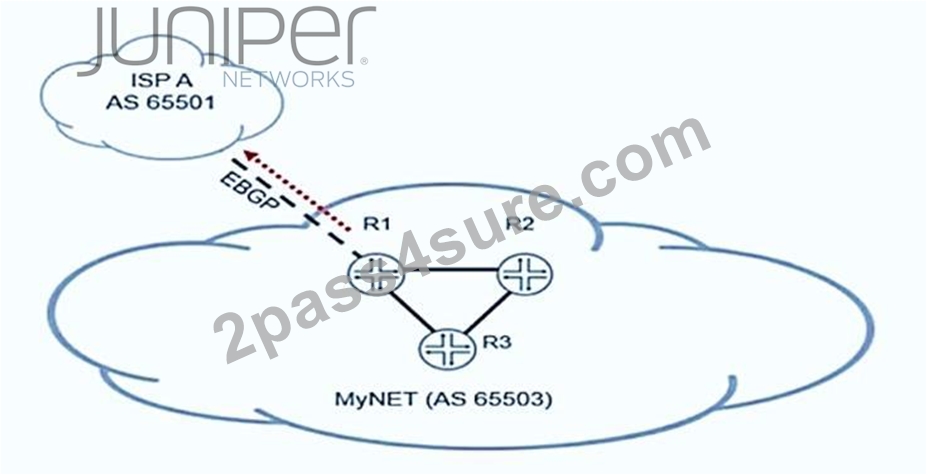
- A. R1 will modify the cluster list attribute in prefixes advertised to AS 65501
- B. R1 will modify the originator ID attribute in prefixes advertised to AS 65501
- C. R1 will modify the next-hop attribute in prefixes advertised to AS 65501
- D. R1 will modify the AS path attribute in prefixes advertised to AS 65501
Answer: B,C
NEW QUESTION # 107
Which two actions are performed by the firewall filter shown in the exhibit? (Choose two.)
- A. Frames with the 88:05:00:29:3c:de source MAC address are accepted and logged.
- B. All traffic is permitted.
- C. Term two requires a fromstatement.
- D. Frames without the 88:05:00:29:3c:de source MAC address are discarded and logged.
Answer: A,B
NEW QUESTION # 108
R1 was started at 4:00 PM. R2 and R3 were started at 6:00 PM. R4 was started at 10:00 PM. All routers are in Area 0 and there are no point-to-point links.
Referring to the exhibit, which router is the designated router?
- A. R4
- B. R3
- C. R2
- D. R1
Answer: D
NEW QUESTION # 109
What does the * indicate in the output shown in the exhibit?
- A. The switch ports have a router attached.
- B. All interfaces have elected a root bridge.
- C. The interface is active.
- D. The interface is down.
Answer: C
Explanation:
The exhibit shows the output of the command show vlans brief, which displays brief information about VLANs and their associated interfaces.
The output has four columns: Routing instance, VLAN name, Interfaces, and Tagging. The * symbol indicates that the interface is active, meaning that it is up and forwarding traffic. This can be verified by the command show interfaces terse, which displays the status of the interfaces.
NEW QUESTION # 110
When trying to commit the configuration shown in the exhibit, you receive an error.
What is the problem?
- A. You have omitted the interface-mode trunkcommand.
- B. You have not set the interface family correctly.
- C. You have not configured an IP address to the interface.
- D. You have omitted the interface-mode accesscommand.
Answer: A
NEW QUESTION # 111
You have configured the four EX Series switches with RSTP, as shown in the exhibit. You discover that whenever a link between switches goes up or down, the switches take longer than expected for RSTP to converge, using the default settings.
In this scenario, which action would solve the delay in RSTP convergence?
- A. The force-version must be removed.
- B. The max-age must be increased to 20
- C. The bridge priority for EX-4 must be set at 4000.
- D. The hello-time must be increased.
Answer: A
Explanation:
The exhibit shows the configuration of RSTP on EX-4, which has the command force-version stp.
This command forces the switch to use the legacy STP protocol instead of RSTP, even though the switch supports RSTP. This means that EX-4 will not be able to take advantage of the faster convergence and enhanced features of RSTP, such as edge ports, link type, and proposal/agreement sequence. The other switches in the network are likely to be running RSTP, as it is the default protocol for EX Series switches. Therefore, there will be a compatibility issue between EX-4 and the other switches, which will result in longer convergence times and suboptimal performance. The switch will also generate a warning message that says "Warning:
STP version mismatch with neighbor" when it receives a BPDU from a RSTP neighbor.
To solve this problem, the force-version command must be removed from EX-4, so that it can run RSTP natively and interoperate with the other switches in the network. This will enable faster convergence and better stability for the network topology. To remove the command, you can use the delete protocols rstp force-version command in configuration mode.
NEW QUESTION # 112
......
PDF (New 2026) Actual Juniper JN0-352 Exam Questions: https://www.2pass4sure.com/JNCIS-ENT/JN0-352-actual-exam-braindumps.html