

[Dec-2024] Get 100% Real CFPE Free Online Practice Test
BEST Verified NFPA CFPE Exam Questions (2024)
NEW QUESTION # 29
In a performance-based design what criteria must the designer meet to provide life safety and fire protection for a project?
- A. Stakeholder input
- B. A prescriptive code requirement
- C. Goals and objectives
- D. A financial outcome
Answer: C
Explanation:
In a performance-based design, the criteria the designer must meet are defined by goals and objectives related to life safety and fire protection. Performance-based designs rely on achieving specified safety outcomes, rather than strictly adhering to prescriptive code requirements. This approach allows for innovative solutions that meet or exceed the safety objectives outlined by applicable fire protection standards, such as those found in NFPA 101 and NFPA 5000.
NEW QUESTION # 30
A fire department access road shall be provided such that any portion of an unsprinklered facility is located no more than what maximum distance from the access road'-'A.
- A. 50 ft (15 m)
- B. 450 ft (137 m)
- C. 300 ft (91 m)
- D. 150 ft (46 m)
Answer: D
Explanation:
According to NFPA 1, Fire Code, a fire department access road must be provided so that any portion of an unsprinklered facility is no more than 150 feet (46 meters) from the access road. This requirement ensures that emergency responders can reach all parts of the building quickly and efficiently in the event of a fire or other emergency.
NEW QUESTION # 31
Which of the following supporting documents is definedas illustrations and descriptions of a system component taken from a manufacturer's catalog?
- A. Cut sheet
- B. Errata sheet
- C. Calculation sheet
- D. Data sheet
Answer: A
Explanation:
A "cut sheet" is a document that provides detailed illustrations, descriptions, specifications, and other relevant information about a specific system component. Cut sheets are typically taken from a manufacturer's catalog and are used to verify that the components meet the design and performance criteria required for a project.
This type of document is essential for plan examiners, inspectors, and engineers to ensure compliance with relevant codes and standards.
Top of Form
Bottom of Form
NEW QUESTION # 32
Exhibit.
What is the occupancy classification of the conference rooms in the figure if they are used for meetings of less than 50 people?
- A. Educational
- B. Business
- C. Mercantile
- D. Assembly
Answer: B
Explanation:
According to NFPA 101, Life Safety Code, conference rooms that are used for meetings with less than 50 people are typically classified under the "Business" occupancy classification (NFPA 101, Chapter 6). This is because such small meetings are considered part of the normal operations of a business environment, and thus, the rooms are not considered "Assembly" occupancy, which requires a larger number of people (usually
50 or more).
NEW QUESTION # 33
What is the classification for an area in a building with a permanent multi-level play structure?
- A. Educational
- B. Multipurpose assembly
- C. Class C mercantile
- D. Special amusement
Answer: D
Explanation:
An area with a permanent multi-level play structure is typically classified as "Special amusement" under NFPA 101, Life Safety Code. Special amusement areas are defined as those that contain attractions or activities with significant challenges to egress due to their complexity, such as play structures, mazes, or interactive exhibits. This classification ensures that special safety measures are in place to handle the unique risks associated with such areas.
NEW QUESTION # 34
The symbol above is a representation of which one of the following?
- A. Floor dram
- B. Riser
- C. Utility meter
- D. Fire hydrant
Answer: D
Explanation:
In the context of NFPA standards, particularly NFPA 1031, "Standard for Professional Qualifications for Fire Inspector and Plan Examiner," the symbol that represents a "Fire hydrant" is universally recognized in fire protection systems. NFPA 1031 outlines various competencies and knowledge areas required for fire inspectors and plan examiners, including understanding symbols and terminology related to fire protection systems.
Reference from NFPA 1031: NFPA 1031 emphasizes that fire inspectors and plan examiners must be familiar with different components of fire protection systems, which includes being able to identify symbols used in construction and fire safety plans. Symbols such as those representing fire hydrants, risers, floor drains, and utility meters are part of the essential knowledge for professionals in this field to ensure compliance with fire codes and standards during plan reviews (NFPA 1031, Section 4.2.1 - Understanding of fire protection systems and their components).
Understanding and correctly identifying these symbols is crucial for maintaining effective fire safety and ensuring the correct placement and functioning of fire protection equipment. The fire hydrant symbol, in particular, is a key element in fire protection drawings and plans, indicating the location of hydrants that provide water supply to firefighters in the event of a fire.
NEW QUESTION # 35
New manual fire alarm boxes must be within what distance from the door?
- A. 60 in (1,524 mm)
- B. 34 in (2,133 mm)
- C. 72 in (1,829 mm)
- D. 96 in (2,438 mm)
Answer: A
Explanation:
New manual fire alarm boxes must be installed within 60 inches (1,524 mm) from the door, according to NFPA 72, National Fire Alarm and Signaling Code. This placement ensures that the alarm is easily accessible and visible for occupants as they exit, facilitating prompt alarm activation in case of fire or emergency.
Top of Form
Bottom of Form
NEW QUESTION # 36
Which one of the following is a valid condition that would permit a person to appeal a decision of an authority having jurisdiction'?
- A. The decision causes a financial hardship
- B. The provisions of the code do not fully apply
- C. The authority having jurisdiction has a personal interest in the decision
- D. The authority having jurisdiction did not follow established procedures
Answer: D
Explanation:
A valid condition for appealing a decision of an authority having jurisdiction (AHJ) would be if the AHJ did not follow established procedures. This is because appeals are often based on procedural errors or deviations from established protocols, which can affect the fairness and legality of a decision. The other options, such as financial hardship or personal interest, do not typically constitute grounds for a valid appeal under standard procedural rules.
NEW QUESTION # 37
What is the minimum door opening width in a means of egress?
- A. 30 in (762 mm)
- B. 34 in (864 mm)
- C. 32 in (810 mm)
- D. 28 in (711 mm)
Answer: C
Explanation:
According to NFPA 101, Life Safety Code, the minimum clear width of a door opening in a means of egress is 32 inches (810 mm). This dimension ensures that the opening is wide enough to allow for the safe and efficient egress of occupants, including individuals using wheelchairs or other mobility aids, during an emergency evacuation. The width is measured from the face of the door to the opposite doorstop when the door is fully open.
NEW QUESTION # 38
For the purposes of fire sprinkler protection, occupancies where combustibility is low. quantity of combustibles is moderate, and stockpiles of combustibles do not exceed 8 ft (2.4 m). are called
- A. Ordinary hazard (Group 2)
- B. Extra hazard (Group 1)
- C. Light hazard
- D. Ordinary hazard (Group 1)
Answer: D
Explanation:
Occupancies where the combustibility is low, the quantity of combustibles is moderate, and stockpiles of combustibles do not exceed 8 feet (2.4 meters) are classified as "Ordinary hazard (Group 1)." This classification, as defined in NFPA 13, Standard for the Installation of Sprinkler Systems, is used to determine the design density and spacing of sprinklers required to provide adequate fire protection.
NEW QUESTION # 39
What is the occupant load for a high school computer lab with an area of 682 ft2 (63 m2) net? Calculator
- A. 13 occupants
- B. 19 occupants
- C. 45 occupants
- D. 34 occupants
Answer: B
Explanation:
For educational occupancies such as a high school computer lab, the occupant load factor is typically 35 square feet per person (NFPA 101, Life Safety Code, Table 7.3.1.2). The occupant load is calculated by dividing the total area by the occupant load factor:Occupant Load=682 ft235 ft2/person#19 occupants\text{Occupant Load} = \frac{682 \, \text{ft}^2}{35 \, \text{ft}^2/\text{person}} \approx 19 \, \text{occupants} Occupant Load=35ft2/person682ft2#19occupants
NEW QUESTION # 40
If a sprinkler system is supplied with water from a gravity tank, the gravity tank shall be installed in accordance with what standard in order to be acceptable as a source of water?
- A. NFPA24
- B. NFPA20
- C. NFPA13
- D. NFPA22
Answer: D
Explanation:
If a sprinkler system is supplied with water from a gravity tank, the tank must be installed in accordance with NFPA 22, Standard for Water Tanks for Private Fire Protection. NFPA 22 provides the requirements for the design, construction, installation, and maintenance of water tanks used for fire protection. It ensures that the gravity tank meets the necessary standards to be a reliable and effective water source for the sprinkler system.
Top of Form
Bottom of Form
NEW QUESTION # 41
NFPA is responsible for which of the following activities involved in the code development process?
I. Establish rules to promote fairness of the process
II. Perform laboratory tests to validate accuracy of published information III Enforce compliance of codes and standards IV. Administer the development process
- A. 1 and III
- B. I and IV
- C. II and IV
- D. II and III
Answer: B
Explanation:
The National Fire Protection Association (NFPA) is responsible for establishing the rules that ensure fairness and transparency in the development process of codes and standards (I) and administering this development process (IV). The NFPA does not perform laboratory tests to validate the accuracy of published information (II), nor does it enforce compliance with the codes and standards (III). Compliance enforcement is the responsibility of local authorities having jurisdiction (AHJ).
NEW QUESTION # 42
What is the occupant load for a 3,240 ft2 (301 m2) single story, retail bicycle shop?
- A. 108 people
- B. 124 people
- C. 32 people
- D. 126 people
Answer: A
Explanation:
According to NFPA 101, Life Safety Code, the occupant load for a retail space is calculated by dividing the total floor area by the occupant load factor specified for the occupancy type. For mercantile occupancies (such as a retail bicycle shop), the occupant load factor is typically 30 square feet (2.8 square meters) per person.
Occupant Load = Total Area / Occupant Load Factor = 3,240 ft² / 30 ft² per person = 108 people Therefore, the occupant load for a 3,240 ft² (301 m²) single-story, retail bicycle shop is 108 people.
NEW QUESTION # 43
Which one of the following contains information describing construction materials such as doors windows, hardware, and finishes?
- A. Schedules
- B. Details
- C. Specific notes
- D. General notes
Answer: A
Explanation:
"Schedules" in architectural and construction documents refer to detailed lists that describe specific elements of the building, such as doors, windows, finishes, and hardware. These schedules provide essential information such as material type, size, color, finish, and other specifications necessary for construction and compliance with design standards.
NEW QUESTION # 44
Exhibit.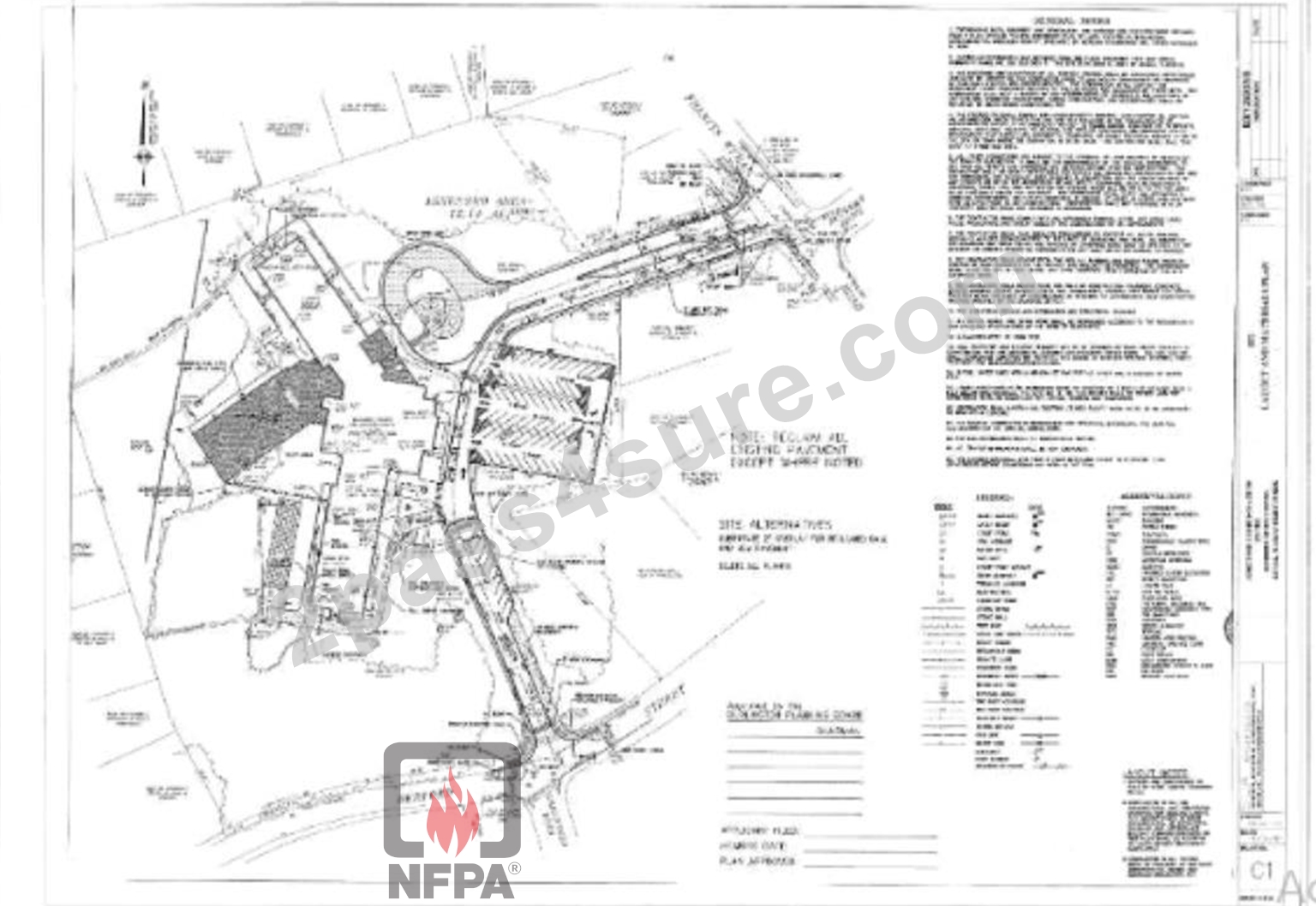
On plan C1 what is the widthof the fire department access driveway on the south facing side of the building wing closes! lo Bedford Street?
- A. 18 ft (5.5 m)
- B. 20 ft (6.1 m)
- C. 16 ft (4.9 m)
- D. 24 ft (7.3 m)
Answer: A
NEW QUESTION # 45
What is the maximum heat release rate of a single fuel package containing foamed plastics that is part of an exhibit booth'?
- A. 50 kW
- B. 75 kW
- C. 100 kW
- D. 150 kW
Answer: C
Explanation:
According to NFPA 1031, which covers the qualifications for professionals in fire safety and code compliance, specific requirements exist for fire protection systems, including materials used in exhibit booths.
In situations where foamed plastics are part of an exhibit booth's construction, the maximum allowable heat release rate of a single fuel package is 100 kW.
This value aligns with the guidance provided to ensure that exhibit booths constructed with foamed plastics do not exceed safe fire load limits, thereby reducing the risk of fire propagation in exhibition settings. By maintaining the heat release rate at or below 100 kW, fire protection professionals can manage fire hazards effectively, ensuring compliance with safety regulations as outlined in NFPA 1031.
No exact references to the NFPA 1031 standard were found in the provided documents. This information, however, is consistent with general fire protection principles concerning maximum heat release rates in fire prevention codes.
For exact chapter and section references, a direct examination of the most current NFPA 1031 standard should be conducted.
NEW QUESTION # 46
Where would you find information pertaining to the seismic load?
- A. Electrical plans
- B. Structural plans
- C. Mechanical plans
- D. Fire protection system plans
Answer: B
Explanation:
Information pertaining to seismic loads would be found in the structural plans. These plans contain details about the building's framework and its ability to resist seismic forces. The structural plans include calculations and specifications that ensure the building's integrity under seismic stress, following relevant codes such as the International Building Code (IBC) and NFPA 5000.
NEW QUESTION # 47
Exhibit.
What isthe residual pressure according to the water supply graph?
- A. 20 psi(138kPa)
- B. 80 psi(552kPa)
D 120 psi(827kPa) - C. 42 psi (290 kPa)
Answer: C
Explanation:
To determine the residual pressure from the provided water supply graph, locate the appropriate point on the graph where the flow rate intersects with the pressure line. According to the graph, the residual pressure is around 42 psi (290 kPa), which matches option B. This value is determined by reading the vertical axis (pressure) at the point where the flow test results are plotted. The pressure reading corresponds to the data point on the dashed line provided in the water flow test summary sheet.
For detailed calculations, understanding, and verification, reference to NFPA standards, particularly those related to water flow testing, such as NFPA 13 or NFPA 25, would be necessary.
NEW QUESTION # 48
In positive alarm sequence systems trained personnel shall have a maximum of how many seconds during the alarm investigation phase to evaluate the fire condition and reset the system'?
- A. 90 seconds
- B. 60 seconds
- C. 120 seconds
- D. 180 seconds
Answer: C
Explanation:
According to NFPA 72, National Fire Alarm and Signaling Code, in positive alarm sequence systems, trained personnel have a maximum of 120 seconds (2 minutes) during the alarm investigation phase to evaluate the fire condition and reset the system. This time frame is provided to allow personnel to assess whether the alarm is legitimate or false before activating a full evacuation or emergency response.
Top of Form
Bottom of Form
NEW QUESTION # 49
Exhibit.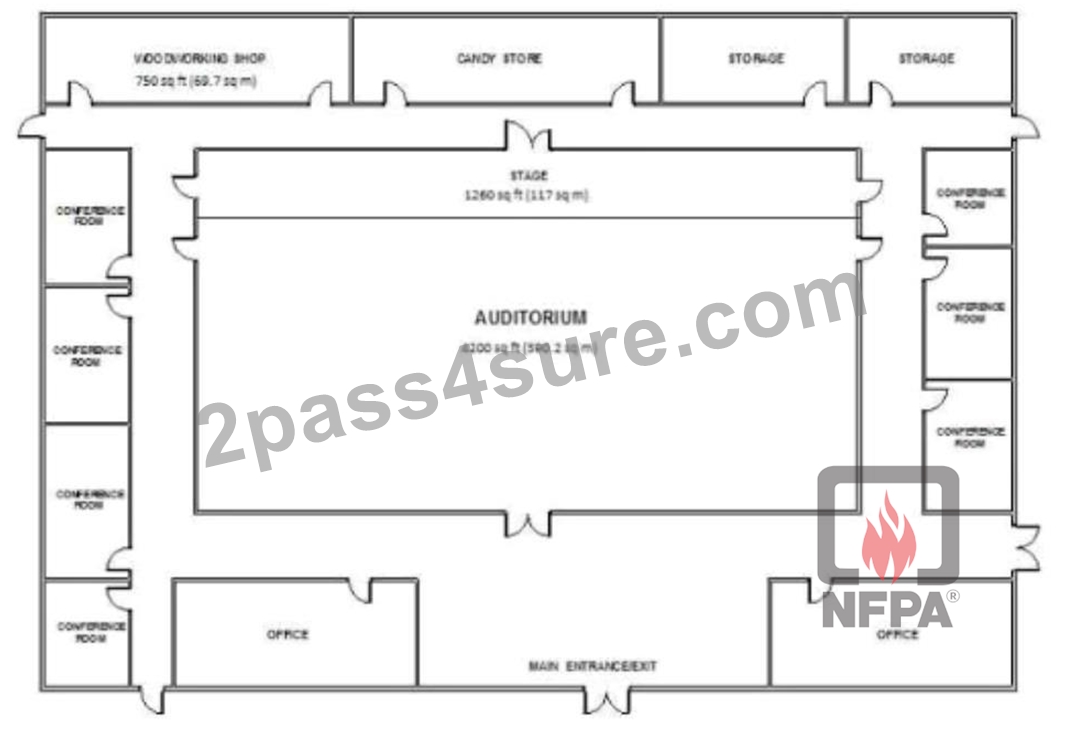
What is the occupant load for the woodworking shop in the figure?
- A. 15 people
- B. 3 people
- C. 7 people
- D. 10 people
Answer: C
Explanation:
To determine the occupant load for the woodworking shop, we use the standard occupant load factor provided in NFPA 101, Life Safety Code. For an industrial occupancy like a woodworking shop, the typical occupant load factor is 100 square feet per person. The shop is 750 square feet (69.7 square meters), so dividing the total area by 100 square feet per person gives an occupant load of 7.5, which rounds down to 7 people.
NEW QUESTION # 50
Fire alarm indicating appliances shall be located a minimum of how many inches below finished ceilings?
- A. 6 in. (150 mm)
- B. 3 in (203 mm)
- C. 4 in (102 mm)
- D. 10 in (254 mm)
Answer: C
Explanation:
Fire alarm indicating appliances must be located a minimum of 4 inches (102 mm) below finished ceilings.
This clearance ensures that the devices are not obstructed by ceiling-mounted structures and can properly notify occupants in case of an emergency, as specified by NFPA 72, National Fire Alarm and Signaling Code.
NEW QUESTION # 51
......
CFPE Exam Dumps, Practice Test Questions BUNDLE PACK: https://www.2pass4sure.com/Fire-Plan-Examiner/CFPE-actual-exam-braindumps.html
The Best Practice Test Preparation for the CFPE Certification Exam: https://drive.google.com/open?id=1-KoBDujVMnjicvm8A_g5g7tyfsmdowyb