

[Jul 09, 2024] PEGACPDC88V1 PDF Recently Updated Questions Dumps to Improve Exam Score
PEGACPDC88V1 Dumps Full Questions with Free PDF Questions to Pass
The PEGACPDC88V1 exam is intended for professionals who work with Pega Decisioning and want to demonstrate their knowledge and skills in this area. PEGACPDC88V1 exam is suitable for business analysts, developers, architects, and consultants who want to enhance their career prospects and demonstrate their proficiency in Pega Decisioning. Certified Pega Decisioning Consultant 8.8 V1 certification is recognized globally and can help professionals to stand out in a competitive job market. PEGACPDC88V1 exam is best suited for individuals who have experience working with Pega Decisioning and have a good understanding of the platform's features and tools.
NEW QUESTION # 24
U+ Bank, a retail bank, has recently implemented a project in which qualified customers see mortgage offers when they log in to the web self-service portal.
Currently, only the customers who satisfy the following engagement policy conditions receive the Fifteen-year fixed-rate mortgage offer:
The bank decides to make two changes:
1. Update the suitability condition for the Fifteen-year fixed-rate mortgage offer.
2. Introduce a new offer , Twenty-year fixed-rate mortgage.
The following table shows the new engagement policy conditions for both mortgage offers:
What is the best practice to fulfill this change management requirement in the Business Operations Environment?
- A. Create two change requests in the 1:1 Operations Manager portal.
- B. Create two change requests: one in the Pega Customer Decision Hub portal and the other in the 1:1 Operations Manager portal.
- C. Create a single change request in the Pega Customer Decision Hub portal.
- D. Create a single change request in the 1:1 Operations Manager portal.
Answer: D
Explanation:
According to the best practice, a single change request should be created in the 1:1 Operations Manager portal, because both changes are related to the engagement policies and propositions that are managed in this portal. The Pega Customer Decision Hub portal is used to design and test the decision strategies, not the engagement policies and propositions. Verified Reference: Pega Decisioning Consultant | Pega Academy
NEW QUESTION # 25
U+ Bank, a retail bank, has recently implemented a project in which credit card offers are presented to qualified customers when they log in to the web self-service portal. The bank added engagement policy conditions to show the offers based on the bank's requirements.
In the Answer Area, select the correct engagement policy for each condition.
Answer:
Explanation:
NEW QUESTION # 26
MyCo, a mobile company, uses Pega Customer Decision Hub™ to display offers to customers on its website. The company wants to present more relevant offers to customers based on customer behavior. The following diagram is the action hierarchy in the Next-Best-Action Designer.
The company wants to present offers from both the groups and arbitrate across the two groups to select the best offer based on customer behavior.
The company wants to present offers from both the groups and arbitrate across the two groups to select the best offer based on customer behavior.
As a decisioning architect, what do you configure to select the best offer from both groups based on customer behavior?
- A. Enable a business value in the prioritization formula.
- B. Create a prioritization decision strategy at the Group-level.
- C. Ensure that the propensity is enabled in Arbitration tab.
- D. Create an adaptive model rule at the Issue-level.
Answer: C
Explanation:
To select the best offer from both groups based on customer behavior, you need to ensure that the propensity is enabled in Arbitration tab. Propensity is a measure of how likely a customer is to accept an offer, based on their past behavior and profile. By enabling propensity in Arbitration tab, you can compare the propensities of different offers across groups and select the one with the highest propensity as the next best action. Verified Reference: Pega Academy - Decisioning Consultant - Arbitrating actions
NEW QUESTION # 27
U+ Bank wants to offer a Gold credit card to customers who have an annual income of more than USD150000. What do you configure in the Next-Best-Action Designer to achieve this outcome7
- A. Prioritization formula
- B. Engagement policy condition
- C. Customer segment
- D. Audience
Answer: B
Explanation:
An engagement policy condition is a rule that determines whether a customer is eligible, applicable, or suitable for an offer. You can use engagement policy conditions to filter customers based on their attributes or behaviors. In this case, the bank wants to offer a Gold credit card to customers who have an annual income of more than USD150000, so creating an engagement policy condition based on the income attribute is the best option. Verified Reference: [Pega Decisioning Consultant | Pega Academy]
NEW QUESTION # 28
MyCo, a telecom company, wants to introduce a new group of offers called Tablets for all customers. As a decisioning architect, which two valid actions do you create? (Choose Two)
- A. 5% discount on the price
- B. Tablet serial number
- C. Tablet operating system
- D. Netflix subscription for 12 months
Answer: A,D
Explanation:
To introduce a new group of offers called Tablets for all customers, you need to create valid actions that represent propositions that you want to present to your customers. In this case, two valid actions are Netflix subscription for 12 months and 5% discount on the price. These are examples of benefits or incentives that can attract customers to buy tablets from MyCo. Tablet serial number and tablet operating system are not valid actions because they are not propositions that can be offered to customers; they are attributes or features of the tablets themselves. Verified Reference: Pega Academy - Decisioning Consultant - Creating actions and treatments
NEW QUESTION # 29
U+ Bank decides to introduce a credit cards group by leveraging the Next-Best-Action capability of Pega Customer Decision Hub™. The bank wants to present the credit card offers through inbound and outbound channels based on the following criteria:
1. Customers must be above the age of 18 to qualify for credit card offers.
2. The site offers credit cards only if customers do not explicitly opt-out of any direct marketing for credit cards.
3. The Platinum Card, one of the credit card offers, is suitable for customers with debt-to-income ratio < 45.
As a decisioning architect, how do you implement this requirement? In the Answer Area, select the correct engagement policy for each criterion.
Answer:
Explanation:
NEW QUESTION # 30
MyCo, a telecom company, developed a new data plan group to suit the needs of its customers. The following table lists the three data plan actions and the criteria that customers must satisfy to qualify for the offer:

Answer:
Explanation:
NEW QUESTION # 31
U+ Bank's marketing department currently promotes various credit card offers by sending emails to qualified customers. The bank wants to limit the number of offers that customers can receive over a given period of time.
In the Answer Area, select the correct artifact you use to implement each requirement.
Answer:
Explanation:
NEW QUESTION # 32
Which of the following reasons explains why a customer might receive an action that they already accepted?
- A. The volume constraint is not set to exclude previously accepted offers.
- B. The suppression rules are not defined to exclude previously accepted actions.
- C. The action suitability conditions are not defined.
- D. The actions are filtered based on eligibility.
Answer: A
Explanation:
A customer might receive an action that they already accepted if the volume constraint for that action is not configured to exclude previously accepted offers. This option can be enabled by selecting the Exclude previously accepted actions checkbox in the volume constraint configuration. The action suitability conditions are used to determine whether an action is suitable for a customer based on their propensity, priority, or other criteria, not based on their previous responses. The suppression rules are used to exclude customers from receiving an action based on certain conditions, such as opt-out preferences or recent purchases, not based on their previous responses. The actions are filtered based on eligibility before applying the volume constraints, so this option does not explain why a customer might receive an action that they already accepted. Verified Reference: Certified Pega Decisioning Consultant | Pega Academy, Volume constraints
NEW QUESTION # 33
U+ Bank follows all engagement policy best practices to present credit card offers on their website. The bank has introduced a new credit card offer, the Rewards card. Anna, an existing customer, currently holds a higher value card, Premier Rewards, and does not see the new Rewards card offer.
What condition possibly prevents Anna from seeing the new Rewards card offer?
- A. Applicability
- B. Suitability
- C. Suppression rules
- D. Eligibility
Answer: C
Explanation:
Suppression rules are used to prevent customers from seeing offers that are not relevant or appropriate for them. For example, if a customer already has a higher value card, they should not see a lower value card offer. Therefore, suppression rules are the most likely condition that prevents Anna from seeing the new Rewards card offer. Verified Reference: [Pega Decisioning Consultant | Pega Academy]
NEW QUESTION # 34
U+ Bank uses a scorecard rule in a decision strategy to compute the mortgage limit for a customer. U+ Bank updated their scorecard to include a new property in the calculation: customer income.
What changes do you need to make in the decision strategy for the updated scorecard to take effect?
- A. The score calculation is independent of the strategy and no change is required.
- B. Add a new Group By component for the mortgage limit calculation.
- C. A new proposition filter needs to be configured in the strategy to filter on customer income.
- D. Remap the scorecard property in the decision strategy for the change to take effect.
Answer: A
Explanation:
The score calculation is independent of the strategy and no change is required. When you use a scorecard component in a decision strategy, you only need to specify the name of the scorecard rule and the output property that will store the score value. The scorecard rule itself defines how the score is calculated based on the input properties and factors. Therefore, if you update the scorecard rule to include a new property in the calculation, you do not need to make any changes in the decision strategy for the updated scorecard to take effect. Verified Reference: [Pega Academy - Decisioning Consultant - Using scorecards]
NEW QUESTION # 35
U+ Bank, a retail bank, is currently presenting a cashback offer on its website.
Currently, only the customers who satisfy the following engagement policy conditions receive the cashback offer:
While continuing cross-selling on the web, the bank now wants to present the cashback offer through a new channel, SMS. The bank also wants to update the suitability condition by lowering the threshold of the debt-to-income ratio from 48 to 45.
As a business user, what are the two tasks that you define to update the cashback offer? (Choose Two)
- A. Add a new treatment.
- B. Remove existing treatment.
- C. Edit the engagement policy.
- D. Edit the action details.
- E. Edit an existing treatment.
Answer: C,D
Explanation:
To update the cashback offer, you need to edit the engagement policy and the action details. Editing the engagement policy allows you to add a new channel (SMS) and update the suitability condition (lowering the debt-to-income ratio). Editing the action details allows you to specify the treatment for each channel (web and SMS). Verified Reference: [Pega Decisioning Consultant | Pega Academy]
NEW QUESTION # 36
U+ Bank wants to offer credit cards only to customers with a low-risk profile. The customers are divided into various risk segments from AAA to CCC. The risk segmentation rules that the business provides use the Age and the customer Credit Score based on the following table. The bank uses a scorecard model to determine the customer Credit Score.
As a decisioning architect, how do you implement the business requirement?
- A. Add a decision table to a decision strategy and pass the credit score as the parameter.
- B. Add a decision table to a decision strategy and reference it in the scorecard component.
- C. Add the risk segmentation rules in the Results tab of the scorecard rule.
- D. Add three contact policies that correspond to the three risk segments.
Answer: A
Explanation:
To implement the business requirement, you need to add a decision table to a decision strategy and pass the credit score as the parameter. A decision table allows you to define rules based on one or more input parameters and return an output value. In this case, you can use the credit score as an input parameter and return the risk category/grade as an output value. You can then use this output value to filter out customers who are not in the low-risk segment (AAA). Verified Reference: Pega Academy - Decisioning Consultant - Using decision tables
NEW QUESTION # 37
U+ Bank, a retail bank, uses the Business Operations Environment to perform business changes. The team members of the Business Content team and Enterprise Capabilities team perform several roles in the change management process.
Select each role on the left and drag it to the task descriptions to which the role corresponds on the right.
Answer:
Explanation:
NEW QUESTION # 38
A decisioning architect wants to use the customer properties income and age in a Filter component. Which decision component is required to enable access to these properties?
- A. None, properties are available
- B. Proposition Data
- C. Set Property
- D. Data Import
Answer: D
Explanation:
To enable access to customer properties in a Filter component, you need to use a Data Import component. A Data Import component allows you to read data from various sources, such as data sets, data pages, or data flows, and make it available for other components in the strategy. In this case, you need to use a Data Import component that reads from a customer data source that contains income and age properties. Verified Reference: Pega Academy - Decisioning Consultant - Importing data
NEW QUESTION # 39
In a decision strategy, you can use aggregation components to____________.
- A. choose between actions
- B. filter actions based on priority and relevance
- C. make calculations based upon a list of actions
- D. set a text value to a strategy property
Answer: C
Explanation:
Aggregation components are used to perform calculations on a list of actions, such as sum, average, count, minimum, or maximum. For example, you can use an aggregation component to calculate the total value of all the actions in a group. Verified Reference: Pega Academy - Decisioning Consultant - Aggregating actions
NEW QUESTION # 40
U+ Bank implemented a customer journey for its customers. The journey consists of three stages. The first stage raises awareness about available products, the second stage presents available offers, and in the last stage, customers can talk to an advisor to get a personalized quote. The bank wants to actively increase offers promotion over time.
What action does the bank need to take to achieve this business requirement?
- A. Enable constant stage upweighting for the second stage of the journey.
- B. Upweight the propensity by adding more predictors that fit the target customers and repeat this process over time.
- C. Enable increasing stage upweighting for the first stage of the journey.
- D. Enable increasing stage upweighting for the second stage of the journey.
Answer: D
Explanation:
Increasing stage upweighting is a feature that allows you to gradually increase the weight of a stage over time, making the offers in that stage more likely to be selected. This is useful for promoting offers that are time-sensitive or have a limited availability. In this case, the bank wants to actively increase offers promotion over time, so enabling increasing stage upweighting for the second stage of the journey, where the offers are presented, is the best option. Verified Reference: [Pega Decisioning Consultant | Pega Academy]
NEW QUESTION # 41
The following decision strategy outputs the most profitable shoe a retailer can sell. The profit is the selling Prices of the shoe, minus the Cost to acquire the shoe.
The details of the shoes are provided in the following table:
The details of the shoes are provided in the following table:
To output the most profitable shoe, which component do you add in the blank space that is highlighted in red?
- A. Decision table
- B. Filter
- C. Group By
- D. Prioritize
Answer: D
Explanation:
To output the most profitable shoe, you need to add a Prioritize component in the blank space. A Prioritize component allows you to rank actions based on one or more properties. In this case, you can rank the shoes based on the Profit property and select the highest ranked shoe as the output. Verified Reference: Pega Academy - Decisioning Consultant - Prioritizing actions
NEW QUESTION # 42
The U+ Bank marketing department wants to leverage the next-best-action capability of Pega Customer Decision Hub™ on its website to promote new offers to each customer.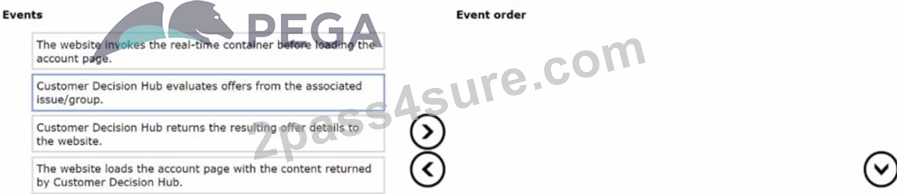
Answer:
Explanation:
1 - The website invokes the real-time container before loading the account page.
2 - Customer Decision Hub evaluates offers form the associated issue/group.
3 - Customer Decision Hub returns the resulting offer details to the website.
4 - The website loads the account page with the content returned by Customer Decision Hub.
NEW QUESTION # 43
In a decision strategy, to use a customer property in an expression, you
- A. prefix the property with the keyword Customer
- B. define Customer page in Pages & Classes
- C. define the property as a strategy property
- D. use the property as defined without any prefix
Answer: B
Explanation:
In a decision strategy, to use a customer property in an expression, you need to define Customer page in Pages & Classes and specify its class as Data-Customer. This allows you to access customer properties by using dot notation, such as Customer.Age or Customer.Gender. You do not need to define the property as a strategy property, use it without any prefix, or prefix it with the keyword Customer. Verified Reference: [Certified Pega Decisioning Consultant | Pega Academy], Decision strategies
NEW QUESTION # 44
You are the decisioning architect on an Al-powered one-to-one customer engagement implementation project. You are asked to design the next-best-action prioritization expression that balances the customer needs with the business objectives.
What factor do you consider in the prioritization expression?
- A. Offer relevancy
- B. Offer eligibility
- C. Customer contact policy
- D. Predicted customer behavior
Answer: D
Explanation:
The prioritization expression is a formula that calculates the priority score of each offer for each customer, based on various factors that reflect the customer needs and the business objectives. One of the most important factors is the predicted customer behavior, which is measured by the propensity. The propensity is a value that indicates how likely a customer is to accept an offer, based on their attributes and behaviors. The propensity is calculated by using predictive analytics models that learn from historical data and feedback. The higher the propensity, the higher the priority score, making the offer more relevant and valuable for the customer. Verified Reference: [Pega Decisioning Consultant | Pega Academy]
NEW QUESTION # 45
U+ Bank wants to offer credit cards only to low-risk customers. The customers are divided into various risk segments from Good to Very Poor. The risk segmentation rules that the business provides use the Average Balance and the customer Credit Score.
As a decisioning architect, you decide to use a decision table and a decision strategy to accomplish this requirement in Pega Customer Decision Hub™.
Using the decision table, which label is returned for a customer with a credit score of 240 and an average balance 35000?
- A. Poor
- B. Fair
- C. Good
- D. Very Poor
Answer: A
Explanation:
Using the decision table, you can find the label for a customer with a credit score of 240 and an average balance of 35000 by following these steps:
Start from the top row and check if the customer's credit score is less than 150. If yes, then the label is Very Poor. If no, then move to the next row.
Check if the customer's credit score is less than 175 and their average balance is less than 25000. If yes, then the label is Poor. If no, then move to the next row.
Check if the customer's credit score is less than 200 and their average balance is less than 50000. If yes, then the label is Fair. If no, then move to the next row.
Check if the customer's credit score is less than 250 and their average balance is less than 75000. If yes, then the label is Good. If no, then move to the last row.
The last row applies to all other cases that do not match any of the previous conditions. The label for this row is Very Poor.
In this case, the customer's credit score is not less than 150, so the first row does not apply. The customer's credit score is less than 175, but their average balance is not less than 25000, so the second row does not apply either. The customer's credit score is not less than 200, so the third row does not apply. The customer's credit score is less than 250 and their average balance is less than 75000, so the fourth row applies. Therefore, the label for this customer is Poor.
NEW QUESTION # 46
MyCo, a telecom company, recently introduced a new mobile handset offer, MyFone 14 Pro, for its premium customers. As the bank has financial targets to meet, the business decides to boost the MyFone 14 Pro offer.
As a decisioning architect, how can you ensure that the MyFone 14 Pro offer is prioritized over other offers?
- A. Increase the context weight of the MyFone 14 Pro offer.
- B. Increase the starting propensity of the MyFone 14 Pro offer.
- C. Increase the business weight of the MyFone 14 Pro offer.
- D. Increase the business value of the MyFone 14 Pro offer.
Answer: C
Explanation:
The business weight is a parameter that allows you to manually adjust the priority of an offer based on your business objectives and preferences. The business weight is multiplied by the business value and the propensity to calculate the final priority score of an offer. A higher business weight means a higher priority score, making the offer more likely to be selected and presented to the customer. Therefore, if you want to boost an offer, you can increase its business weight. Verified Reference: Pega Decisioning Consultant | Pega Academy
NEW QUESTION # 47
1yCo, a telecom company, wants to start promoting data plan offers through SMS to qualified customers. The marketing team needs to ensure that the outbound run always uses the latest customer information.
What do you configure to implement this requirement?
- A. Select a different audience sample with a similar profile.
- B. Trigger an external Extract-Transform-Load (ETL) process.
- C. Run the starting population segment daily.
- D. Select the Refresh the audience checkbox.
Answer: D
Explanation:
To implement this requirement, you need to select the Refresh the audience checkbox in the outbound run configuration. This option allows you to refresh the audience data before each run by executing a data flow that reads from your customer data source and updates your customer data set. This way, you can ensure that the outbound run always uses the latest customer information available in your system. Verified Reference: Pega Academy - Decisioning Consultant - Configuring outbound runs
NEW QUESTION # 48
......
The PEGACPDC88V1 Certification Exam is intended for both experienced and novice consultants who wish to validate their knowledge of Pega Decisioning. PEGACPDC88V1 exam covers a wide range of topics, such as Pega Decisioning architecture, data modeling, rule creation, and integration with other Pega applications. Successful candidates will be able to demonstrate a comprehensive understanding of Pega Decisioning and apply this knowledge to real-world situations. By earning this certification, consultants will be able to demonstrate their expertise to potential clients and employers, thus enhancing their career prospects.
100% Updated Pegasystems PEGACPDC88V1 Enterprise PDF Dumps: https://www.2pass4sure.com/Pega-Decisioning-Consultant/PEGACPDC88V1-actual-exam-braindumps.html
Free Pega Decisioning Consultant PEGACPDC88V1 Official Cert Guide PDF Download: https://drive.google.com/open?id=11gJ09VaBqwE1--GlAJI36w1f_sE1czaM