

Updated Mar-2026 Exam Network-Security-Essentials Dumps - Pass Your Certification Exam
Latest Real WatchGuard Network-Security-Essentials Exam Dumps Questions
NEW QUESTION # 35
The Firebox can scan the contents of encrypted zip files with Gateway AntiVirus when HTTPS content inspection is enabled.
- A. True
- B. False
Answer: B
Explanation:
The Firebox cannot scan the contents of encrypted zip files even if HTTPS content inspection is enabled.
HTTPS content inspection allows the Firebox to inspect encrypted HTTPS traffic by decrypting it. However, the content within encrypted zip files remains inaccessible to Gateway AntiVirus scanning because the encryption key for the zip file is not available to the Firebox. This limitation is consistent with standard network security practices, where encrypted files need to be decrypted with a known key before content scanning can occur.
NEW QUESTION # 36
Clients on the 10.0.10.0/24 network must connect to the server at 10.0.20.100. Based on this image, what static route must you add to the Firebox for traffic to reach the server? (Select one.)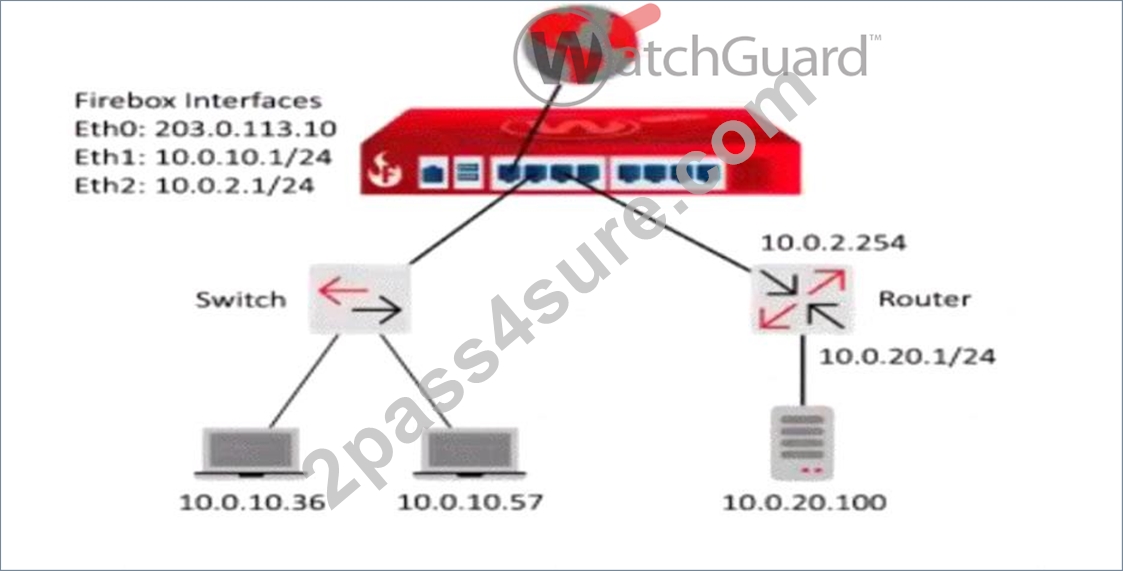
- A. Route to 10.0.20.0/24, Gateway 10.0.2.254
- B. Route to 10.0.20.0/24, Gateway 10.0.2.1
- C. Route to 10.0.20.0/24, Gateway 10.0.2.254
- D. Route to 10.0.2.0/24, Gateway 10.0.2.1
- E. Route to 10.0.10.0/24, Gateway 10.0.0.1
Answer: A
Explanation:
In this network configuration:
* The Firebox needs a static route to direct traffic intended for the 10.0.20.0/24 network (where the server
10.0.20.100 resides).
* The gateway address that allows the Firebox to reach the 10.0.20.0/24 network is 10.0.2.254, which is the router's IP address on the 10.0.2.0/24 network.
By configuring a static route:
* Destination: 10.0.20.0/24
* Gateway: 10.0.2.254
This route instructs the Firebox to send traffic destined for the 10.0.20.0/24 network via the router at
10.0.2.254, enabling clients in the 10.0.10.0/24 network to reach the server.
* Option Bis correct because it provides the correct destination and gateway for traffic to the 10.0.20.0
/24 network.
* Option Aincorrectly sets the route to 10.0.10.0/24, which doesn't address the server network.
* Options C and Dset incorrect gateways (10.0.2.1), which do not route traffic correctly in this setup.
* Option Eis a duplicate of B and would also be correct; thus, B and E are equivalent.
NEW QUESTION # 37
There is an Internet outage at your primary ISP, but the Internet connection from the Firebox has not failed over to your backup ISP. Both ISP connectors are correctly cabled and have active physical links. What could cause this problem? (Select two.)
- A. The secondary IP addresses are not defined for the backup ISP interface
- B. Link Monitor target for the backup ISP interface is not responding
- C. The Link Monitor target for the primary ISP interface is set to ping the default gateway, but the outage is further upstream
- D. In the Multi-WAN settings, the Immediate Fallback option is enabled
- E. In the Multi-WAN settings, the Gradual Fallback option is enabled
Answer: B,C
Explanation:
* Link Monitor Target for Backup ISP: If the backup ISP's Link Monitor target is not responsive, the Firebox will not initiate a failover, as it interprets the backup connection as inactive or faulty.
* Primary ISP Link Monitor Configuration: When the Link Monitor for the primary ISP only checks the default gateway, it may not detect issues occurring further upstream. If the outage is beyond the gateway, failover will not activate because the monitor assumes the link is still valid.
These settings are critical to ensuring proper Multi-WAN failover behavior in case of ISP issues.
NEW QUESTION # 38
You can run TCP Dump directly from the Firebox.
- A. True
- B. False
Answer: B
Explanation:
You cannot runTCP Dumpdirectly from a Firebox device. While Firebox has various monitoring tools such as Traffic Monitor and Firebox System Manager, it does not natively support TCP Dump, which is a command-line tool primarily available on Linux-based systems. Instead, packet captures and traffic monitoring need to be handled through Firebox-specific tools or by exporting logs to external devices for further analysis.
NEW QUESTION # 39
In a Mobile VPN configuration, why would you choose default-route (full tunnel) VPN instead of split tunnel VPN? (Select one.)
- A. Default-route VPN is the only option you can use to apply security services to connections routed to your internal servers.
- B. Default-route VPN uses less processing power.
- C. Default-route VPN uses less bandwidth.
- D. Default-route VPN enables your Firebox to examine all remote user traffic.
- E. Default-route VPN automatically allows dynamic NAT.
Answer: D
Explanation:
In a Mobile VPN setup, adefault-route (full tunnel)VPN routes all of a remote user's internet traffic through the VPN tunnel to the Firebox. This configuration allows the Firebox to inspect and apply security policies to all traffic, including traffic that is not destined for internal network resources. In contrast, asplit tunnel VPN would route only traffic meant for the internal network through the VPN, while internet-bound traffic would bypass the Firebox, potentially exposing it to threats and limiting the Firebox's ability to inspect all traffic.
NEW QUESTION # 40
You lost access to a Firebox because no one knows the administrator passphrase. How can you regain access to the Firebox? (Select one.)
- A. Plug in a USB flash drive with the WatchGuard Password Reset utility loaded
- B. Restore a backup image of the Firebox
- C. Connect with a console cable to reset the passphrase
- D. Call WatchGuard Support for a passphrase reset
- E. Reset the Firebox to its factory defaults
Answer: E
Explanation:
If the administrator passphrase is lost:
* Option A: Resetting the Firebox to factory defaults is the recommended solution to regain access, as it clears the current configurations, including the admin passphrase, allowing reconfiguration from scratch.
* Option B(USB reset utility) andOption E(console cable reset) are not standard options for passphrase recovery on Firebox.
* Option C(Calling WatchGuard Support) cannot directly reset the passphrase.
* Option D(Restoring a backup) requires access to the device with the current passphrase.
NEW QUESTION # 41
Which of these sites are denied by the WebBlocker action shown in this image? (Select three.)
- A. www.google.com
- B. login.facebook.com
- C. www.youtube.com
- D. schedule.myschool.edu
- E. www.watchguard.com/wgrd-blog
- F. www.wikipedia.com/firewall
Answer: A,B,C
Explanation:
The WebBlocker action in the image contains bothAllowandDenyrules based on specific patterns:
* www.youtube.com- This is explicitly denied by the WebBlocker configuration for the pattern youtube.
com*.
* login.facebook.com- This would also be denied because it matches the pattern facebook.com*.
* www.google.com- There is no specificAllowrule for google.com or any associated subdomain, and since WebBlocker defaults toDenywhen a URL does not match any exceptions, www.google.com would be denied as well.
The other options:
* A.www.wikipedia.com/firewall- Allowed due to the wikipedia.com* pattern.
* D. schedule.myschool.edu- Allowed due to the regular expression matching *.myschool.edu.
* E.www.watchguard.com/wgrd-blog- Allowed by the regular expression for watchguard.com.
NEW QUESTION # 42
You can add your Firebox to WatchGuard Cloud but continue to manage it locally. When you do this, what additional features does WatchGuard Cloud provide for your locally-managed Firebox? (Select two.)
- A. Ability to schedule Firebox firmware updates
- B. Unified event correlation and analysis
- C. Real-time network traffic data
- D. Live status and access to reports
- E. Automatic Firebox firmware updates
Answer: A,D
Explanation:
When adding a Firebox to WatchGuard Cloud while maintaining local management:
* Option B: WatchGuard Cloud allows the scheduling of Firebox firmware updates, which provides flexibility in managing update timing without disrupting operations.
* Option E: It provides live status updates and reporting access, giving insights into device health and performance metrics for informed management decisions.
* Option A(Automatic firmware updates) is typically managed manually in a locally managed configuration.
* Option C(Real-time network traffic data) andOption D(Unified event correlation andanalysis) are advanced features that require full cloud management rather than hybrid (local/cloud) setup.
NEW QUESTION # 43
When you configure a Branch Office VPN tunnel to a third-party device, AES-GCM encryption is recommended for:
- A. Troubleshooting purposes
- B. Routing over a BOVPN
- C. Better performance and throughput when supported by both VPN endpoints
- D. Connections to third-party firewalls only
- E. Better uptime because of additional keep-alive options
Answer: C
Explanation:
AES-GCM (Galois/Counter Mode)encryption is recommended for VPNs because it provides strong encryption with high performance and low overhead, making it an ideal choice for environments where both endpoints support it. AES-GCM combines encryption and authentication in a single step, resulting in faster processing compared to traditional encryption modes that handle these tasks separately. This mode is advantageous for maintaining high throughput in VPN tunnels, especially beneficial for branch office or inter- site VPNs where performance is critical.
NEW QUESTION # 44
Based on the configuration shown in this image, clients on the network can successfully connect tohttps://www.watchguard.com.
- A. False
- B. True
Answer: B
Explanation:
Based on the configuration shown in the image, the HTTPS-proxy-out policy allows traffic fromAny-Trusted andAny-Optionalnetworks toAny-Externaldestination on port443(which is the standard port for HTTPS).
This rule effectively permits outbound HTTPS connections from clients within the trusted network to external HTTPS websites, such as https://www.watchguard.com.
Since the policy type isHTTPS-proxy, it can inspect and manage HTTPS traffic according to configured policies, but it does not block the connection itself. Therefore, users on the network should be able to successfully connect to external HTTPS sites.
NEW QUESTION # 45
After you enable content inspection, your users cannot connect to the business-critical website www.example.
com/account.html hosted by a trusted partner. To try to resolve this issue, you added a Domain Name exception of www.example.com/account.html, but users still cannot connect to the website. What is the Domain Name exception format to add to the HTTP proxy to correctly resolve this issue? (Select two.)
- A. /account.html
- B. www.example.com
- C. example.com/
- D. *.example.com
- E. /example.com/
Answer: B,D
Explanation:
When using domain exceptions to bypass content inspection for specific websites on a Firebox, the format is critical. For the domain www.example.com/account.html, two viable exception formats are:
* A. *.example.com: This wildcard format will include all subdomains of example.com, covering www.
example.com as well as any other subdomains like api.example.com. This format is useful when you need to exclude an entire domain and its subdomains from content inspection.
* D. www.example.com: This specifies the exact domain. Adding this as an exception will directly match www.example.com, making it suitable for bypassing content inspection on that specific subdomain.
Other formats, like /example.com/ or /account.html, do not match the required structure for domain name exceptions in the Firebox HTTP proxy settings.
NEW QUESTION # 46
You enable a network device monitoring application on a server with IP address 10.0.1.22. After you run the application, it reports that it cannot ping the Firebox at 10.0.1.1, and you see this log message in Traffic Monitor. What is the most likely cause of this issue? (Select one.)
- A. The server IP address is on the Blocked Sites list
- B. There is no route on the Firebox for the 10.0.1.0/24 subnet
- C. There is no policy that allows Ping traffic from the server to the Firebox alias
- D. The dynamic NAT statement is not configured correctly for the 10.0.1.0/24 subnet
- E. The default Unhandled Internal Packet policy is at the top of the policy set
Answer: C
Explanation:
The most likely reason for the network device monitoring application's failure to ping the Firebox is the absence of an explicit policy permitting Ping traffic from the server (IP 10.0.1.22) to the Firebox alias (10.0.1.1). By default, Firebox policies are configured to allow only traffic explicitly permitted by a policy.
Therefore, without a dedicated policy allowing ICMP (Ping) requests from this specific source to the Firebox, the device will drop the traffic, resulting in a connectivity failure for Ping.
This is a common scenario in Firebox configurations, where restrictive policy settings enhance network security by blocking all traffic types unless specifically allowed.
NEW QUESTION # 47
If you have only one public IP address, can you use Static NAT to enable inbound connections to both an email server and a web server on the private network? (Select one.)
- A. Yes, if both servers are on different private subnets
- B. Yes, if both servers use different ports
- C. No, you must use Dynamic NAT to route inbound connections to more than one server
- D. No, you must assign a public IP address to each server
Answer: B
Explanation:
With only one public IP address, you can still configure Static NAT to route connections to both an email server and a web server, as long as each service is accessed on a different port. For instance, HTTP/HTTPS traffic for the web server can use port 80/443, while the email server can use ports associated with email protocols (e.g., 25 for SMTP). Static NAT can direct incoming requests to different internal servers based on port, making this approach feasible.
NEW QUESTION # 48
You configured your Firebox interfaces and routes and want to verify the status of the routes and connected hosts. You found this information in Firebox System Manager > Status Report. What is true about the IPv4 routes and ARP table in this deployment? (Select one.)
- A. The Firebox is publicly reachable at 198.51.100.1 through the eth0 interface
- B. The MAC address for the default gateway that currently routes traffic is 00:50:56:b5:e5:42
- C. The Firebox cannot resolve a MAC address for 10.0.1.32
- D. 10.0.20.53 can be reached through the vlan20 interface
- E. The MAC address for 172.16.1.20 is 00:50:56:b0:22:0f
Answer: A
Explanation:
Analyzing the routing table and ARP table in the provided image:
* Routing Table Analysis:
* The route 0.0.0.0 with a gateway of 198.51.100.1 on the eth0 interface suggests this is the default route for outbound traffic, indicating that the Firebox's public interface (eth0) is configured to route traffic through this gateway.
* This confirms that the Firebox is publicly reachable at the IP address 198.51.100.1.
* ARP Table Analysis:
* The ARP entry for the gateway IP 198.51.100.1 is not directly shown in the image but could typically be resolved to verify connectivity.
* Other options provided, such as MAC address validation, do not correspond with the current ARP entries shown in the image.
This setup indicates that the Firebox is accessible publicly on the eth0 interface using the IP 198.51.100.1, makingOption Athe correct answer.
NEW QUESTION # 49
When Mobile VPN is enabled, remote users receive the domain name and DNS servers from the Firebox Network Configuration by default.
- A. False
- B. True
Answer: B
Explanation:
WhenMobile VPNis enabled on a Firebox, remote users receive network configuration settings, including domain nameandDNS server informationfrom the Firebox by default. This setupensures that remote users can resolve internal domain names and access network resources as though they were connected directly to the internal network. This functionality is essential for maintaining consistent user experience and connectivity while working remotely.
NEW QUESTION # 50
To accurately detect applications over an HTTPS connection with Application Control, you must enable content inspection in the HTTPS proxy.
- A. False
- B. True
Answer: B
Explanation:
For Application Control to accurately detect and manage applications over HTTPS connections, content inspection must be enabled in the HTTPS proxy. This is because HTTPS encrypts application traffic, making it unreadable without decryption. By enabling content inspection, the HTTPS proxy can inspect and classify the application traffic within HTTPS sessions, allowing Application Control to function effectively on secure connections.
NEW QUESTION # 51
In the network configuration shown in this image, which aliases include Eth2 as a member? (Select three.)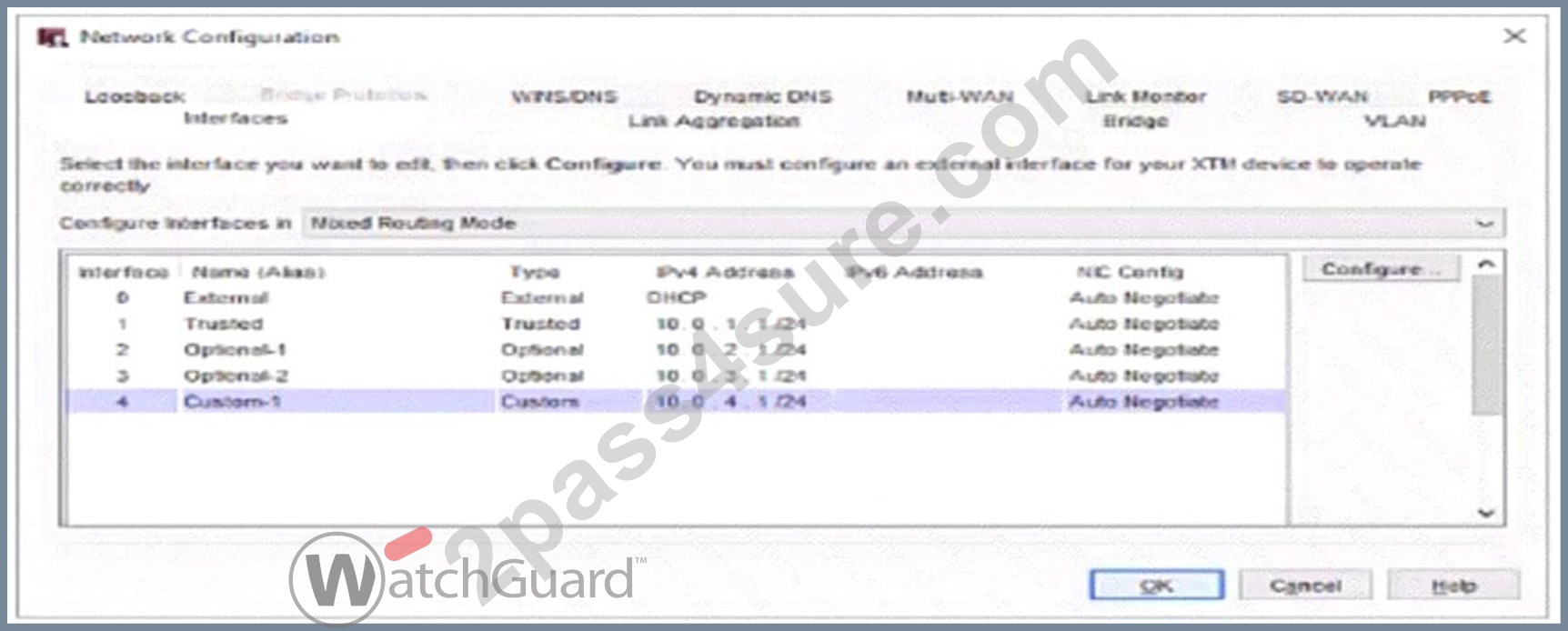
- A. Optional-1
- B. Any
- C. Any-Optional
- D. Any-Trusted
- E. Any-External
Answer: A,B,C
Explanation:
In the network configuration image provided, the interfaceOptional-1is mapped toEth2. Here's how the aliases work:
* Optional-1: Directly includes Eth2 since it's configured as Optional-1 in the network configuration.
* Any-Optional: This alias includes all optional interfaces, which would cover Eth2 as it is associated with Optional-1.
* Any: The "Any" alias includes all interfaces on the Firebox, covering all Trusted, Optional, and External interfaces. Thus, Eth2 is part of this alias by default.
Aliases likeAny-TrustedandAny-Externalwould not include Eth2 since it is configured as an Optional interface, not Trusted or External.
NEW QUESTION # 52
Which WatchGuard tools can you use to review the traffic log messages generated by your Firebox? (Select three.)
- A. Traffic Monitor
- B. FireWatch
- C. WatchGuard Cloud
- D. Dimension
- E. Status Report
- F. Policy Manager
Answer: A,B,D
Explanation:
* FireWatch: FireWatch provides a visual interface to monitor traffic and review log messages related to network activities on the Firebox. It offers real-time visibility into network usage, highlighting application activity and bandwidth utilization, which helps in analyzing traffic patterns and reviewing logs.
* Traffic Monitor: Traffic Monitor is an integral part of the Firebox System Manager, which displays detailed logs of network traffic. Administrators can use Traffic Monitor to review live traffic logs, filter traffic based on criteria, and troubleshoot network issues by examining these logs.
* Dimension: WatchGuard Dimension is a cloud-based logging and reporting solution that aggregates log messages from multiple Fireboxes. Dimension provides comprehensive reporting and enables administrators to analyze traffic patterns, detect potential threats, and generate detailed log-based reports for security audits and monitoring.
These tools are commonly used in WatchGuard environments for reviewing traffic log messages and ensuring thorough monitoring of network activities.
NEW QUESTION # 53
If the Firebox does not have a feature key installed, which of these statements are true? (Select three.)
- A. You cannot save configuration changes to the Firebox
- B. Only one user can connect to the Internet through the Firebox
- C. You cannot upgrade the Firebox
- D. You cannot configure subscription services
- E. You cannot run the Web Setup Wizard
Answer: A,C,D
Explanation:
Without a feature key:
* Option A: Upgrades are restricted, as the device relies on the feature key to validate software entitlement.
* Option B: Subscription services like antivirus, IPS, or web filtering cannot be configured without the feature key, which activates these services.
* Option D: Configuration changes cannot be permanently saved to the Firebox without the feature key, limiting the device's functionality.
* Option C(Web Setup Wizard) andOption E(one user internet access) do not depend on the feature key and are not restricted in this scenario.
NEW QUESTION # 54
Before packets are examined by Default Threat Protection, they are processed by firewall policies in top- down order.
- A. False
- B. True
Answer: B
Explanation:
In Firebox configuration, packets are processed by firewall policies in atop-down orderbefore they reach Default Threat Protection. This ordering ensures that the firewall policies defined higher in the policy list take precedence. Packets are evaluated against each rule sequentially from top to bottom until a matching policy is found, which then determines the action taken (allow, deny, or inspect further). Only after this process will any unfiltered traffic be subject to Default Threat Protection for additional security checks.
NEW QUESTION # 55
Which of these statements are true for this log message? (Select three.)
- A. The connection used an HTTP Packet Filter
- B. The URL path matched the proxy content type restrictions
- C. Application Control detected the application as a virus
- D. The connection used an HTTP Proxy
- E. The connection was denied
- F. Gateway AntiVirus detected a virus
Answer: D,E,F
Explanation:
Analyzing a typical Firebox log message for a denied connection with an associated virus detection involves recognizing multiple elements:
* HTTP Proxy Detection (C): If the connection utilized an HTTP proxy, this is typically noted in the log. Firebox's HTTP proxy is often used to inspect and manage web traffic, including scanning for malicious content.
* Gateway AntiVirus Detection (D): This service scans HTTP traffic for malware and will generate log messages if it identifies a virus. When a virus is detected, the action taken is generally to block the connection.
* Connection Denial (E): When a threat is detected (e.g., a virus via Gateway AntiVirus), Firebox policies are configured to deny the connection to prevent potential infection or data breaches. This is logged as a denied connection.
Other options, such as Application Control detecting a virus or the use of an HTTP Packet Filter, are not relevant in this context based on the function of HTTP proxies and Gateway AntiVirus in Firebox logs.
NEW QUESTION # 56
Match each type of NAT with the correct descriptor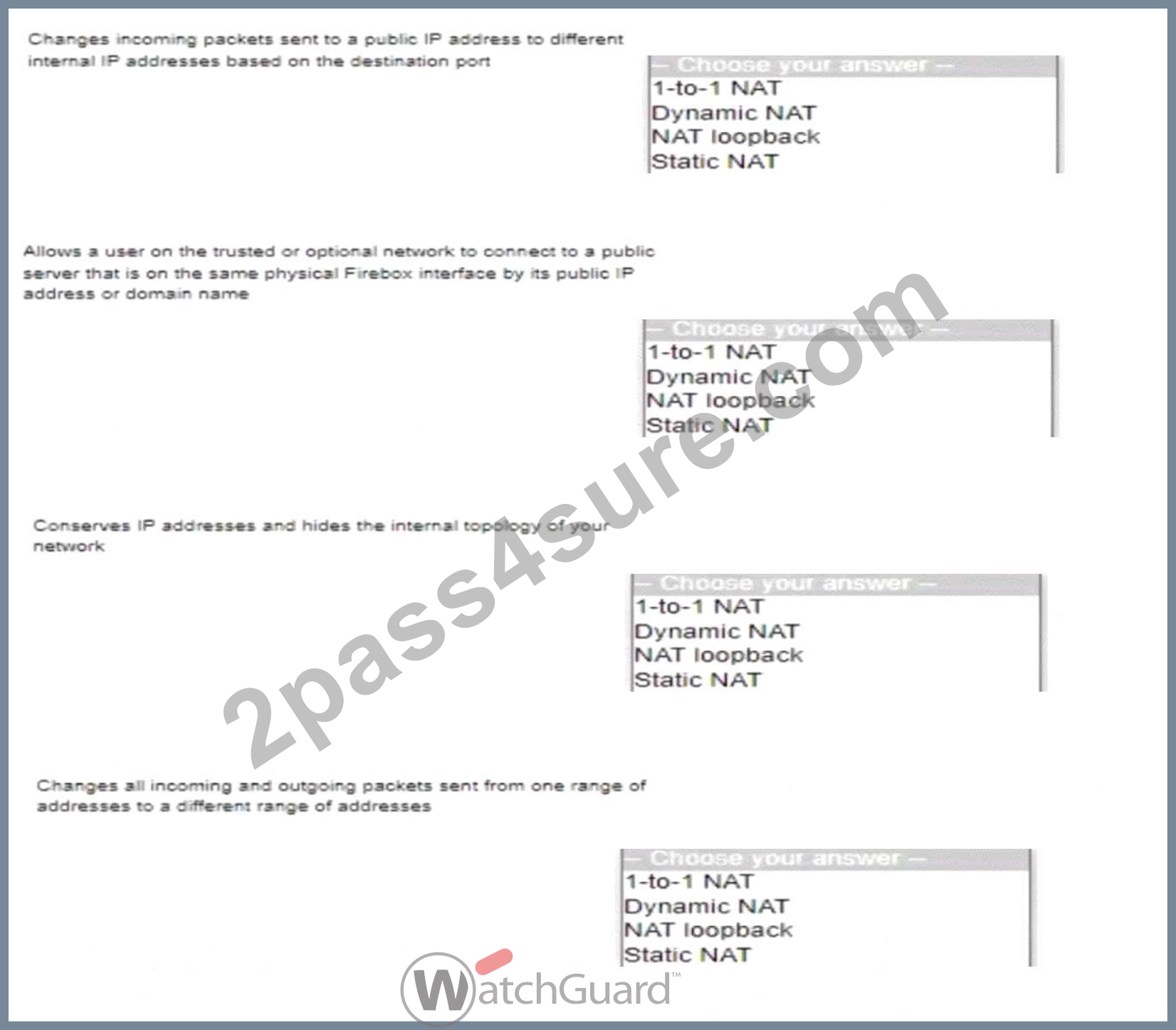
Answer:
Explanation: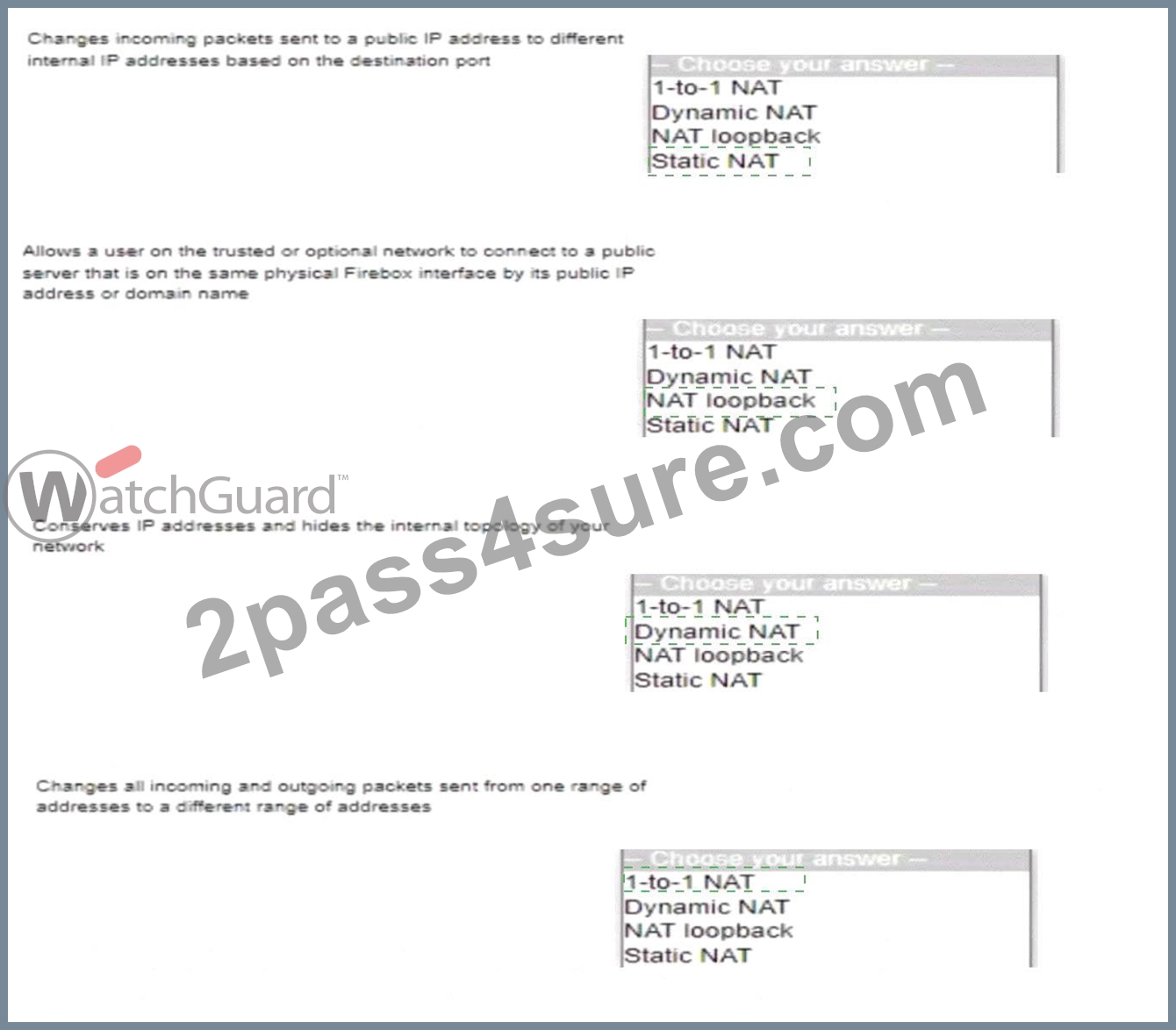
Explanation: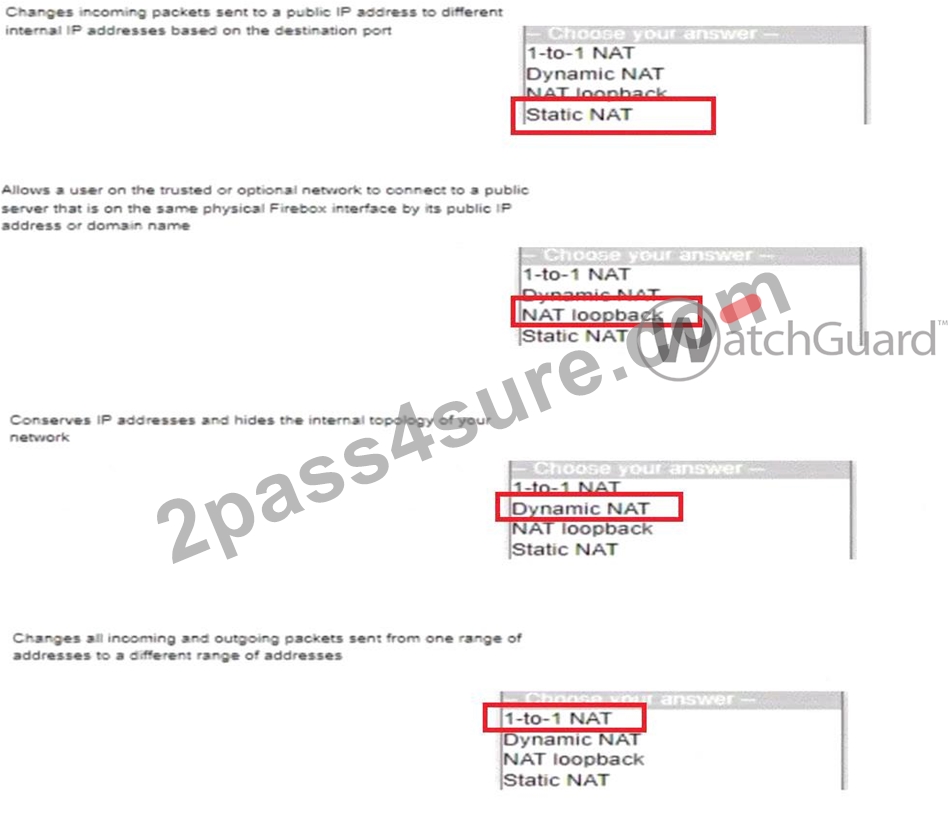
Here are the correct answers for matching each NAT type with its descriptor:
* Changes incoming packets sent to a public IP address to different internal IP addresses based on the destination portanswer:Static NAT Explanation: Static NAT maps a public IP address to multiple internal IP addresses based on the port, allowing specific services or applications to be routed to various internal destinations.
* Allows a user on the trusted or optional network to connect to a public server that is on the same physical Firebox interface by its public IP address or domain nameanswer:NAT loopback Explanation: NAT loopback (or NAT reflection) allows internal users to access a public IP address or domain name that resolves to the same local network, making it appear as if they are connecting from outside the network.
* Conserves IP addresses and hides the internal topology of your networkanswer:Dynamic NAT Explanation: Dynamic NAT (or PAT - Port Address Translation) conserves public IP addresses by allowing multiple internal devices to share a single public IP address. This setup is commonly used for outbound internet connections from a private network.
* Changes all incoming and outgoing packets sent from one range of addresses to a different range of addressesanswer:1-to-1 NAT Explanation: 1-to-1 NAT maps each internal IP address to a unique public IP address, providing a one-to-one relationship. This type of NAT is often used for networks that require external access to specific internal resources.
NEW QUESTION # 57
......
Network-Security-Essentials Dumps To Pass Locally-Managed Fireboxes Exam in One Day: https://www.2pass4sure.com/Locally-Managed-Fireboxes/Network-Security-Essentials-actual-exam-braindumps.html
100% Guaranteed Results Network-Security-Essentials Unlimited 60 Questions: https://drive.google.com/open?id=1B7oC32NZLZq9D_TM3vOkZ2m8fRvsXsu-